

In the first article on the river-linking projects, you read about why this mega project is necessary for India. Now, in Part II, we will discuss what the flagship project of this mega initiative, the ‘Ken-Betwa River Link Project’, is all about. Will this project truly succeed in changing the picture and fate of drought-prone Bundelkhand? Let’s find out.
The Government of India said in the Rajya Sabha on Monday (August 10, 2026) that the Ken-Betwa River Link Project is at the top of India’s ambitious river-linking initiative. Currently, the Government of India is focusing on completing this project. Apart from this, state governments are working on all other aspects according to their own requirements.
Meanwhile, another project of national importance, the Polavaram Irrigation Project (PIP), is being jointly completed by the Andhra Pradesh government and the Polavaram Project Authority (PPA). This is a project connecting the Godavari and Krishna rivers, which is in its final stage. The central government has provided financial assistance of ₹20,658 crore for this project so far. Union Minister of State for Jal Shakti, Raj Bhushan Choudhary, gave a written reply to a question asked in this regard in the Rajya Sabha.

Now coming to the core issue. In fact, when the historic journey began to realise the decades-old dream of creating a national water grid by interconnecting rivers in India, the first project chosen for this was the ‘Ken-Betwa Link Project’ (KBLP).
Launch of the country’s first ‘River-Linking Model’ and Ken-Betwa Link Project
Out of the 30 Inter-Basin Water Transfer projects identified by the National Water Development Agency (NWDA), Ken-Betwa became the first national project on which the Central Government, the Madhya Pradesh Government, and the Uttar Pradesh Government reached a formal and historic agreement. On December 8, 2021, the Union Cabinet chaired by Prime Minister Narendra Modi approved a massive amount of ₹44,605 crore for this project.
This ambitious project has been designed primarily with the intention of changing the destiny and picture of Bundelkhand – the most drought-prone, backward, and socio-economically neglected region of Central India spread across Madhya Pradesh and Uttar Pradesh.

Geographically both Ken and Betwa rivers originate in Madhya Pradesh. Betwa originating from Raisen district of Madhya Pradesh and Ken originating from Katni district, flow towards the northeast and eventually merge into the Yamuna River at different locations in Uttar Pradesh.
According to in-depth hydrological studies by the Central Water Commission (CWC) and NWDA, even after meeting its own agricultural, drinking water and future local needs, a huge amount of ‘surplus’ water remains in the Ken River basin during the monsoon rains. Every year, this surplus water flows into the Yamuna as a surge and ultimately goes to waste in the sea.

On the other hand, the Betwa River basin is a ‘deficit basin’. Areas around the Betwa River (especially the upper and middle basin) face severe water shortages for agriculture, industry and drinking water. To balance this water imbalance, a scientific blueprint was prepared to divert surplus water from the Ken River through a 221-kilometer-long canal into the Betwa River.
Daudhan Dam and 221 km Long Link Canal Are the Centerpiece of the Project
The Ken-Betwa Link Project is an extremely complex, modern, and massive structure of civil engineering and water management. The entire functioning of this project primarily rests on two major engineering structural components:

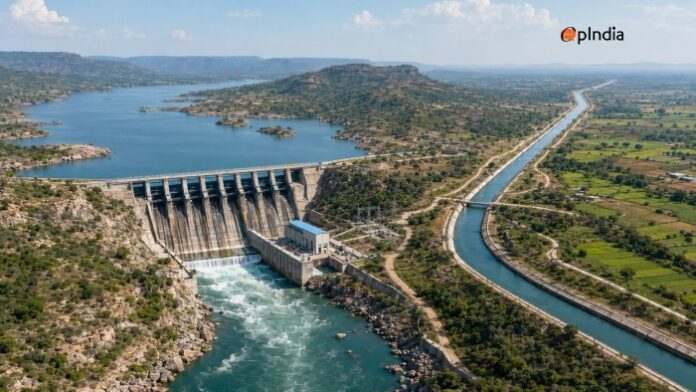
Daudhan Dam: The main center point and backbone of the project is the Daudhan Dam to be constructed on the Ken River on the border of Chhatarpur and Panna districts of Madhya Pradesh. The proposed height of Daudhan Dam is about 77 meters and its length is about 2,031 meters. The under construction dam will be a multipurpose reservoir with a total water storage capacity of approximately 2,853 Million Cubic Meters (MCM). Its primary function is to stop the heavy flow of the Ken River during the monsoon and store it for round-the-year use.
221-Kilometer-Long Main Link Canal: A massive, concrete-lined main link canal will be drawn from the reservoir of Daudhan Dam. This canal will be about 221 kilometers long, of which around 21 kilometers will be in Uttar Pradesh and the rest in Madhya Pradesh.
As an engineering marvel, maximum use of natural slope (gravity flow) has been made along the canal route. However, where geographical barriers or high terrains arise, modern lift pumping stations, underground tunnels, and aqueducts are being constructed so that water can reach the upper Betwa basin without any disruption.
Local ponds, Chandela-era stepwells (Baolis), and other small rivers (such as Bina, Orr, etc.) falling along the canal route will also be connected to this main canal system to provide water directly to hundreds of rural areas along the way.
Ken-Betwa Link Project will be completed in 2 phases
Considering the massive size, heavy budget, and technical complexity of the Ken-Betwa project, its execution has been divided into two major phases (Phase-I & Phase-II) for administrative ease:
Ken-Betwa Link Project Phase-I: The main focus of the first phase is centered on the primary infrastructure to hold the Ken River water and convey it to the Betwa. Major construction works will be undertaken under this, including the construction of Daudhan Dam, the 221 km main link canal, the Lower Orr Project, Kotha Barrage, and two powerhouses.
Additionally, two main powerhouses will be set up at the Daudhan Dam site for power generation, with a total capacity to generate 103 MW of hydropower and 27 MW of solar power.
The primary goal of Phase-I is to provide immediate drinking water and irrigation water to the most water-stressed border districts like Chhatarpur, Panna, Tikamgarh and Banda.

Ken-Betwa Link Project Phase-II: In the second phase, subsidiary structures are to be constructed on the Betwa River and its tributaries to ensure efficient distribution of the transferred water. This includes the construction of 3 major projects:
Bina Complex Multipurpose Project: Under this, dams and canals will be built on the Bina River and its tributaries in Sagar district.
Kotha Barrage: Construction of a barrage on the Betwa River in Vidisha district.
Lower Orr Project: Dams will be built on the Orr River for Shivpuri and Guna districts.
The main objective of Phase-II is to ensure that water brought from the Ken River reaches the last farm in the Betwa catchment area and there is no loss of water at any level.
Direct benefits to Bundelkhand districts
Bundelkhand is a historic region of Central India that has been known for decades for severe droughts, drying wells and handpumps, poverty, and large-scale migration of agricultural laborers. The Bundelkhand region spans a total of 13 districts across Madhya Pradesh and Uttar Pradesh. The Ken-Betwa project is being seen as a ‘life-saving elixir’ (Sanjeevani) for this entire area.
A total area of 6.35 lakh hectares will be irrigated across 10 districts of Madhya Pradesh: Chhatarpur, Panna, Tikamgarh, Niwari, Damoh, Sagar, Datia, Vidisha, Shivpuri, and Raisen. Along with this, 4.1 million (41 lakh) people will get drinking water. In addition to groundwater recharge, stability will be brought to agricultural activities.
Meanwhile, 2.51 lakh hectares of land will be irrigated in 4 districts of Uttar Pradesh: Banda, Mahoba, Jhansi, and Lalitpur. A population of 2.1 million (21 lakh) will receive tap water under ‘Har Ghar Nal Se Jal’. Additionally, drought will be practically eliminated in Banda and Mahoba districts.
In fact, during summer, the water table drops alarmingly low across these 13 districts. Villagers have to walk several kilometres for a pot of water. Completion of this project will not only provide clean drinking water to every home but will also ensure continuous water availability for livestock and local industries.
Mathematics of irrigation, drinking water and industrial water distribution
According to the Detailed Project Report (DPR) of NWDA and the Ministry of Jal Shakti, the socio-economic figures of the Ken-Betwa Link Project point toward revolutionary changes, including:
Annual Irrigation: Once fully operational, annual irrigation will be available for a total of 10.62 lakh hectares (1,062,000 hectares) of cultivable land every year. Out of this, 6.35 lakh hectares will be irrigated in Madhya Pradesh, while 2.51 lakh hectares will be irrigated in the drought-prone districts of Uttar Pradesh. In addition, an extra 1.76 lakh hectares will receive water through the strengthening of existing canal systems. This regular source of irrigation will free Bundelkhand’s farmers from the uncertainty of the monsoon, allowing them to grow two or three crops (Rabi, Kharif, and Zaid) a year instead of just one.
Safe Drinking Water: The Ken-Betwa Link Project will provide 24-hour safe and clean drinking water via pipelines and taps to approximately 6.2 million (62 lakh) people in Bundelkhand (4.1 million in Madhya Pradesh and 2.1 million in Uttar Pradesh). This will curb water-borne diseases and free women from the physical burden of hauling water.
Industrial Water Supply: Approximately 62 MCM of water has been specifically allocated for the Defence Industrial Corridors being built in Uttar Pradesh and Madhya Pradesh, local food processing units, and small and medium industries. Adequate water availability will pave the way for new industrial investment in Bundelkhand.
Impact of hydropower generation and groundwater recharge
Clean Energy Generation: A total of 103 MW of hydropower will be produced through the two power stations to be set up at Daudhan Dam. In addition, 27 MW solar power plants will be installed on the reservoir surface and canal banks.
Thus, a total of 130 MW of clean energy will be generated. This electricity will primarily be used to run the project’s own lift irrigation pumps, and the remaining power will be fed into the local rural grid, relieving power shortages.
Groundwater Recharge: Most of Bundelkhand’s surface geology consists of hard crystalline rocks. Here, rainwater does not naturally seep easily into the ground, causing groundwater levels to fall alarmingly due to continuous tubewell usage.
When the massive 221-kilometer-long link canal and the huge reservoir of Daudhan Dam are built, continuous seepage and water percolation will occur across tens of kilometers in the surrounding areas. This will raise the water table across the entire Bundelkhand region by several meters. Dried-up traditional wells, stepwells, and borewells will naturally come back to life, acting as a shield during drought periods.
Permanent brakes on migration via transformation of agriculture and rural economy
Bundelkhand’s biggest social tragedy has been ‘forced migration’. Due to crops drying up in the absence of water, every year as soon as the monsoon ended, lakhs of youth, small farmers, and entire families migrated to metros like Delhi, Mumbai, Surat, and Ahmedabad to work as daily-wage labourers.
The Ken-Betwa project holds the potential to break this human and economic cycle; its benefits include:
- Crop Diversification: Until now, farmers were limited to sorghum (jowar), millet (bajra), or low-water oilseed crops. With irrigation water, they will be able to cultivate wheat, gram, mustard, pulses, as well as green vegetables, fruits, and cash crops.
- Local Employment Generation: Round-the-year work in fields will provide agricultural laborers employment within their villages. Furthermore, dairy farming, animal husbandry, and fisheries will receive a massive boost.
- Economic Stability: Guaranteed agricultural yields and earnings will strengthen the rural economy, leading to a drastic decline in migration rates.
Environmental impact and concerns raised for Panna Tiger Reserve
While on one hand, the Ken-Betwa link promises development and prosperity, on the other hand, its most controversial and sensitive aspect is the projected impact on the environment and wildlife.
Submergence of Panna Tiger Reserve: The construction of Daudhan Dam is taking place right inside the belly, i.e., the core area, of Madhya Pradesh’s world-famous Panna Tiger Reserve (PTR). According to official figures, a total of 5,803 hectares of forest land in Panna Tiger Reserve will be completely submerged due to the dam’s construction. Out of these 5,803 hectares, nearly 4,141 hectares are Panna’s ‘Core Tiger Habitat’.
Panna is the same tiger reserve that, after losing all its tigers in 2009, rebuilt its tiger population through an unprecedented and historic tiger reintroduction program. Due to the dam, hunting areas and corridors of tigers will be split into two forever.
However, the government and the Wildlife Institute of India (WII) claim that a special plan worth over ₹1,000 crore has been drawn up to compensate for Panna’s loss. Under this, the surrounding Ranipur Wildlife Sanctuary (UP) and Nauradehi (MP) forests are being linked to Panna to create a massive ‘Greater Panna Landscape’ so that tigers can roam freely.
Not just tigers, this area of the Ken River is globally the largest natural nesting site for endangered vultures. The construction of the dam will submerge the rocky habitats of rare vulture species in water. Furthermore, the natural flow supporting gharials (Gharial Sanctuary) and rare aquatic life found in the Ken River will be adversely affected.
Several lakhs of large and old trees are set to be felled from the dense forests of Panna for the construction of the reservoir and canal, a loss that cannot be instantly compensated for by planting new saplings alone.
Expert’s View in Favor of the Ken-Betwa Project: Proponents of this project argue that quenching the thirst of 6.2 million people and irrigating lakhs of acres of barren fields is a greater humanitarian duty than any other loss. No other major alternative is available to lift Bundelkhand out of poverty.
Critic’s and Environmentalist’s View: Water experts argue that calling the Ken River ‘surplus’ is scientifically incorrect. The surge of the Ken during the monsoon is what keeps Bundelkhand’s ecosystem and the Yamuna alive. Diverting water from the Ken could lead to the river itself drying up in the future.
Critics believe that instead of spending billions of rupees to submerge forests and tiger habitats, if thousands of traditional Chandela and Bundela era ponds, stepwells, watershed management and check dams across Bundelkhand had been restored, Bundelkhand’s water crisis could have been solved at a fraction of the cost and without any environmental damage.
What does the ‘Waterman of India’, Prof. Rajendra Singh, say on this issue?
Rajendra Singh, popularly known as the ‘Waterman of India’, is strongly opposing this scheme. Speaking to OpIndia’s Associate Editor Shravan Shukla over the phone, he said, “The river-linking scheme is a terrible plan. It is an attempt to constitutionally break the triple rights over India’s rivers (the rights of the Center, States, and Panchayats/Municipal Corporations).”
Rajendra Singh claimed that this project had been approved by the Manmohan Singh government, but after our protests and hearing our side, Manmohan-Rahul-Sonia Gandhi halted it. Now, this project is running purely due to the misappropriation of funds. He claimed that this project will not succeed at all. He said that this scheme will meet the same fate as the Sutlej-Beas link, which has never received water to this day.
Rajendra Singh said that the project should not be considered useful for India. He said that he could list 100 disadvantages of this project, whereas the government highlights benefits like ending drought and bringing water. He questioned how more water is being claimed in the Ken when rainfall is equal in the catchment areas of both the Ken and Betwa. He also cited a study report by PSI-Dehradun, which did not consider the Ken River’s water as surplus.
Displacement from Daudhan Dam, alleged compensation scam and ST community’s outrage
Ground-level problems associated with the Ken-Betwa Project also exist. Media reports from July 2026 reveal an atmosphere of intense tension and uncertainty in the villages coming under the submergence zone of Daudhan Dam in Chhatarpur and Panna districts.
Displacement of Tribals and Crisis: Dozens of tribal villages located in the core area of Panna Tiger Reserve, such as Daudhan, Kharyani, Pachmarhi, Dhodhan, Mainari, and Palkoha, will be completely submerged in the reservoir of Daudhan Dam. Gond and Baiga tribals, who have lived here for generations, stand on the brink of losing their ancestral lands, forests, and cultural identity.
According to a ground report by ‘Frontline’ of ‘The Hindu’ published in May 2026, the unknown and barren areas where the displaced ST families are planned to be resettled outside Panna’s forests have neither cultivable land nor sources of livelihood. People say, “The forest and river are our mother and livelihood; we don’t want compensation, we want our land.”
Compensation scam and allegations of corruption: Reports of large-scale irregularities and corruption regarding compensation distribution in villages under the Daudhan Dam submergence zone have made headlines.
And according to a report by The New Indian Express (July 26, 2026), a nexus of lower-level staff from Chhatarpur and Panna district administration and land mafia prepared fake survey reports. Allegations state that influential outsiders bought valuable lands of ST families for dirt-cheap prices as soon as the dam was announced, and are now siphoning off crores of rupees in government compensation.
Dainik Bhaskar claimed in its report that people are having to pay bribes even to receive compensation. According to the report, genuinely displaced villagers are not getting fair compensation and transparent rehabilitation packages under the rehabilitation policy.
This very social discontent and the pain of displacement have brought the Ken-Betwa project to a highly sensitive political and moral crossroads.
Nevertheless, the government will have to find solutions to such administrative and political issues, as major projects of national importance usually face resistance. This is because this project is not only crucial for Bundelkhand, but its impact will also shape the long-term future of the country.

Project Cost, Timeline and Current Status
Financial Cost: The estimated total cost for this mega project has risen multiple times. However, the total cost approved by the Union Cabinet in December 2021 stands at ₹44,605 crore. Out of this total cost, a 90% share (approximately ₹39,317 crore) is being provided by the Central Government as grants and loans, while only 10% of the cost will be jointly borne by the governments of Madhya Pradesh and Uttar Pradesh.
The government had set an 8-year timeline to complete the project. According to official targets, it is planned to be fully constructed and operational by 2029-2030.

Current Ground Status (2026): The Central Government has constituted a special authority, the Ken-Betwa Link Project Authority (KBLPA), to execute the project.
The process of land acquisition for initial infrastructure, approach roads, and the link canal at the Daudhan Dam site is currently underway.
Can the Ken-Betwa model become the basis for India’s other river-linking projects?
The Ken-Betwa Link Project is not merely a dam or canal being built across two districts of Bundelkhand. This project is, in fact, a ‘National Test Case’ for the other 29 inter-basin river-linking projects proposed across India. Policy makers in India and around the world are keeping a close watch on how this model performs on the ground. In such a scenario, if…
If Ken-Betwa succeeds: If this project is successfully completed within its stipulated timeframe, approved budget, and environmental balance, and frees 6.2 million people of Bundelkhand from drought and poverty, it will prove that large-scale inter-basin water transfers are feasible in India. This will make building political, social, and public consensus much easier for the remaining 29 proposed links under the Himalayan and Peninsular components (such as Manas-Sankosh-Teesta or Mahanadi-Godavari).
If Ken-Betwa fails or remains controversial: If the Ken-Betwa project becomes synonymous with extreme financial delays, cost overruns, compensation scams, severe discontent among displaced tribals, or permanent destruction of Panna’s ecosystem, a massive question mark will hang forever over any future national plan to interconnect two rivers in India.
Therefore, the success or failure of the Ken-Betwa project will not only decide the fate of Bundelkhand, but will also prove to be the most crucial milestone defining the future of India’s entire national water management, river-linking vision, and environmental policy in the 21st century.
(Read in India’s River Linking Project Part III: Other major river-linking projects of India, in-depth analysis of Himalayan and Peninsular links, official proposals concerning Himachal-Punjab-Rajasthan and Jammu & Kashmir. Also, learn about the world’s largest water transfer experiments: China’s South–North Water Transfer Project, America’s California State Water Project, Pakistan’s Indus Basin Irrigation System, Spain’s Tagus–Segura Transfer, and Australia’s Snowy Mountains Scheme.
Understand through these projects what lessons they hold for India, environmental challenges, the impact of climate change, and how are the projects are expected to take shape.



