

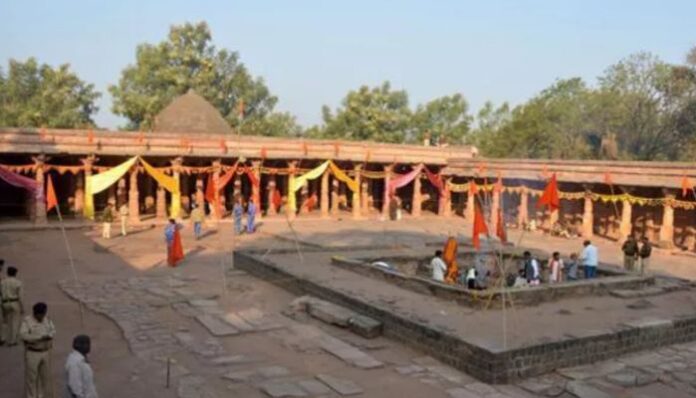
On Tuesday, 14th July, the Supreme Court agreed to hear the appeal filed by the Muslim side against the Madhya Pradesh High Court’s decision declaring the Bhojshala complex in Dhar as a temple. Calling the matter ‘highly sensitive’, the court said it would hear the case on a day-to-day basis and asked both Hindu and Muslim parties to maintain patience while the dispute is being resolved.
No interim permission for namaz inside complex
The bench, headed by Chief Justice Surya Kant and comprising Justices Joymalya Bagchi and V. Mohan, refused to pass an interim order allowing Friday Namaz inside the disputed complex. Instead, it directed the Madhya Pradesh government to provide an open space next to the site where Muslims can offer Friday prayers between 1 pm and 3 pm.
The court also instructed the Archaeological Survey of India (ASI) not to make any structural changes at the Bhojshala complex without its permission.
High Court verdict challenged
The Muslim side has challenged the Madhya Pradesh High Court’s May 2026 judgment, which cancelled a 2003 ASI arrangement that had allowed Muslims to offer Friday prayers at the Bhojshala premises. The appeal also seeks the restoration of Namaz rights at the site.
In its judgment, the High Court said there were signs that Bhojshala was once a temple dedicated to Goddess Saraswati and also served as a Sanskrit learning centre.
ASI survey at the centre of the case
The dispute is closely linked to the ASI’s scientific survey of the Bhojshala Temple-Kamal Maula Mosque complex. The High Court had ordered the survey on 11th March 2024, and the ASI began the work on 22nd March. After a 98-day study, the agency submitted a report of more than 2,000 pages.
According to the ASI, a large structure from the Parmar dynasty existed at the site before the mosque was built. The report also said that parts of the present structure were made using materials taken from an earlier temple.
The Hindu side says the survey uncovered coins, sculptures and inscriptions that prove the complex was originally a temple. The Muslim side, however, has told the court that the ASI report is biased and was prepared to support the claims of the Hindu petitioners.
Background of the Dispute
The Hindu community believes Bhojshala is an ancient temple dedicated to Vagdevi (Goddess Saraswati), built by scholar-king Raja Bhoj. The Muslim community, on the other hand, says the site has functioned as the Kamal Maula Mosque for centuries.
Under the 2003 ASI arrangement, Hindus offered prayers on Tuesdays while Muslims held Friday Namaz at the complex. The Hindu side later moved the High Court seeking exclusive worship rights, leading to the court’s order for the ASI survey and the subsequent judgment now under challenge in the Supreme Court.
