

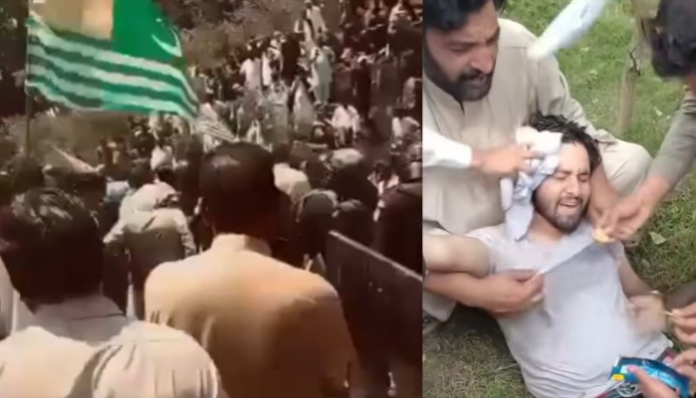
Pakistan-occupied Kashmir (PoK) experienced more violence as Pakistani security forces launched a crackdown on civilians in Rawalakot and Baloch sectors. Six civilians were killed after security personnel opened fire following clashes.
The deceased have been identified as Zahid Mughal, Zafar Mughal, Arslan Akbar, Raqib Abid and Ihsanullah in the Baloch area of Sudhanoti, while Wajid Hayat was shot dead at the Mati Almaira Bus Terminal in Rawalakot.
After the deaths, the grieving people held large-scale funeral processions for the victims, and their bodies were marched through the streets, reported News18. All main transit lines and arterial highways have been methodically shut by the PoK regional administrations and federal security organisations in an effort to quell the escalating revolt. Meanwhile, two Pakistani Rangers also died, and numerous others have suffered serious injuries as a result of the violent standoffs.
The Joint Awami Action Committee (JAAC), which is leading the demonstrations, had planned a long and widely reported march to Muzaffarabad for 15th July. The organisation has been banned by Pakistan under the anti-terrorism act for raising its voice against the systematic exploitation and subjugation of the region and its people.
They have encouraged people to participate in large numbers. However, the lockdown is specifically intended to prevent it. The agitators have received a stern warning from security personnel, declaring that any attempt to break through the blockades or move closer to the regional capital will culminate in swift and severe kinetic action.
However, the leadership of the JAAC remains defiant and has openly reaffirmed its commitment to surround Muzaffarabad in the fight for their civil rights and regional autonomy, which could trigger further bloodshed.
“For 78 years, they sold us the ‘Srinagar liberation’ churan (propaganda). That fake churan is now expired. Kashmiris are no longer buying it. When we ask for flour, we get bullets, when we ask for electricity, we get bullets and when we ask for water, we get bullets,” JAAC leader Javed Iqbal expressed while addressing a gathering. “Every single child will fight to the death, but Kashmir (Pakistan-occupied Kashmir) will not become a province,” he announced.
Furthermore, students, teachers and parents also reached Rawalakot’s Eidgah Ground with white flags, raising concerns about the brutalities inflicted by the Pakistani military. The protestors carried placards which read, “International Media Give Us Coverage,” and chanted “Yeh jo deshatgardi hai, iske peeche wardi hai” (Men in uniform are behind this terrorism). Notably, Pakistani officials had threatened to take legal action against JAAC if students engaged in the agitation.
On the other hand, members of Pok who are staying in the United States, including women, children and community leaders assembled outside the White House to call for world attention to the alarming and escalating humanitarian catastrophe in the occupied territory.
Protesters asked the global community to intervene against the deployment of deadly force on defenceless people and demanded the removal of Pakistani troops from civilian zones throughout PoK. Additionally, they emphasised that the protracted internet outage had cut off around four million people from the outside world. Locals even pleaded with India to step in to aid with humanitarian assistance measures and save lives. They also insisted on opening the Line of Control via the Poonch and Doda regions so that impacted citizens could receive humanitarian aid.
India denounced Pakistan for using extreme police brutality, denying necessary supplies and enforcing internet bans in an attempt to crush protesters. However, it conveyed hope that the Islamic Republic will be held responsible for the “egregious abuses and misdeeds” by the international community.
“The ongoing protests in PoJK (Pakistan occupied Jammu and Kashmir) are a direct consequence of Pakistan’s decades-long systemic exploitation, denial of fundamental rights, and administrative oppression in areas under its illegal and forcible occupation,” Randhir Jaiswal, the official spokesperson of the Ministry of External Affairs stated on 14th July.
He added, “Rather than addressing the legitimate grievances of the local populace, the Pakistani state has responded with extreme police brutality, including against helpless women and children, blocking essential supplies, including food and medicine, enforcing internet blackouts, and deploying lethal force against unarmed civilians that has resulted in tragic fatalities.”
PoK has been burning for over a month as citizens who are fighting for their basic rights, against skyrocketing inflation and demanding autonomy are met with harsh crackdowns to stifle opposition, causing consistent deaths and injuries among vulnerable civilians. Over the years, the region has witnessed frequent protests arising from the atrocities carried out by the Pakistan government and its military rulers against the locals.
