

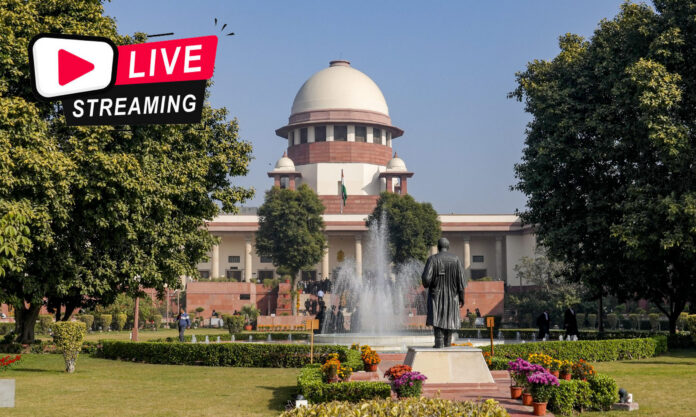
The Supreme Court of India on Friday passed an interim order restraining the extraction, editing, dissemination, posting, re-posting, uploading or monetisation of audio and video recordings of judicial proceedings on social media and other digital platforms without prior permission from the Registrar General of the concerned High Court or the Secretary General of the Supreme Court.
A three-judge bench comprising Chief Justice of India Surya Kant, Justice Joymalya Bagchi and Justice V. Mohana issued the direction while hearing a public interest litigation filed by journalist Harshita Grover. The petition sought guidelines to regulate the clipping, editing and commercial exploitation of audiovisual recordings of court proceedings that have been circulating widely online, often out of context and for monetisation. After the courts in India started livestreaming the proceedings, clips of hearings are being widely shared on social media.
The Court made it clear that the interim restraint would not interfere with legitimate news reporting of court proceedings. Notice has been issued on the petition to the Union government, all High Courts and social media intermediaries including Meta and X. The High Courts have been asked to submit reports on the implementation of the Supreme Court’s existing livestreaming guidelines and the impact of continuous livestreaming, while the Centre has been directed to identify the nodal ministries that can address the issues raised.
During the hearing, Solicitor General Tushar Mehta supported the need for interim protection, pointing to the risks posed by artificial intelligence tools that could alter the words spoken by judges and lawyers while retaining their lip movements and voices. He also highlighted how selective clips from livestreams are extracted and given a particular narrative that distorts the actual proceedings. Chief Justice Surya Kant observed that even in print media he had faced instances where remarks he never made were attributed to him.
Justice Joymalya Bagchi remarked that regulating digital data has become one of the biggest challenges of the digital space and suggested that livestreaming itself may need to be restricted. “It can’t be a 24/7 entertainment channel by court,” he said, adding that parties should expressly seek permission for access rather than it remaining the norm. Senior advocate Vikas Singh, appearing for the petitioner, clarified that there was no objection to livestreaming as such, but only to the misuse of selectively edited clips that go viral and expose judges, lawyers and litigants to trolling and reputational harm.
In a related administrative measure announced earlier this week, the Supreme Court has decided that proceedings involving litigants appearing as party-in-person who insist on physical presence in court will not be live-streamed or video-recorded. Such litigants are generally being encouraged to participate through virtual hearings. The decision, taken in a full-court meeting, follows a disruptive incident on 10 July and is aimed at preserving courtroom decorum and preventing such episodes from receiving undue public attention.
The latest order comes against the backdrop of growing concerns that unrestricted clipping and circulation of courtroom exchanges, often accompanied by sensational captions, are undermining the dignity of the courts and eroding public confidence in the justice system. Oral observations made during hearings are frequently tentative, yet selective dissemination can create lasting and misleading public narratives. The petition had also referred to the United Kingdom Supreme Court’s copyright terms as a possible model for safeguards in India.
