

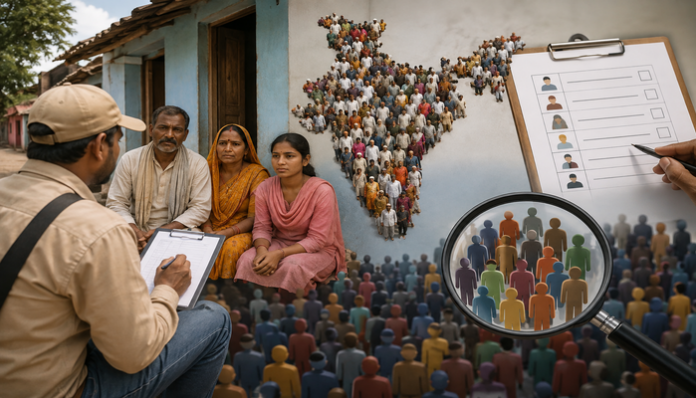
The caste census set to be conducted alongside the population enumeration phase of the Census 2027 will use an ‘open column’ to record the entries. As per reports, the format has been finalised in compliance with the decision taken by the Registrar General of India (RGI).
The ‘open column format’ is different from the ‘drop-down menu format’ where people are given options to pick from. In the open-column format, when people are asked their castes during the caste census, they will not be given any options or categories to select from. Instead, they will have to enter their caste identities in the open column. The responses of the people will be recorded verbatim, without categorising them into castes, sub-castes or other related categories.
“It has been finally decided that no dropdown menu or any other means will be used for caste enumeration. People have to just state their caste and the same will be recorded as it is. Enumerators are not supposed to categorise any surname or sub-caste in a caste category. Things will be recorded verbatim,” The Indian Express quoted a senior Ministry of Home Affairs (MHA) official.
The decision is not free from challenges. A similar manner of recording caste data was adopted during the 2011 Socio-Economic and Caste Census (SECC). The exercise turned out to be a failure as the caste data collected ended up producing nearly 46.7 lakh distinct caste names. The number was humongous compared to the 4,147 castes recorded in the last comprehensive caste census in 1931. Since respondents self-recorded caste names, the caste data collected could not fit into a standardised caste registry. As a result, the central government had to withhold the caste data.
“Yes, it is true that an open-ended question will likely produce 2011-like results. But what can we do? We have always maintained that a caste census is fraught with possibilities of producing poor data because of the complexities involved. But the Opposition has been demanding it for political reasons. We have accepted it. Let them deal with the final data,” a Union Minister reportedly said.
However, despite the failure of the same mechanism during the 2011 SECC, the government believes that an open column method is appropriate for recording caste data without the State becoming an arbiter of caste identities. According to an MHA official, caste data collected during a Census is inherently unreliable, as enumerators have no way to verify the information provided by respondents. Therefore, the rationale behind the open-column format is to do away with government interference in data collection, which is inherently unreliable.
