

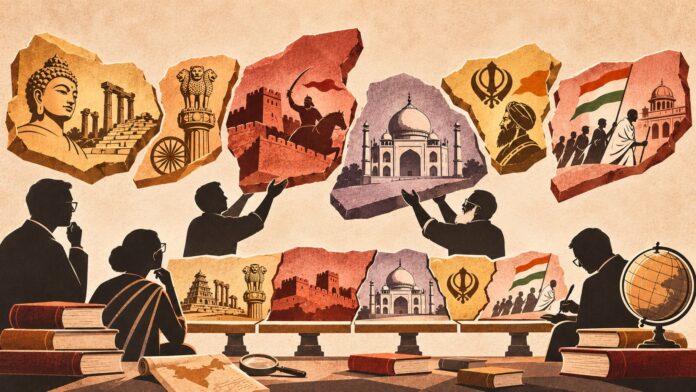
Who decides what a country learns about its past? Historians who gather the details, governments that approve school textbooks, or institutions that decide which interpretations deserve recognition?
For decades, a small circle of historians shaped how Indians learned their past: in school textbooks, university syllabi, and the bodies that fund research. They wrote the NCERT textbooks that millions of children read.
The same people taught at the country’s top universities, ran the body that funds historical research, and led the main association of historians. Their version of the past, built on Marxist ideas of class and economics, on a “composite culture” of Hindus and Muslims, and on a soft account of medieval conquest, became the official version of India’s history for decades.
The story begins under British rule. In 1817, James Mill divided Indian history into Hindu, Muslim and British periods without ever visiting India. His interpretation portrayed British rule as an improvement over India’s supposedly backward past. Indian historians challenged this colonial perspective, producing their own accounts of the subcontinent’s political, cultural and intellectual achievements.
Scholars such as R.C. Majumdar, Jadunath Sarkar, R.G. Bhandarkar and K.A. Nilakanta Sastri helped establish a substantial tradition of Indian historical scholarship. Yet after independence, another intellectual school would become especially influential.
Between 1961 and 1972, three institutions emerged that would profoundly shape historical education: NCERT, Jawaharlal Nehru University and the Indian Council of Historical Research (ICHR).
NCERT prepared textbooks, JNU trained historians, and ICHR funded historical research. What made this arrangement particularly consequential was the overlap between the people running these institutions.
R.S. Sharma wrote NCERT’s Ancient India and became ICHR’s first chairman. Romila Thapar helped establish JNU’s Centre for Historical Studies and wrote influential textbooks. Satish Chandra and Bipan Chandra similarly combined academic leadership with textbook writing, while Irfan Habib became a prominent figure in historical research.
These people were no doubt scholars whose work received wide recognition. But their concentration of influence also raised a question: when the same intellectual circle with a specific political leaning writes textbooks, trains future historians and influences research funding, how much room remains for competing interpretations and dissenting views?
Their scholarship emphasised economic structures, class relations, social hierarchies and India’s ‘composite’ cultural traditions. But critics have highlighted again and again how these narratives were often forced, ignoring the evidence at hand, just to push certain ideas.
Some of the most intriguing disputes concerned individual historical claims. One NCERT textbook discussed Mughal grants for religious institutions under rulers including Aurangzeb. When an RTI applicant sought supporting records, NCERT reportedly replied that the information was unavailable. That response raised questions about documentation and narrative building to consolidate bias.
Historians like RC Majumbar and KS Lal who had contrarian views, and highlighted the atrocities, destructions of temples and conversions during the Islamic conquests, were sidelined from the ecosystem that controlled what is being taught as history in India.
Sita Ram Goel and Ram Swarup also worked outside this powerful academic circle. When Goel countered Romila Thapar’s narrative of Hindu rulers destroying Buddhist sites by highlighting that the cited inscriptions do not say what she claimed, he never got a response.
The irony gets evident. When Islamic rulers destroyed Hindu temples, the historians who controlled the government institutions explained it away in terms of politics and money, not religion. But when it came to Hindu rulers and Buddhist sites, the same historians suddenly found religion everywhere. As Arun Shourie pointed out, R.S. Sharma’s NCERT textbook blamed the Turks’ destruction of Nalanda on “greed” in three lines, but gave Hindu rulers going against Buddhists a paragraph six times the length, and their motive was called entirely religious.
Since 2014, another transformation has gained pace. New NCERT textbooks have drawn attention to regional dynasties, indigenous knowledge traditions and episodes of religious persecution. Supporters see overdue corrections; critics question particular omissions and interpretations.
Yet the new books have also faced scrutiny, including an erroneous historical map and debates over omitted figures like Tipu Sultan. Correcting perceived distortions does not eliminate the obligation to verify every claim.
The deeper problem is not simply whether left-leaning or right-leaning historians control the narrative. It is what happens when any intellectual establishment becomes too closely intertwined with political power.
History cannot be reduced to a contest between celebrating civilisation and exposing its uncomfortable realities. India’s achievements, social inequalities, cultural exchanges, conflicts and acts of resistance all belong to the same historical record.
The real challenge is to build a system where different interpretations can compete openly, evidence takes precedence over ideology, and textbooks survive changes of government because their scholarship is credible.
The full article can be read here in Chapter 1 Magazine.


