

For the first time in the Independence Day celebrations at the Red Fort, ‘Vande Mataram’ was rendered in full at the historic venue. The presentation was part of the celebrations marking 150 years of the national song, which has remained closely linked with India’s freedom struggle and patriotic history.
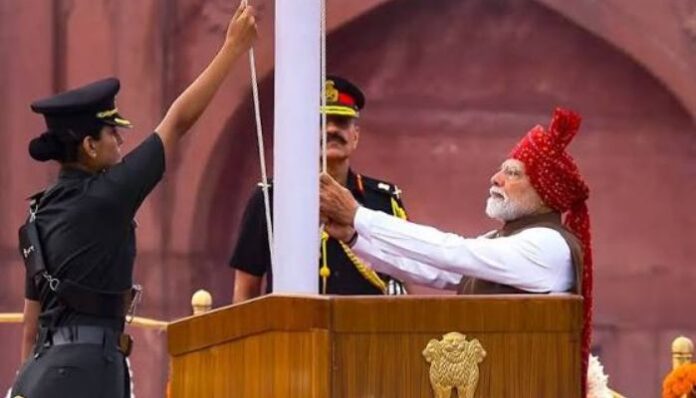
Prime Minister Narendra Modi led the Independence Day celebrations at the Red Fort amid tight security and a strong patriotic atmosphere. An Army band played the tune of ‘Vande Mataram’, while guests at the event joined in singing the national song. The performance was followed by the hoisting of the national flag and the recitation of the national anthem.
After the flag was hoisted, the Tricolour received a ‘Rashtriya Salute’. The celebrations also featured a special aerial display by two Mi-17 helicopters of the Indian Air Force. One helicopter carried the national flag, while the other carried a flag featuring ‘Vande Mataram’. Flower petals were showered over the venue as part of the ceremony.
The Red Fort complex was also decorated specially for the occasion. The floral arrangement on the ramparts showed the national flag at the centre, with the words ‘Vande Mataram’ written in Hindi on either side.
A song born in the freedom movement
‘Vande Mataram’ was written by Bankim Chandra Chatterjee in 1875. It was first published in the literary journal Bangadarshan on 7th November, 1875, and was later included in his 1882 novel Anandamath.
The song soon became an important part of the national movement. Its use as a political slogan dates back to 7th August, 1905, during the Swadeshi movement. Large gatherings used the song to express patriotism and opposition to British rule.
‘Vande Mataram’ was first sung publicly at the Indian National Congress session in Calcutta in 1896, where Rabindranath Tagore sang it and later composed its music. Over the years, it became closely associated with the freedom struggle and inspired many people who took part in the movement.
The song was adopted as India’s national song by the Constituent Assembly in 1950. The Union government launched a year-long programme last November to mark 150 years of ‘Vande Mataram’.
Congress and Muslim League opposed its full version
The controversy around ‘Vande Mataram’ became more prominent in the 1930s. The Muslim League, under Muhammad Ali Jinnah, objected to the song’s religious imagery. The League argued that the idea of treating the motherland as a divine figure could conflict with Islamic beliefs. It also raised concerns about the portrayal of Muslim rulers in Anandamath.
The issue was discussed within the Congress as well. In October 1937, the Congress Working Committee decided that only the first two stanzas of ‘Vande Mataram’ should be sung at public functions. The decision was aimed at avoiding religious objections to the remaining portions.
The matter was discussed by Jawaharlal Nehru. Nehru acknowledged that ‘Vande Mataram’ had been closely linked with Indian nationalism for more than three decades, but also supported avoiding some stanzas containing allegorical references at national events.
Gandhi’s view on the song
Mahatma Gandhi had also spoken highly of ‘Vande Mataram’ during the freedom movement. Writing in 1905, he described how large gatherings during the Swadeshi movement came together to sing Bankim Chandra’s song. Gandhi said its main purpose was to awaken patriotism and described the emotions expressed in it as noble.
However, during the communal tensions of the late 1930s, Gandhi also advised that the song should not be sung at gatherings where people had serious objections to it. His position reflected his broader effort to prevent confrontation between communities during a politically sensitive period.
Despite the controversy, ‘Vande Mataram’ continued to hold a special place in India’s national movement. Its history reflects both its powerful role in mobilising people against British rule and the debates that emerged around its religious imagery.
Now, 150 years after its creation, the song has once again taken centre stage at the Red Fort. Its rendering before the national anthem during the Independence Day ceremony has added a new chapter to the long history of ‘Vande Mataram’, a song that moved from the pages of a 19th-century Bengali literary work to becoming one of the most recognised symbols of India’s freedom struggle.
