

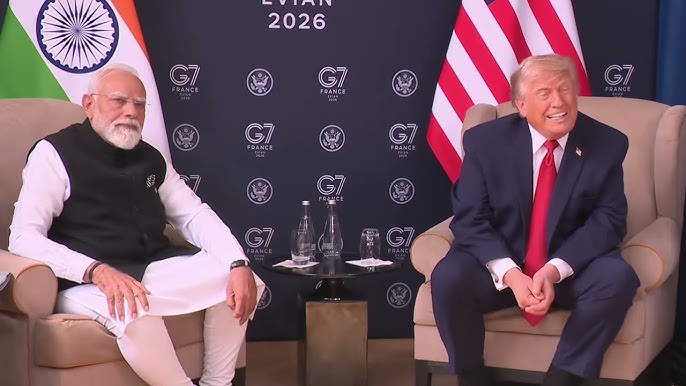
A day after US Ambassador to India Sergio Gor claimed that New Delhi had asked Washington to keep questions out of the media interaction following PM Modi’s meeting with US President Donald Trump at the G7 Summit in France, government sources said such caution is part of standard preparations for engagements with the US President, whose unpredictable behaviour in public interactions is well known.
Govt sources on Gor's comments on Trump's meet with PM Modi on G7 sidelines
— Sidhant Sibal (@sidhant) August 24, 2026
"Delegations when meeting US President are wary about his unpredictable behaviour, as may be seen from his interactions with President of South Africa, UKraine etc. Thus, the cautious approach by India" https://t.co/mJB0PMsPEm
Government sources said discussions over arrangements for public appearances of leaders are routine ahead of VVIP visits. They added that delegations meeting Trump are wary of his unpredictable behaviour, citing his past public interactions with leaders including those from South Africa and Ukraine.
“Discussions regarding arrangements for public appearances of leaders are normal practice ahead of any VVIP visit. In this regard, the Indian side communicated its standard practice for such visits,” government sources said.
The clarification came after Gor, speaking at the Economic Times World Leaders Forum on Saturday, August 22, claimed that the Ministry of External Affairs had requested that media be allowed into the Modi-Trump meeting but that there should be no questions from journalists.
According to Gor, Trump had asked him beforehand what issues the Indian side was likely to raise during the meeting. He said he subsequently told the US President that India preferred there to be no questions from the media.
Gor claimed Trump initially agreed, saying it was “no problem”. However, after Modi and Trump made their opening remarks in front of dozens of cameras, Trump turned towards reporters and asked, “Any questions?”
Gor said that question effectively opened up the interaction, which eventually continued for around 45 minutes.
The Indian government’s response sought to frame the communication not as an attempt to avoid scrutiny, but as part of the standard protocol followed while coordinating public appearances involving VVIPs.
Why India was cautious about the Trump interaction
The government sources indicated that India’s approach was also shaped by Trump’s tendency to depart from carefully planned formats during public engagements.
“Delegations, when meeting the US President, are wary about his unpredictable behaviour, as may be seen from his interactions with the President of South Africa, Ukraine, etc. Thus, the cautious approach by India,” the sources said.
The remarks suggest that New Delhi’s preference for a controlled media format was driven by the need to ensure clarity over how the high-level engagement would proceed, rather than by any unusual restriction on media access.
Gor’s account, meanwhile, presented the episode differently. He said India had specifically asked for media access without a full-fledged press conference and that Trump agreed to the request before unexpectedly opening the floor to journalists.
Issues discussed during Modi-Trump meeting
The Modi-Trump meeting took place on June 17 on the sidelines of the G7 Summit in Evian-les-Bains, France, amid tensions in West Asia and concerns over shipping through the Strait of Hormuz.
The safety of Indian seafarers was among the issues raised by Modi. Three Indian mariners had been killed in an attack by the US Navy on a commercial vessel in the region. Modi told Trump that the safety of Indian seafarers in the Strait of Hormuz was of the “utmost importance”, while Trump described seafaring as a “rough profession”.
The two leaders also discussed the situation around the Strait of Hormuz, India-US trade relations and the possibility of a bilateral trade agreement. Trump said at the time that the two countries were “very close” to reaching a trade deal.
