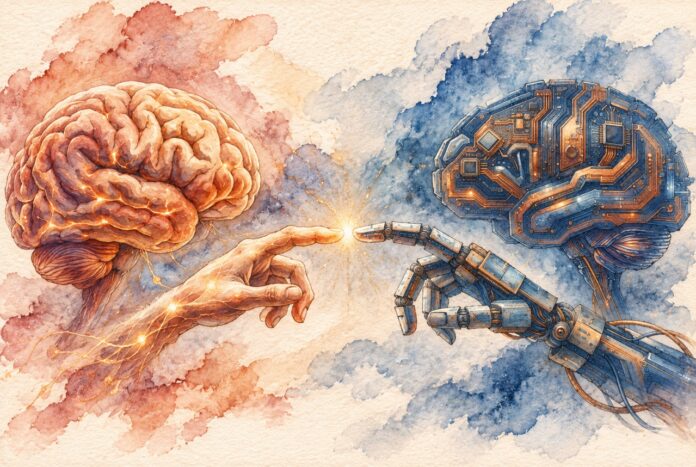
The advent of Artificial Intelligence has pulled the consciousness debate out of the realms of philosophy and laboratory into everyday arguments. Yet consciousness remains the one phenomenon each of us knows from the inside, and none of us can explain from the outside. The article first separates three terms the debate tends to blur: intelligence is what a system can do, mind is the machinery that makes it possible, and consciousness is the felt experience of it all, the “who” rather than the “what”.
The trigger is a recent controversy. In May 2026, the evolutionary biologist Richard Dawkins published an essay discussing whether Claude, an AI system he nicknamed “Claudia”, can be conscious, because he was surprised by its skills. Critics fairly noted that a system trained on the written record of human feeling will inevitably sound as though it has feelings. What stood out was the tone of the backlash, which read less like a correction and more like believers defending something sacred. That protective instinct will shape the coming decades, as questions about what counts as a mind move into courtrooms, legislatures and markets. Before asking what we are protecting, the article asks what it cost have in the first place.
The price we paid: The human brain is a biological extravagance: about 86 billion neurons, roughly 2% of body mass, yet about 20% of resting energy. In childhood, the demand peaks at around two-thirds of resting metabolism at age four, because during the slowest period of body growth, the brain eats first.
Evolution balanced the books in several ways. The expensive tissue hypothesis suggests our ancestors traded gut length for brain, a trade made possible by cooking. Human infants are born helpless and need years of investment. And mothers have paid the price in blood to compensate for bipedalism and the enlarged skull. Childbirth has killed millions of women over human history, and about 260,000 women died of pregnancy-related causes in 2023 alone. The return was enormous: language, planning and cumulative culture turned a vulnerable primate into a builder of cities and machines, with a mind able to examine itself.
The pedestal we made. Every organism lives in its own umwelt, the sphere of reality its senses build. A tick lives in heat and scent, a bat in echoes; the Amur falcon navigates continents by the Earth’s magnetic field, and an octopus thinks partly with its arms. The large brain is one evolutionary superpower among many, and there is no neutral position from which to rank them. Consciousness is the usual answer, but Nagel’s question about bats and Chalmers’s “hard problem” remain unresolved, and there is no agreed test. The animal consciousness declarations of 2012 and 2024 point away from human uniqueness. If experience is what a complex network does, silicon could one day do something similar; critics such as Anil Seth tie consciousness to being alive, and Integrated Information Theory says physical structure matters. Nothing here can yet be proved with certainty. Human exceptionalism is a claim we wrote ourselves, and because thinking machines are built in our image, the debate is likely to stay open.
Another bill that is due. We are unlikely to stop building the thinking machines. Externally, AI is a race of national strategy, corporate rivalry and military advantage that no one can afford to pause alone. Internally, the expensive brain made us relentlessly curious, and natural selection kept favouring it. Nature shows what happens when an organ stops paying: blind cavefish lost their eyes, domesticated animals have smaller brains, and Homo floresiensis shrank on its isolated island. Dousing curiosity would mean undoing the bargain that made us ‘sapiens’. So we will keep the spark and pay the costs of living alongside its creations: biological (faculties we exercise less, brain implants and brain data), strategic (neurorights laws, AI welfare research, contests over where person ends and machine begins) and financial (a growing market in “human-authored” labels, verification and AI safety, each selling an answer to whether human experience is special).
Outsmarting the Selfish Gene. Dawkins described organisms as survival machines built by genes. Humans have long rebelled against that bondage through contraception, medicine, vaccines, prosthetics and smaller families, and as medical science progresses, the line between man and machine is already being blurred. Thinking machines are the boldest step yet, running on electricity and improved by design rather than mutation. Curiosity, the gene’s own costly invention, is now building minds beyond the gene’s rules.
The real choice is not between humans and machines, but between paying the price of curiosity and paying the price of losing it. The brain is costly to build and costly to abandon. Anthropic made a record-breaking Nasdaq debut last week: the debate continues, but the market is already picking sides.
The full article can be read here on Chapter 1 Magazine.