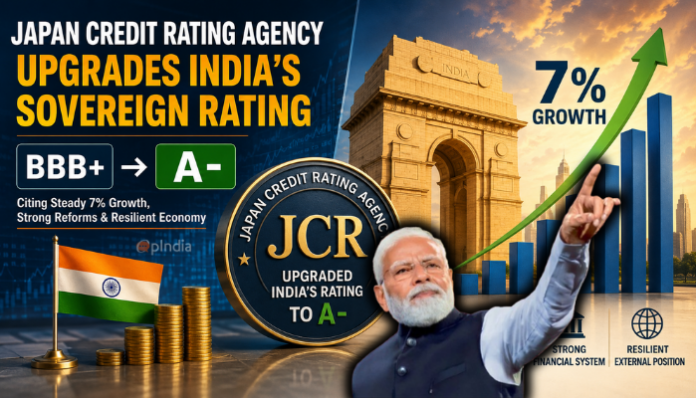
“Doomsayers were doomed, and India bloomed”. Prime Minister Narendra Modi said this recently as he praised India’s real GDP growth rate in the first quarter reaching 7.8%. While detractors of the Modi government engaged in casting aspersions on the GDP growth rate, the Japan Credit Rating Agency (JCR) relied on the sustained 7% growth to upgrade India’s sovereign rating from BBB+ to A- with a stable outlook.
India’s exemplary GDP growth of 7.8% during Q1 of FY 2026-27 is a herculean feat.
— Narendra Modi (@narendramodi) August 31, 2026
The collective strength of our people ensured India delivered such growth despite oil price shocks and supply chain issues in the midst of global uncertainties.
Doomsayers were doomed and India…
The JCR had assigned India BBB+ since 2007. The A- is the highest rating any major international sovereign ratings agency has currently assigned to India, and the first A- category rating from an international sovereign rating agency in over 35 years. The last time India received an A rating was in 1988 by Moody’s, which assigned A2. However, Moody’s withdrew its rating in 1990-1991 due to the infamous balance-of-payments crisis.
Japan Credit Rating Agency cites steady 7% GDP growth to upgrade India’s sovereign rating from BBB+ to A-
In a press release dated 2nd September, the Japan Credit Rating Agency explained the rationale behind the upgradation.
It said that India has managed to maintain a high growth rate of 7%, strengthening the economy’s foundations, including digital public infrastructure and the Goods and Services Tax (GST) regime, enhanced quality of government spending, a healthier financial system, and an impressively resilient external position contrary to the state of affairs in the past.
“The Indian economy has maintained a high growth rate of around 7%, supported by robust private consumption and public investment. The government of India has steadily implemented policies conducive to productivity growth and economic development, including the development of digital public infrastructure and the implementation of the goods and services tax (GST), strengthening the country’s economic foundations as compared to the past,” the JCR said.
The Agency also noted that India’s banking sector’s nonperforming loan ratio has declined to below 2%, aided by the establishment of the Insolvency and Bankruptcy Code and the Reserve Bank of India’s (RBI) “strengthened financial supervision and macroprudential policies.”
It further pointed out that the financial foundation of the non-banking financial sector has also been bolstered, significantly contributing to the improvement in the soundness of the financial system in recent years.
In view of India’s strong economic growth, economic policies that reinforced the foundations for growth, as well as the improved health of the financial system, the JCR said that they have upgraded India’s Foreign Currency and Local Currency Long-term Issuer Ratings to “A-”.
“Considering India’s solid economic growth, the effectiveness of economic policies that strengthen the foundations for growth, and the improved soundness of the financial system, JCR has upgraded the Republic of India’s Foreign Currency and Local Currency Long-term Issuer Ratings by one notch to “A-”. JCR has also raised the country ceiling by one notch to “A,” the JCR stated.
Highlighting India’s 1.4 billion population and GDP of USD 3.9 trillion, the Japan Credit Rating Agency said that India grew 7.7% in real terms in FY26 and 7.8% in the first quarter of FY27 and expected India to grow at a rate above 6% in FY27.
Inflation increased amidst unfavourable weather and West Asia war, but within RBI’s target: JCR highlights structural challenges
The JCR noted that while inflation has surged since early 2026, with an increase in food prices due to adverse weather conditions and higher energy prices resulting from the West Asia war, it has remained within the RBI’s target range
“Inflation has been rising since the beginning of 2026, reflecting higher food prices caused by unfavourable weather conditions and higher energy prices amid escalating tensions in the Middle East. Nevertheless, the inflation rate has remained within the RBI’s target range,” it said.
The JCR also pointed out certain “structural challenges” that keep fiscal deficits persistently high. These challenges, as per JCR, are:
- complex intergovernmental fiscal relations;
- fiscal transfer arrangements aimed at reducing disparities among states; and
- fiscal management that is susceptible to electoral cycles.
The agency, however, noted that in recent years, the Indian government has curbed expenditures on subsidies and placed greater emphasis on capital expenditure, especially infrastructure investment.
“In recent years, however, the government has restrained growth in current expenditures including subsidies while placing greater emphasis on capital expenditure, particularly infrastructure investment, that helps raise the economy’s potential growth rate,” it said.
Meanwhile, the Modi government has also reduced the fiscal deficit from 4.7% of GDP in the previous fiscal year to 4.4% while maintaining capital expenditure at a high level. The central government debt-to-GDP ratio stood at 56.1% at the end of FY2026 and is expected to decline gradually.
However, the agency says that the general government debt, including that of state governments, and the associated interest burdens remain high.
Asset quality of public-sector banks improved “substantially”
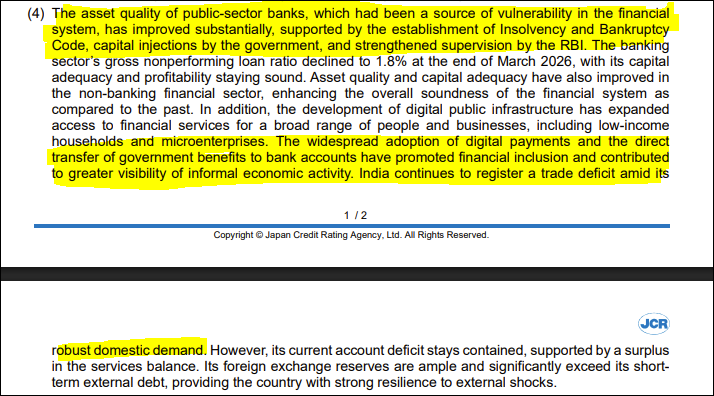
The Japan Credit Rating Agency study further indicates that the establishment of the Insolvency and Bankruptcy Code, capital injections by the government, and strengthened supervision by the RBI have resulted in the substantial improvement in the asset quality of public-sector banks.
It further noted that the Indian banking sector’s gross nonperforming loan ratio declined to 1.8% at the end of March 2026, with its capital adequacy and profitability staying sound.
“Asset quality and capital adequacy have also improved in the non-banking financial sector, enhancing the overall soundness of the financial system as compared to the past. In addition, the development of digital public infrastructure has expanded access to financial services for a broad range of people and businesses, including low-income households and microenterprises,” the JCR stated.
The JCR lauded the Modi government for the massive adoption of digital payments and the direct transfer of government benefits to bank accounts of beneficiaries. This rapid adoption of the digital payments system for disbursal of government benefits directly not only promoted financial inclusion but also caused increased visibility of informal economic activity.
“India continues to register a trade deficit amid its robust domestic demand. However, its current account deficit stays contained, supported by a surplus in the services balance. Its foreign exchange reserves are ample and significantly exceed its short-term external debt, providing the country with strong resilience to external shocks,” the JCR concluded.
AAA, A, A-, BBB, BB: What sovereign credit ratings are and what they mean in practice?
A sovereign credit rating is an independent research-based opinion of a national government’s ability and willingness to meet its debt obligations on and in full. Various rating agencies assess growth, financial balances and debt burden, external finances, including reserves, current account position, the financial system, institutions and policy credibility, alongside political and economic stability.
These ratings use letter grades such as:
- AAA / AA, which means very high credit quality.
- A, including A-, which means high credit quality, indicating high certainty of fulfilling obligations.
- BBB, including BBB+, which indicates adequate capacity, though more vulnerable to unfavourable economic conditions.
- BB and below indicate speculative or non-investment grade.
- C signifies an extremely high risk of default pertaining to the payment of financial commitments.
- D reflects that the security is either in default or is highly likely to default in the near future.
Here the “+” and “-” modifiers indicate relative standing within a category. A one-notch pivot from BBB+ to A- moves from the top of the BBB (adequate capacity) band into the A (high credit quality) band.
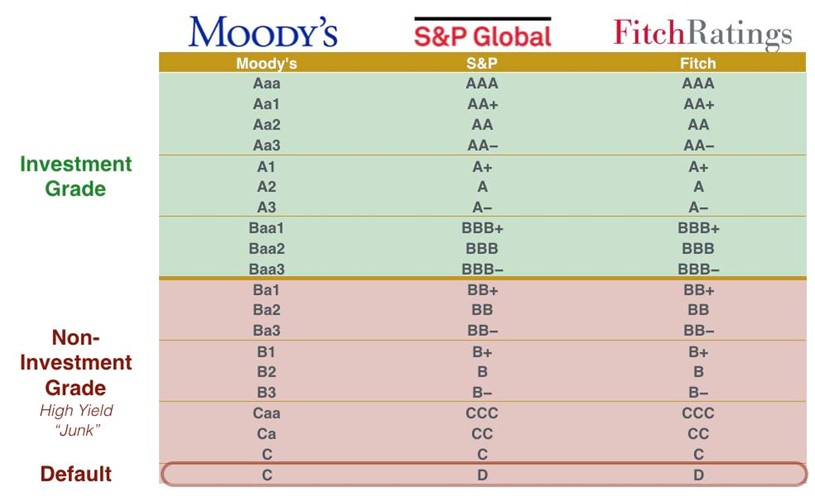
In the context of the JCR’s upgradation of India’s rating, it has essentially upgraded India from the adequate capacity category BBB+ to the high credit quality band A-.
It is, however, notable that these ratings are opinions, not any automatic market event. A higher sovereign rating, though, can over time bring down the risk premium on government and corporate debt, particularly for entities whose ratings are capped by the sovereign or country ceiling.
Given India borrows massively domestically, the direct impact on the Centre’s rupee debt of such ratings is very limited, although the bigger channel is external commercial borrowing by companies alongside the overall cost of capital.
An A- rating might improve investor access for some, as in many cases funds and insurers have mandates that consider A- rated paper more positively than BBB.
JCR is more optimistic than S&P, Fitch and Moody’s
If we compare the ratings by the “Big Three”: Fitch Ratings, S&P Global Ratings, and Moody’s Ratings, the Japan Credit Rating Agency’s rating stands higher. S&P rated India BBB- in August 2025; Fitch Ratings has also placed India in the BBB band, while Moody’s has put India at Baa3, equivalent to BBB.
India on a positive trajectory: Government of India welcomes JCR ratings
Notably, over the past year, India had previously received sovereign rating upgrades from major international rating agencies. Morningstar DBRS upgraded India’s sovereign rating in May 2025, followed by S&P Global Ratings in August 2025 and Rating and Investment Information, Inc. (R&I) and Japan in September 2026.
In a press release issued on 2nd September, the Ministry of Finance said, “The Government of India welcomes the decision of Japan Credit Rating Agency (JCR) to upgrade India’s Long-Term Foreign Currency and Local Currency Issuer Ratings by one notch from ‘BBB+’ to ‘A-’, while maintaining the Stable Outlook. JCR has also raised India’s country ceiling by one notch to ‘A’.”
Data Doesn't Lie!
— Piyush Goyal (@PiyushGoyal) September 2, 2026
Japan Credit Rating Agency (JCR) has upgraded India's sovereign rating to A- from BBB+, citing steady ~7% growth, strong digital public infrastructure & GST, and a healthier banking sector.
Global institutions are giving India's growth story the stamp of… pic.twitter.com/uVIYKNEhHe
Meanwhile, Union Minister of Commerce and Industry, Piyush Goyal, wrote on X: “Data Doesn’t Lie! Japan Credit Rating Agency (JCR) has upgraded India’s sovereign rating to A- from BBB+, citing steady ~7% growth, strong digital public infrastructure & GST, and a healthier banking sector. Global institutions are giving India’s growth story the stamp of approval it deserves.”