

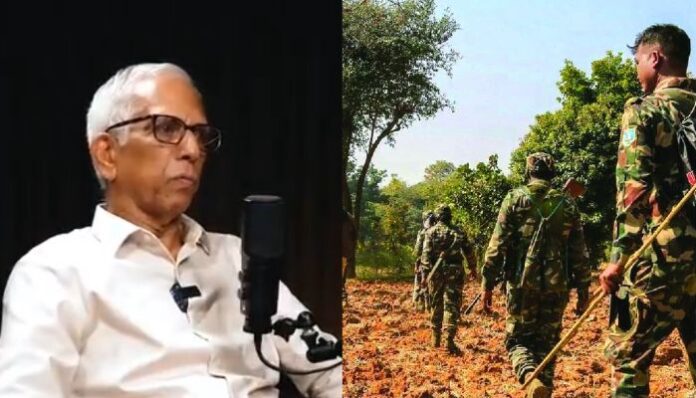
Former Intelligence Bureau (IB) officer P.G. Balakrishna Kamath, who spent decades working undercover, has offered insight into how the Naxal movement operated on the ground and how demonetisation affected its finances and cadres. Kamath made the remarks while discussing his intelligence career and the Maoist movement in an episode of The Prakhar Gupta Xperience (PGX): Raw & Real.
Kamath was featured in a podcast hosted by Prakhar Gupta and uploaded on Friday, 4th September. The episode, titled around his experience as a former IB officer who spent 50 years undercover, covered several aspects of intelligence work. One section focused specifically on Maoists and the impact of demonetisation on their finances. The episode itself lists “How Demonetization Broke The Naxals” among its topics.
How Maoists operated in Maharashtra
During the conversation, Gupta asked Kamath about the containment of Maoists in Maharashtra and whether he could discuss what had changed on the ground.
The discussion soon turned towards money and how the Maoist movement financed its activities. Gupta initially referred to fake currency being stopped and asked whether this had affected the Maoists. Kamath, however, clarified that the bigger issue was not fake currency but the large amounts of genuine cash collected by Maoists from people living in areas under their influence.
Kamath explained that Maoists collected money from villagers, including people involved in activities such as cultivating tendu leaves and other forest-based produce. Since this money could not simply be moved through the formal banking system, large amounts were kept as cash with individual groups or dalams.
“It’s not exactly the fake notes. You know, what has happened is that these people collect money. And from the, you know, in that area, whoever is cultivating tendu leaves and so many other things. They collect it from the villages. Now, that is all real money,” Kamath said.
Ex-IB officer Kamath (who was undercover for 50 years)on the ground reality: every Naxal needed large unaccounted cash to move, eat and buy weapons. 2016 demonetisation shut that window. Government offered exchange — with identification. Naxals couldn’t take it. Money slipped.… pic.twitter.com/8DvYQYdZjJ
— Yo Yo Funny Singh (@moronhumor) September 5, 2026
He said an individual dalam, or Maoist unit, could have a significant amount of cash with it.
“So, what would happen is that one dalam would have a certain amount of money, like ₹5 lakh or ₹10 lakh, because they needed that much cash to move forward. Then demonetisation came, and they got stuck. The question was, what would they do with so much cash?” Kamath said.
How demonetisation affected Maoist finances
Kamath explained that demonetisation created a major problem for Maoists because their cash holdings were outside the banking system. Although the government had provided a window during which old currency could be exchanged, doing so required identification and banking details.
According to Kamath, Maoist groups were unwilling or unable to directly deposit or exchange the cash. This forced them to approach people who had bank accounts, including landlords and others from whom they had collected money.
“They had to go to the landlords and the people from whom they had taken the money because those people had bank accounts. They went to them and said, ‘You get this exchanged for us,’” Kamath said.
Even those people could not exchange unlimited amounts of money on behalf of the Maoists. Kamath said the Maoists therefore began sending money through relatives and people living in towns. “What we understand is that they spoke to them and said, ‘We will send this money through our relatives to the towns,’ and so the money flow became a trickle. These people could not do much. The Maoist leadership could not do anything,” he said.
Demonetisation also created an ideological divide
Kamath said the impact of demonetisation was not limited to the loss or movement of cash. According to him, the episode also created an ideological problem within the Maoist ranks.
He explained that some cadres were deeply ideological and believed that landlords and other wealthy groups were enemies of the class they claimed to represent. However, after demonetisation, Maoist leaders had to approach some of those same people to get their cash exchanged. “Those who were ideological did not like it. The people we considered to be the enemies of the masses, we had to go to them,” Kamath said. This created divisions within the movement and some cadres eventually began leaving.
“So, a split started emerging. Some people came out. I don’t know why this aspect has not been discussed much in the press either. So, this was a turning point. That is how demonetisation affected the Maoists,” he said.
When Gupta asked whether the impact was therefore not about fake currency but real currency, Kamath agreed. “No. It was real currency,” Kamath said. He further explained that Maoist leaders were forced to “climb down” from the ideology that had motivated some of their cadres. “They climbed down from the ideology, and the cadres who were actually ideologically motivated saw this,” Kamath said.
Money was essential for Maoist operations
Kamath also said that the disruption to the Maoists’ financial collection put additional pressure on their movement.
He explained that ideology alone was not enough to keep an armed insurgency running. The movement needed money for movement, daily requirements and weapons. “The other thing is that the collection also stopped for some time. This put pressure on their movement. Money is everything, you know? Ideology is there, but without money, they could not move or meet their needs. They had to buy arms and ammunition,” Kamath said.
His assessment therefore presents demonetisation as a financial disruption that, according to his experience and intelligence inputs, affected the Maoists’ cash reserves, money movement and internal cohesion.
Operation Kagar and the wider anti-Naxal campaign
While Kamath’s comments focus on the financial side of the Maoist movement, the government’s wider campaign against Left-Wing Extremism has involved security operations, intelligence gathering, technology, infrastructure development and efforts to encourage Maoist cadres to surrender.
Operation Kagar was launched by the government in January 2024 as part of this broader strategy, with security forces focusing on Maoist strongholds in the Dandakaranya region. Central and state forces, including the CRPF, CoBRA units, District Reserve Guards and state police, have been involved in operations against Maoist groups.
The campaign has also increasingly focused on reaching areas that were earlier difficult for the government and security forces to access. Road construction and other infrastructure projects have been used alongside security operations to improve connectivity and bring remote communities closer to government services.
One major operation took place in the Karreguttalu hill range along the Chhattisgarh-Telangana border in 2025, where security forces conducted an extended operation against Maoist cadres.
The broader decline of Left-Wing Extremism has been attributed by the government to a combination of security action, intelligence-led operations, development work and the surrender of cadres.
