

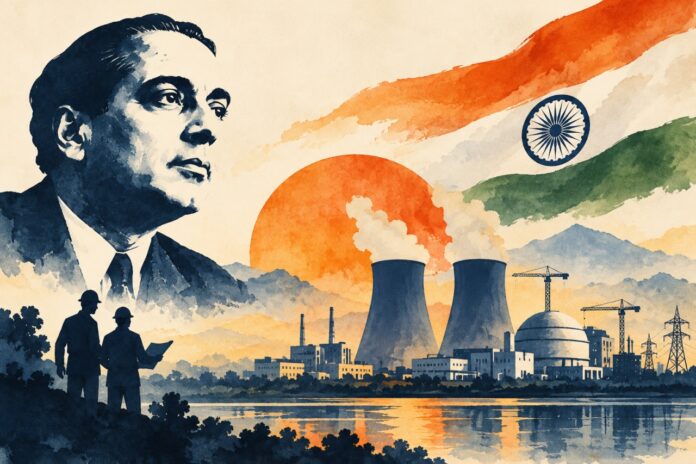
The world seems to have shed its inhibition toward nuclear power and is starting to build nuclear reactors at a pace not seen in the last few decades.
The government of India has set an extraordinary ambition: expand nuclear capacity to around 22 GW by 2032 and 100 GW by 2047. The goal is ambitious and necessary too, if India wants to expand clean energy production while matching the ever-increasing demand of a rapidly growing economy of 1.4 billion people.
India has spent decades mastering the science of nuclear reactors. However, to match the enormous gap between the current installed capacity of nuclear power at 8.78 GW and the 2047 ambition of 100 GW, India needs to build at an industrial scale.
The target of around 22 GW by 2032 and 100 GW by 2047 also highlights the acknowledgement that India’s future electricity needs cannot be met through conventional energy sources alone. Rapid industrialisation, expanding cities, artificial intelligence, data centres and electrification will require enormous quantities of dependable power.
Solar and wind are essential to India’s energy transition, but nuclear energy offers something different: continuous, low-carbon electricity that does not depend on sunshine or wind conditions.
The government’s immediate goal is to add roughly 13 GW of nuclear capacity by 2031–32. That means commissioning reactors at an average pace of approximately 2.4 GW annually over the remaining five-plus years. The longer-term challenge is considerably greater. Even if India reaches 22 GW by 2032, achieving 100 GW by 2047 would require another 78 GW in the next 15 years, an average of 5.2 GW every year. No other country in the world has ever built at such a scale and speed.
The United States added approximately 95 GW during its major nuclear expansion between 1970 and 1990, averaging 4.75 GW annually. France’s nuclear expansion during the 1970s and 1980s averaged around 4 GW annually, while China’s recent growth has been approximately 3 GW per year. India’s proposed construction pace would demand an industrial mobilisation at levels unprecedented in the nation.
Construction of nuclear power plants has been difficult in India. Rajasthan Unit 7 took roughly fifteen years to reach full power. Kudankulam’s four upcoming Russian-supported reactors could add 4 GW, but delays and cost escalation remain concerns. The approved costs of Kudankulam Units 3–6 have risen to approximately ₹1.38 lakh crore, around 55% above initial estimates.
The problem is not merely technical either. Nuclear plants require specialised equipment, skilled welders, engineers, stringent quality controls and experienced contractors. Delays increase financing costs while postponing electricity revenues. India’s strategy of constructing standardised 700 MW PHWR reactors in fleet mode could improve efficiency, but only if multiple projects advance simultaneously and without any delays.
The SHANTI Act, 2025 brought a major reform by opening nuclear power generation to private participation and revising the liability framework. Companies including Adani Power, Tata Power, Reliance and JSW Energy have expressed interest, while the government envisages substantial private investment towards the 2047 target.
Also, legal permission does not automatically translate into operational reactors. Private investors still need clarity on tariffs, financing, liability, fuel supply and long-term returns. India’s expansion could require investment approaching $210 billion, making financial viability as important as technological capability.
India’s domestic uranium production is insufficient for its expanding requirements. Canada’s agreement to supply nearly 22 million pounds of uranium concentrate between 2027 and 2035 strengthens supply security, but international dependence is expected to remain significant.
Geopolitics also affects construction. Russia provides reactor technology and fuel for Kudankulam, but disruptions associated with the Ukraine war have complicated project execution. Meanwhile, proposed American reactors at Kovvada and French reactors at Jaitapur remain stalled despite years of negotiations.
India has demonstrated that it can build nuclear reactors. The question is whether it can build them fast enough, consistently enough and economically enough to transform the country’s energy future.
The 2032 deadline is a test of execution, while 2047 is a test of industrial transformation. Read the full article here in Chapter 1 Magazine.


