

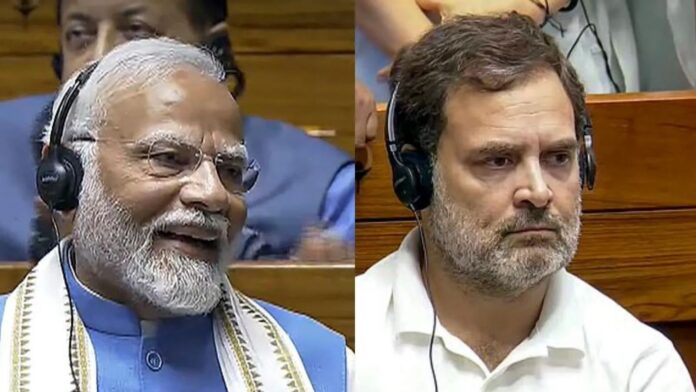
The Bombay High Court on Tuesday refused to quash a defamation case against Leader of Opposition Rahul Gandhi over alleged defamatory remarks about PM Modi, holding that the magistrate’s order summoning him showed no apparent illegality or perversity.
Justice N R Borkar dismissed Gandhi’s plea seeking to set aside the summons issued by the Girgaon Magistrate Court. The Court said the matter did not warrant interference under its inherent powers under Section 482 of the Code of Criminal Procedure (CrPC).
“In the absence of any manifest illegality or perversity in the impugned order, it is not a fit case for interference,” the Court observed, finding no infirmity in the magistrate’s decision.
However, Gandhi was granted six weeks’ protection from appearing before the magistrate, giving him time to approach the Supreme Court against the High Court’s ruling.
What is the defamation case against Rahul Gandhi?
The complaint was filed by BJP member Mahesh Shrishrimal before the Girgaon Magistrate Court. According to the complaint, Gandhi made allegedly defamatory remarks against Prime Minister Narendra Modi during a rally in Rajasthan in September 2018.
Shrishrimal alleged that the remarks subsequently led to Modi being subjected to trolling across news channels and social media platforms.
The magistrate issued summons to Gandhi in August 2019. Gandhi later challenged the order before the Bombay High Court after receiving the summons in July 2021.
During the proceedings, the High Court had sought assistance from the Maharashtra Advocate General on questions of law arising from Gandhi’s plea. Advocate General Milind Sathe appeared before the Court and argued that the material on record disclosed a prima facie offence, restricting the scope for quashing the proceedings at this stage.
Sathe also argued that Section 199 of the CrPC, read with Explanation 2 to Section 499 of the Indian Penal Code, permitted a BJP member to claim that he was an “aggrieved person” in the circumstances of the case.
Gandhi’s defence
Senior advocate Sudeep Pasbola, appearing for Gandhi along with advocate Kushal Mor, argued that the complaint was frivolous, vexatious and politically motivated.
The defence contended that allowing individual political party members to initiate defamation proceedings over remarks directed at a party leader could open the door to a flood of similar, bad-faith prosecutions.
Gandhi’s lawyers also relied on Section 199(2) of the CrPC, arguing that the provision barred a private complaint in relation to alleged defamation of a public servant.
They further submitted that Explanation 2 to Section 499 of the IPC did not recognise a political party as a “group of persons” capable of maintaining a defamation complaint in such circumstances.
Gandhi therefore urged the High Court to quash the magistrate’s order issuing process against him.
BJP member argues complaint is maintainable
Advocate Rohan Mahadik, representing Shrishrimal, opposed Gandhi’s plea and argued that the complainant had established a prima facie case by giving evidence in support of his complaint and placing relevant material before the magistrate.
According to Shrishrimal, the magistrate had independently scrutinised the material before deciding to issue process against Gandhi.
He also maintained that he was personally an aggrieved person and had approached the court in his capacity as a member of the BJP Maharashtra Pradesh Committee.
What did the Bombay High Court say?
The High Court held that, at the present stage, the alleged defamatory remarks could potentially extend beyond Modi personally to people clearly identified with the BJP and its leadership, including party office-bearers.
The Court said determining whether Gandhi’s remarks were restricted solely to the Prime Minister or also cast a defamatory “shadow” over BJP members and functionaries would require an assessment of evidence and context.
That question, Justice Borkar held, should therefore be decided during the trial rather than conclusively determined while exercising the High Court’s limited jurisdiction under Section 482 of the CrPC.
The Court accordingly refused to interfere with the magistrate’s order summoning Gandhi, while granting him six weeks to seek relief from the Supreme Court.
Rahul Gandhi has apologised in previous defamation cases
The Bombay HC ruling also comes against the backdrop of Gandhi previously expressing regret or tendering an apology in cases involving controversial remarks.
In June 2026, Gandhi expressed regret before the Madhya Pradesh High Court over a statement concerning Kartikeya Singh, the son of Union Minister Shivraj Singh Chouhan. Kartikeya Singh had filed a defamation complaint alleging that Gandhi had mentioned his name while referring to the Panama Papers during an election rally in Jhabua in 2018.
After a Bhopal court summoned Gandhi for personal appearance, he approached the Madhya Pradesh High Court seeking to quash both the summons and the defamation proceedings. In his application, Gandhi said that the statement was not related to Singh and expressed regret over the alleged reference.
The episode was not the first instance in which Gandhi had been compelled to clarify or apologise over remarks that became the subject of legal proceedings.
2019 Rafale case: Gandhi tendered unconditional apology
In May 2019, Gandhi tendered an unconditional apology before the Supreme Court after wrongly attributing his political slogan “Chowkidar chor hai” to the apex court in the context of the Rafale case.
The controversy arose after the Supreme Court allowed a review petition concerning documents relating to the Rafale deal. Welcoming the development, Gandhi had said that the Supreme Court had agreed that “Chowkidar chor hai”.
BJP leader Meenakshi Lekhi subsequently initiated contempt proceedings against him, arguing that Gandhi had falsely attributed the statement to the Supreme Court.
Initially, Gandhi expressed regret and said he had made the attribution unintentionally and in the heat of political campaigning. The BJP argued that an expression of regret did not amount to the unconditional apology required by the Court.
Gandhi subsequently filed a fresh affidavit in which he “unconditionally” apologised for the wrongful attribution, describing it as “entirely unintentional, non-willful and inadvertent”. He also said he held the Supreme Court in the highest esteem and respect and had never intended to interfere with the administration of justice.
Gandhi had, however, maintained at the time that his apology was limited to wrongly attributing the statement to the Supreme Court and did not amount to an apology to Prime Minister Narendra Modi over his political slogan.
With the Bombay High Court now refusing to quash the latest defamation proceedings, Gandhi has six weeks before he is required to appear before the magistrate. He can use the period to challenge the ruling before the Supreme Court—or consider other legal options in the case.
