

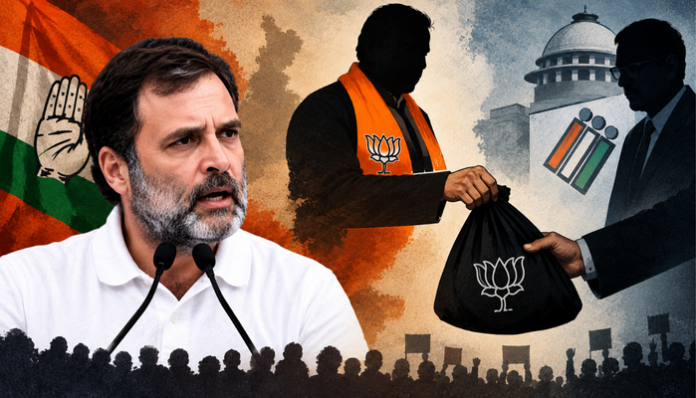
Congress leader Rahul Gandhi recently took his bogus ‘Vote Chori‘ claims to a new level and accused the BJP and the Election Commission of India (ECI) of “Party Chori” (Party theft). In a post made on X on September 18, 2026, the Congress scion claimed that the BJP and the Election Commission join forces to split political parties and snatch away their election symbols. He accused the top election body of acting in consonance with the ruling BJP to “overturn people’s verdict”.
Gandhi accused the BJP and the ECI of causing splits in the Shiv Sena, the National Congress Party (NCP), and now the Trinamool Congress (TMC) and “stealing” parties. He went on to claim, without any proof, that just like the BJP was able to steal parties with the help of the ECI, it can also steal millions of votes.
“Every time, the same pattern—BJP and the Election Commission join forces to split a party. Then its election symbol is snatched away. When an entire party can be stolen, it’s hardly surprising that the votes of millions of Indians can be stolen too. Vote theft. Government theft. Now party theft—these have become symbols of our democratic decline. The ECI’s constitutional responsibility is to protect the mandate—but instead, it’s aiding those very forces that overturn the people’s verdict,” Gandhi claimed.
“This fight isn’t just Mamata Banerjee’s. It’s the fight of every political party, every voter who wants free and fair elections,” he added.
पहले शिवसेना, फिर NCP और अब तृणमूल कांग्रेस।
— Rahul Gandhi (@RahulGandhi) September 18, 2026
हर बार एक ही पैटर्न – BJP और चुनाव आयोग मिलकर एक पार्टी को तोड़ते हैं। फिर उसका चुनाव चिन्ह छीन लिया जाता है।
जब पूरी की पूरी पार्टी चोरी हो सकती है, तो करोड़ों भारतीयों के वोट चोरी होना भी हैरानी की बात नहीं।
वोट चोरी। सरकार चोरी।…
Gandhi’s remarks come after the ECI recently froze the TMC’s election symbol till a settlement in the internal party dispute is reached. An internal rift emerged in the Mamata Banerjee-led TMC after the party faced a crushing defeat at the hands of the BJP in the recent assembly elections. Subsequently, a rival faction emerged within the party, led by expelled leaders Ritabrata Banerjee and Sandipan Saha, which aligned with the National Democratic Alliance (NDA).
The Congress leader alleged that the emergence of the rival faction within the TMC and the freezing of the TMC’s election symbol by the ECI was the handiwork of the BJP and not a result of internal differences of the party after the electoral defeat. Gandhi cited the examples of similar splits in the Shiv Sena and the NCP in Maharashtra to claim that the BJP and the EC posed a threat to the constitutional and democratic setup in the country.
Gandhi’s allegations against the BJP and the ECI paint an utterly false picture and give the impression that the latter has been acting in an arbitrary manner, at the direction of the ruling party. However, if one looks at the legal framework dealing with the structure of political parties and their symbols, the truth of Gandhi’s baseless allegations lies exposed.
The decision regarding party symbols in the case of rival factions within a party is not taken by the ECI based on its whims; it is governed by Paragraph 15 of the Election Symbols (Reservation and Allotment) Order, 1968. Paragraph 15 of the Order contemplates a situation where rival factions or groups emerge within a party. In such a situation, the provision empowers the ECI to consider all available facts and circumstances, hear the representatives of the rival faction before taking a decision on which faction constitutes the recognised political party.
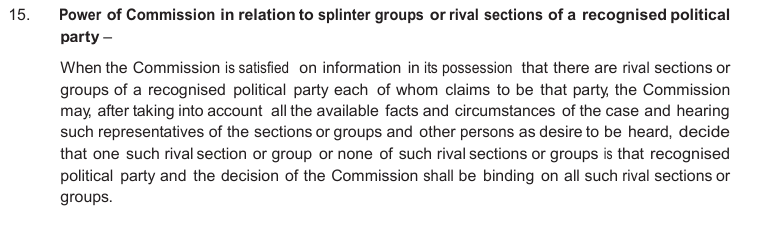
The legal framework expressly gives the Commission an adjudicatory function when rival factions both claim the identity of the recognised party. The decision taken by the ECI is binding on all the parties concerned. However, even if the parties are not satisfied with the decision of the Election Commission, they can challenge it before a court of law. It is clear from the bare reading of the provision that the Election Commission is legally empowered under the Symbols Order, 1968, to decide on the recognition and election symbols of political parties or their rival factions.
Interestingly, the legal framework was not created under a BJP government, and it existed during the previous Congress government. The Election Commission has many times exercised its powers under the Order, including during Congress rule. The Congress Party went through two major election symbol disputes, which were addressed under the same legal framework. The first split within the Congress Party happened in 1969, followed by another split in 1978.
At the time of the first split in 1969, two factions emerged within the Congress Party: one faction led by S. Nijalingappa and others, and another group led by Indira Gandhi and Jagjivan Ram. No symbol freezing was ordered by the ECI during the dispute, but the Commission adjudicated it under Paragraph 15 of the Symbols Order. The Supreme Court also intervened in the matter. Eventually, the faction led by Indira Gandhi and Jagjivan Ram was recognised as the Indian National Congress with the election symbol of a “Cow and Calf” (yes! you read that right).
The second split in the Indian National Congress in 1978 involved the freezing of the election symbol by the Election Commission under the Symbols Order 1968. The Cow and Calf symbol of the Indian National Congress was frozen by the EC amid a dispute between two rival groups. One of the groups was associated with Indira Gandhi, and the other was initially associated with K. Brahmananda Reddy and subsequently with D. Devaraj Urs. The Indira Gandhi faction was eventually recognised as the Congress Party by the Election Commission, which continued till the present day, and it was given its existing election symbol of a hand.
A look at the historical facts reveals that the current Congress Party received its name and election symbol by the order of the Election Commission, which exercised its power under the Symbols Order.
