

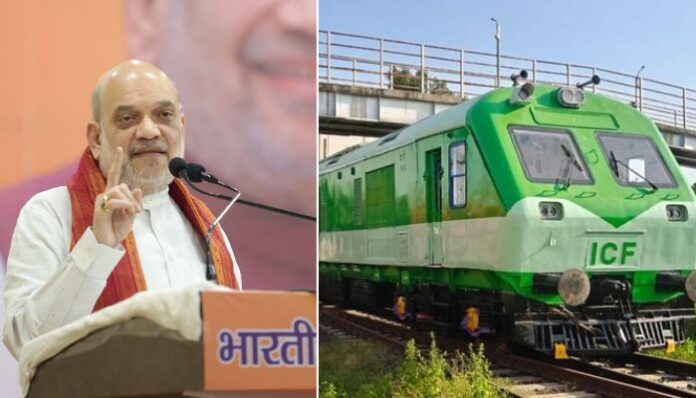
On Sunday, September 26, Union Home Minister Amit Shah flagged off India’s first LNG-powered train from Sabarmati Railway Station in Ahmedabad, Gujarat and inaugurated railway projects worth ₹1,472 crore. Gujarat Chief Minister Bhupendra Patel and other dignitaries were present at the event.
LIVE: Home Minister Amit Shah Flags Off India’s First LNG-Diesel Dual-Fuel Train in Gujarat #AmitShah #Gujarat #LNGTrainhttps://t.co/G7pM4FkEyn
— ANI (@ANI) September 27, 2026
Shah said the LNG-powered train would help reduce the environmental impact of railway operations. He also described the new projects as important for railway safety, passenger facilities, connectivity and environmental sustainability.
Railway safety and infrastructure projects
One of the major projects inaugurated was the WAG-12 Maintenance Shed, built at a cost of ₹700 crore for the maintenance of railway locomotives.
The programme also saw the installation of the Kavach train protection system on the Sabarmati-Kalol-Sabarmati section. The project has been taken up at a cost of ₹48 crore. Kavach-related work has also started on the Ahmedabad-Palanpur and Ahmedabad-Samakhiali sections.
Work has also begun on doubling the Sabarmati-Sarkhej railway line.
Shah highlighted the strength of the WAG-12 locomotive, which has a 12,000-horsepower twin-section capacity. He said one such locomotive can carry freight equal to nearly 600 trucks, while earlier two locomotives were required for similar operations.
Focus on freight capacity
Shah also referred to the successful trial of India’s first long-haul double-stack container train between Jawaharlal Nehru Port near Mumbai and Vadodara.
He said India has limited rail infrastructure for freight movement and that double-stack trains can help carry more goods. He added that an 11,000-km corridor is being converted into a four-lane network, which will support movement towards the Delhi-Howrah and Delhi-Guwahati routes.
The Home Minister also mentioned Dedicated Freight Corridors, Rapid Rail systems and upgraded railway stations as major changes in Indian Railways since Narendra Modi became Prime Minister in 2014. He also referred to the recent commissioning of a hydrogen-powered train, saying India is among the four countries with this technology.
Electrification cuts diesel use
Shah said the expansion of railway electrification has reduced diesel consumption. According to him, railway diesel use fell from 293 crore litres in 2015-16 to 108 crore litres in 2024-25.
He said railway electrification has increased from around 30 % before 2014 to 99.6 % now, with the remaining 0.4 % expected to be completed soon. Electrification work, he added, rose from 75 km in 2010-11 to 7,188 km in 2023-24.
Shah said electrification stands at 92 % in China, 68 % in Spain, 60 % in France and 49 % in the UK. Sweden has complete railway electrification, he said, although its network is much smaller than India’s.
He also said railway safety spending increased by 67 %, while locomotive production capacity grew by 66 %. He credited Make in India and Aatmanirbhar Bharat with strengthening domestic production of railway equipment and locomotives.
Gujarat gets higher railway allocation
Shah said Gujarat’s railway allocation has risen from ₹589 crore during 2009-14 to ₹17,366 crore for 2026-27. He said the figures show the increase in the pace of railway development in the state and urged opposition leaders to discuss development using facts and figures.
He also criticised the opposition, saying scams, scandals and corruption worth ₹12 lakh crore took place over 10 years during its tenure. Shah further said that in the last 12 years, not even the slightest corruption allegation has been levelled against Prime Minister Narendra Modi.
Recalling Sabarmati’s connection with Mahatma Gandhi, Shah said the place was associated with Gandhi’s ideas of Satyagraha, simple living, rural development and khadi. He said the effort to turn these ideas into action had begun in Sabarmati.
