

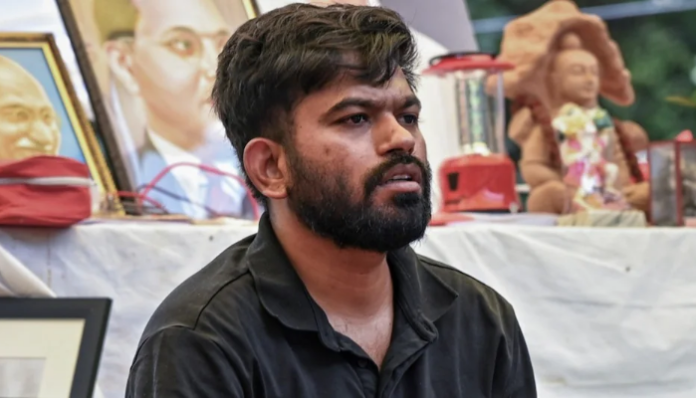
A petition has been submitted to the Supreme Court seeking intervention against social media platforms that facilitate access for minors, emphasising the associated dangers to vulnerable young individuals. Afterwards, the centre was directed to ensure that the companies adhere to the “law of the land” for the safety and protection of those below 18 years of age. However, Cockroach Janta Party (CJP) founder Abhijeet Dipke has found a political conspiracy in the development.
“All these years, the BJP (Bharatiya Janata Party) controlled the narrative through mainstream media and WhatsApp. But Instagram is a different battlefield. Gen Z has used it to question, mock and challenge political propaganda in ways that are far harder to control. And now Gen Alpha is coming of age online,” he wrote on social media.
He then claimed that limitations on minors might seem acceptable in the cause of online safety, and added, “But it is fair to ask whether there is another motive too: stopping Gen Alpha from doing what Gen Z did. Even 15 and 16-year-olds are openly mocking the Prime Minister and those in power.”
All these years the BJP controlled the narrative through mainstream media and WhatsApp.
— Abhijeet Dipke (@abhijeet_dipke) September 29, 2026
But Instagram is a different battlefield. Gen Z has used it to question, mock and challenge political propaganda in ways that are far harder to control. And now Gen Alpha is coming of age… https://t.co/T80mdnXn05
Dipke alleged that the centre should concentrate on making the internet safer for youngsters if it truly cares about them, remarking, “Start by cracking down on accounts that harass and abuse girls online, not by silencing an entire generation.”
It is noteworthy that the central government has agreed with the apex court’s decision, which transpired following a petition by nonprofit group Just Rights for Children Alliance (JRCA) that emphasised the risks of online grooming, sexual exploitation, trafficking, behavioural profiling, misuse of personal information, cyberbullying and exposure to content unsuitable for those under the age of adulthood. Similarly, enabling minors to access social media creates higher vulnerability to exploitation and abuse by predators and pedophiles.
The court asked, “How can these platforms allow 12 to 13-year-olds to have accounts? It is contrary to the law of the land?” It highlighted that the social media platforms “have registered under the laws of the US and imported into the Indian digital space the restrictions which are applicable in the US, which is impermissible under Indian law.”
The court stressed, “They must restrict, at least in registering membership, to a minimum threshold of 18 years.” Hence, it expressed, “Please pass directions under the intermediary rules that they fashion their software, or whatever the platform is called, in conformity with Indian law. The software has to conform with Indian law. That is our request.”
Solicitor General Tushar Mehta assured that the centre will make it legally required for intermediaries to prevent minors from opening social media accounts. Mehta stated that intermediaries are going to have to adhere to Indian regulations, and the restriction would need to be included in legislation or rules.
However, Dipke tried to give a political colour to the decision that was taken to safeguard the younger generation, only to advance his political objectives and agenda. He appeared to be willing to allow minors to be subjected to such grave dangers, including child sexual abuse material (CSAM), as long as it serves his interests.
