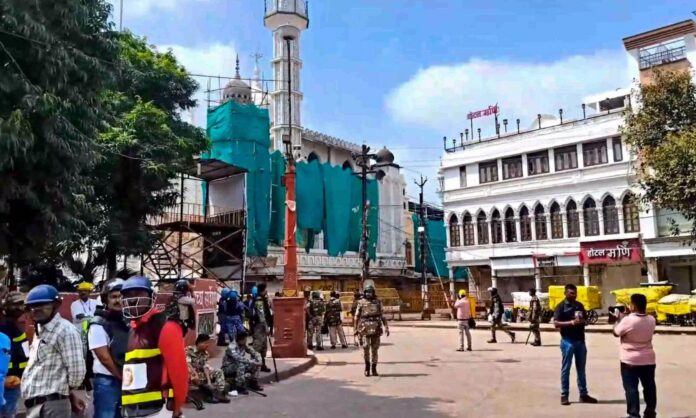
Tensions flared on Monday morning after a Muslim mob gathered to oppose the removal of a portion of the Shahi Masjid as part of a road-widening project in Ujjain being undertaken ahead of Simhastha 2028.
The situation escalated when protesters allegedly pelted stones at police and pushed against barricades, prompting the police to use tear gas and lathi-charge to disperse the crowd. A police personnel member was injured in the stone-pelting, while additional forces, including RAF personnel, were deployed to bring the situation under control.
The violence also brought parts of Ujjain to a standstill, with markets in several areas shut and some schools closing early as a precaution. Police divided the affected areas into four sectors and deployed a large force, while FIRs were registered and several people were detained or arrested. AIMIM Madhya Pradesh president Mohsin Ali Khan was also taken into custody while he was reportedly travelling to Ujjain in connection with the dispute.
There is a very simple question at the heart of the Ujjain controversy: Can a religious structure claim immunity from a development project merely because it is a religious structure?
If the answer is yes, then every road-widening project, highway, metro line and public infrastructure project in India will have to first negotiate the religious identity of every structure standing in its path. If the answer is no, then the same rule must apply equally to temples, mosques, churches and every other religious structure.
That is why what happened in Ujjain on September 27 is far more important than the partial removal of one mosque.
Ujjain is preparing for Simhastha 2028, which is expected to bring millions of pilgrims to the city. As part of the infrastructure plan, a 15-metre road is being developed along a stretch between Kanthal Chauraha and Gopal Mandir. Several structures fall within the proposed alignment.
One of them is a portion of the Shahi Masjid.
The matter did not remain outside the legal system. It went to court. The Madhya Pradesh High Court rejected petitions challenging the demolition notices and found no discriminatory treatment by the authorities. Most importantly, the court recorded that portions of 10 temples and another mosque had already been removed along the same road. It also noted action against numerous religious structures elsewhere in Ujjain.
So the claim that the administration suddenly decided to target a Muslim religious structure is difficult to sustain.
The road does not know whether the building standing in its alignment is a temple or a mosque.
Apparently, some protesters wanted the street to make that distinction.
When the administration moved to implement the decision, a confrontation broke out. Protesters allegedly pelted stones at police and pushed through barricades. Police responded with tear gas and a lathi-charge. A police officer was injured, additional forces were deployed and large parts of the surrounding area were placed under heightened security.
This is where the phrase “street veto” becomes relevant.
You can disagree with the government. You can oppose a demolition notice. You can suggest an alternative alignment. You can approach the courts. You can appeal. You can hold a peaceful protest.
But once a crowd attempts to physically prevent the State from implementing a decision that has already survived judicial scrutiny, it is no longer simply exercising a democratic right. It is attempting to replace the legal process with mob pressure.
And that is a dangerous precedent.
If a temple can make way for a road, so can a mosque
This principle really should not be controversial.
If a temple stands in the path of a legitimate road-widening project, the temple cannot automatically demand immunity because it is a temple.
If a mosque stands in the same alignment, the mosque cannot demand immunity because it is a mosque.
If religious structures are automatically exempt, then India’s historic cities can never modernise. Every road, railway, metro corridor and drainage project could be blocked by whichever religious structure happens to stand in the way.
That is not secularism. That is religious exceptionalism.
The law must therefore apply uniformly. Religious sentiment can be considered. Heritage can be considered. Alternative alignments can be considered. Compensation can be provided where applicable.
But religious identity cannot become an automatic veto against development.
And this is exactly why the Ujjain High Court order matters. The court did not merely rubber-stamp an action against a mosque. It examined the broader road-widening exercise and noted that Hindu and Muslim religious structures alike had already been affected.
That inconvenient fact destroys the simplistic narrative of “Muslims being targeted.”
The foreign-media framing is even more revealing
And then came the predictable international coverage.
Al Jazeera described hundreds of Muslims gathering to protest the partial demolition of a mosque and highlighted that the road widening was being undertaken ahead of the 2028 Hindu pilgrimage.
Hundreds of Muslims have gathered in the Indian city of Ujjain to protest the partial demolition of a mosque they say is more than 600 years old.
— Al Jazeera English (@AJEnglish) September 27, 2026
The BJP-led state government says the action is needed to widen roads ahead of the 2028 Hindu pilgrimage. pic.twitter.com/8bOyhcesoG
Notice what this framing does. Apparently, only demolitions of mosques in India get such wide coverage. Such developments taking place in Saudi Arabia or UAE, Australia, or even China hardly get the kind of coverage that Al Jazeera devotes to India. But more importantly, it is the manner in which Al Jazeera and similar foreign-based media outlets try to stoke unrest in India.
The story becomes:
Muslims + mosque + demolition + BJP government + Hindu pilgrimage.
What gets pushed into the background?
The road-widening project.
The wider master plan.
The other temples and mosque affected by the same project.
The High Court judgment.
And the stone-pelting and confrontation with police.
This is how narrative laundering works.
You do not necessarily have to publish an outright falsehood. You simply select the facts in such a way that the reader is nudged towards a predetermined conclusion.
Suddenly, a civic infrastructure project becomes a communal project.
A court-backed administrative decision becomes an attack on Muslims.
And a violent confrontation becomes merely a story about a minority community “protesting” against a mosque demolition.
Why is the fact that this is being done ahead of Simhastha repeatedly highlighted?
Because it allows a road-widening project to be presented as something being done for Hindus.
But the road will not disappear after Simhastha.
The widened road will remain.
The infrastructure will remain.
The traffic benefits will remain.
Ujjain residents, be it Hindu, Muslim, Jain, Sikh, Christian or otherwise, will use it.
A road does not check the religion of the person travelling on it.
Where was this outrage in Ayodhya?
The selective outrage becomes even more obvious when one remembers the road-widening projects in Ayodhya.
Around 30 temples were reportedly affected by the Ram Path widening project, along with hundreds of shops and other structures.
The existence of a temple did not automatically invalidate the road project.
And nor should the existence of a mosque automatically invalidate one in Ujjain.
That is the only consistent position.
If the rule is that religious structures can never be touched, then say so openly.
But if temples can be affected by development, then mosques can be affected too.
And if mosques can be affected, temples cannot subsequently demand a different standard.
Equal treatment means equal inconvenience as well as equal protection.
The Chief Minister’s own house makes the narrative even harder to sustain
There is another detail that conveniently disappears from much of the communal framing.
Madhya Pradesh Chief Minister Mohan Yadav himself initiated the demolition of part of his more than 50-year-old ancestral house because it fell within the road-widening alignment.
His own ancestral property is making way for the project.
Yet we are expected to believe that the same administration has suddenly designed the entire exercise around targeting Muslims?
That does not mean every administrative decision is automatically correct. It does mean that the lazy explanation that “the government is demolishing Muslim property because it is Muslim” deserves far more scrutiny than it receives.
The eventual cooperation is the correct model
Interestingly, after the confrontation, Ujjain City Qazi Khali Kurre Rahman appealed to people not to pay heed to rumours or unnecessarily gather at the site. The administration subsequently said members of the community were voluntarily cooperating in removing the affected portion.
That is how the matter should have been handled.
Disagree.
Argue.
Litigate.
Appeal.
Propose alternatives.
And if the final lawful decision goes against you, accept it.
That is how a constitutional democracy works.
Not by throwing stones until the government backs down.
Because once we accept the principle that a sufficiently large crowd can physically prevent implementation of a lawful decision, the same principle will inevitably be used by every other community.
Today it is a mosque.
Tomorrow it could be a temple.
Then a church.
Then a gurudwara.
Eventually, no road can be widened unless the government first obtains the permission of whoever happens to have the strongest crowd outside the structure.
That is not democracy.
That is mob arbitration.
Ujjain therefore presents India with a very simple test.
The State must not demolish a religious structure merely because it belongs to a particular religion.
But equally, a religious structure must not become untouchable merely because it belongs to a particular religion.
If a temple can make way for a road, so can a mosque. The mob cannot dictate what rules the administration can enforce.
The rule must be the same. The law must be the same. And the street must never be allowed to become a substitute for the courtroom.