

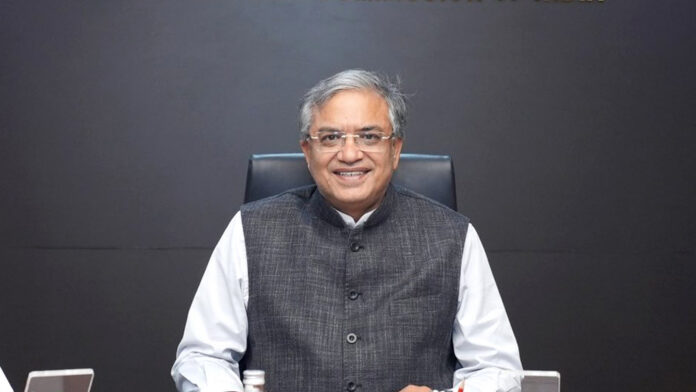
The Supreme Court on Monday refused to pass an immediate order suspending Chief Election Commissioner Gyanesh Kumar over allegations that crucial decisions relating to the Special Intensive Revision (SIR) of electoral rolls were taken unilaterally.
Instead, the Court chose to first hear the Election Commission and other officials accused of violating the statutory framework governing the poll panel.
A bench headed by Chief Justice of India Surya Kant, along with Justices Joymalya Bagchi and V. Mohana, issued notices to the Union government, the Election Commission of India, CEC Gyanesh Kumar, Election Commissioners Sukhbir Singh Sandhu and Vivek Joshi, Deputy Election Commissioner Maneesh Garg and DG (IT) Seema Khanna.
The controversy stems from reports that 14 important decisions concerning the SIR exercise were taken in the name of the ECI despite objections allegedly recorded by the two other Election Commissioners between October 2025 and August 2026.
Senior Advocate Vikas Singh, appearing for petitioner Rakesh Kumar Singh, sought Kumar’s immediate suspension, arguing that the allegations went to the heart of the electoral process and could jeopardise citizens’ voting rights.
Singh relied on Section 18 of the Chief Election Commissioner and Other Election Commissioners Act, which provides that decisions of the multi-member Commission should, as far as possible, be unanimous and, failing unanimity, decided by majority.
“This is a grave situation which can undermine the very basis of our democracy,” Singh argued, pressing the Court to intervene before the alleged irregularities could have irreversible consequences.
The bench, however, was unwilling to suspend the CEC without first hearing the respondents.
“If the CEC is suspended, the ECI functioning will be stalled. Who will conduct the elections?” the bench asked. Singh responded that the remaining two Election Commissioners could discharge the Commission’s functions.
Justice Bagchi questioned whether the Court could conclude, without hearing the respondents, that all the disputed decisions were unilateral. He indicated that if the Commission’s records ultimately establish a violation, the Court could strike down decisions found to be contrary to law.
CJI Kant also cautioned that the Court could not pass an order merely based on newspaper reports.
Singh countered that the alleged unilateral decisions had already vitiated the electoral rolls and warned that some consequences could not simply be reversed later. “Your Lordships cannot undo an election, or undo an elected government,” he told the bench.
The Court nevertheless declined to grant the requested interim relief and issued notice to the respondents.
A separate petition filed by advocate Shailendra Mani Tripathi also received notice. It seeks the quashing of the 14 allegedly unilateral decisions and an independent judicial inquiry or SIT headed by a retired Supreme Court judge, with technical experts assisting the probe.
The petitions also allege that around 13 crore names were deleted from electoral rolls across 30 States and Union Territories during the SIR exercise. They seek a forensic audit of the ECINet and ERONet databases and an investigation into alleged irregularities involving voter applications, centralisation of electoral-roll data and restoration of eligible voters.
One petition has also sought action under Section 32 of the Representation of the People Act, 1950, against officials allegedly responsible for breaches of official duty.
