

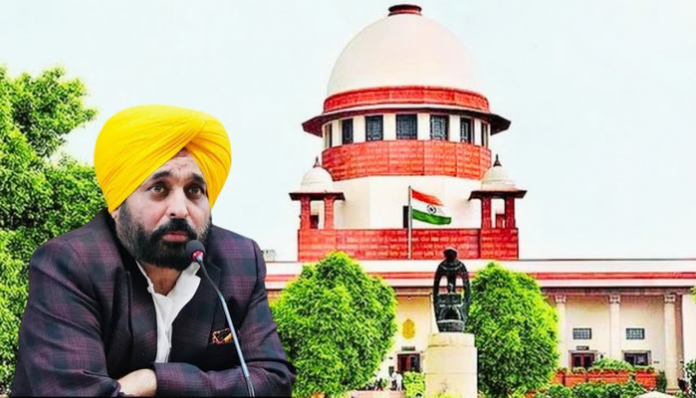
The Supreme Court recently set aside polls in 50 municipal wards of Aam Aadmi Party-ruled Punjab after it found that the nomination process was widely obstructed and the opposition candidates were prevented from filing nominations. The wards include 28 wards of Patiala Municipal Corporation and 22 of Baghapurana and Dharamkot municipal councils in Moga district.
The decision on the polls, which were held in December 2024, was passed by a bench comprising Chief Justice Surya Kant and Justices Joymalya Bagchi and V Mohana. Candidates from opposition parties accused AAP members and police personnel of preventing them from filing nomination papers. The petitioners apprised the apex court that candidates were physically assaulted, their clothes were torn, and nomination papers were snatched during the filing process. They added that the nomination process was not videographed despite directions issued by the Punjab and Haryana High Court.
The Supreme Court appointed a single-member Fact-Finding Commission, headed by Justice Nirmaljit Kaur (former Judge of the Punjab & Haryana High Court), to investigate the parties’ claims. The Commission found widespread obstruction during the nomination process, whereby nomination papers were snatched, torn, or destroyed, and candidates were assaulted, detained, or threatened.
With respect to the wards in Patiala Municipal Corporation, the Commission held that elections in 13 wards (Wards 1, 12, 32, 33, 36, 41, 43, 44, 45, 48, 50, 51, and 52) were vitiated as opposition candidates were prevented from filing nominations. In 14 wards of the Corporation (Wards 4, 6, 14, 16, 22, 26, 28, 37, 38, 40, 46, 53, 55, and 57), the election was vitiated due to the forcible exclusion of specific opposition candidates. In Ward 34, polls were vitiated because a specific candidate was blocked from filing nominations. In Wards 15 and 58, the Commission found evidence of bogus/multiple voting and intimidation. Claims regarding polls in Wards 7, 18, and 19 were found not proved due to lack of evidence.
Elections in 7 wards of Dharam Municipal Council (Wards 1, 2, 3, 4, 7, 9, and 13) were found vitiated due to forcible prevention of nominations, coercive withdrawals, or wrongful rejections. Elections in all 15 wards of the Baghapurana Municipal Council were held to be vitiated due to systematic prevention of opposition candidates from filing nominations.
Based on the findings of the commission, the Apex Court ordered fresh elections in 50 wards to be completed within 6 weeks and issued a set of directions. The Supreme Court requested the Chief Justice of the Punjab & Haryana High Court to appoint a Monitoring Committee of a retired High Court Judge within one week to oversee the entire re-election process. The re-election schedule will be notified after this committee is constituted.
The top court requested the Chief Justice of the Punjab & Haryana High Court to nominate 2 or 3 senior Bar members who will act as Observers throughout the entire process. The court directed that the filing, scrutiny, symbol allocation, and polling must be videographed in their presence and handed over to the Monitoring Committee.
The court directed the state government to furnish a ward-wise list of election duty officials and DSP-rank (and above) police officers to the Monitoring Committee prior to nomination filing.
The court further directed that any complaints regarding obstruction or interference may be submitted directly to the Monitoring Committee, which will inquire into them and report to the High Court Chief Justice for judicial action if substantiated.
The apex court directed the state government to bear the expenses of all honoraria, logistical, transportation, secretarial, and security support costs for the Monitoring Committee and Observers. The court added that the re-poll process will be deemed complete only after the High Court Chief Justice is satisfied with the report on the elections’ fairness.
The re-election process will only be deemed complete once the High Court Chief Justice is satisfied with the report on the elections’ fairness. Results can only be declared after this satisfaction is formally recorded.
