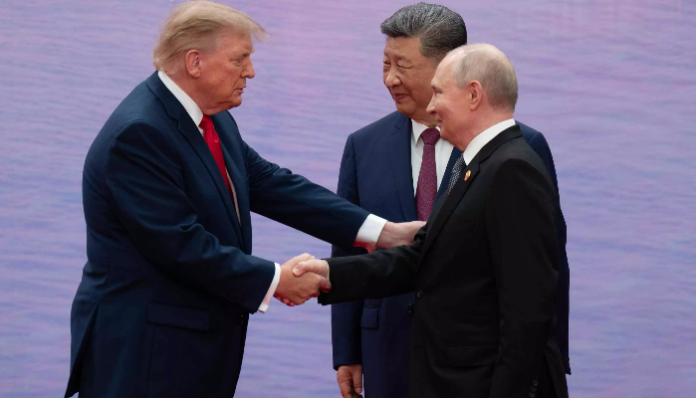
Global politics could be heading toward another major shift as attention turns to the much-anticipated trilateral meeting between the United States, China, and Russia on the sidelines of the 33rd Asia-Pacific Economic Cooperation (APEC) Economic Leaders summit, which is taking place on 18th and 19th November (Wednesday and Thursday) in Shenzhen. US President Donald Trump and Russian President Vladimir Putin were received with warm embraces, cheerful smiles, and friendly handshakes by their Chinese counterpart and host, Xi Jinping, as they arrived, captured in carefully curated visuals that have since circulated widely.
In a move that caught many by surprise, he personally welcomed Trump with a hug on the tarmac at Shenzhen Bao’an International Airport. The gesture is believed to be the first by a Chinese leader in decades. However, Trump had also broken with convention by similarly greeting Xi on the tarmac in Washington in September. The three leaders will also take part in separate bilateral meetings with one another on Thursday.
BREAKING: Xi Jinping personally greets President Trump at Air Force One in Shenzhen, China with massive fanfare @RealAmVoice @HumanEvents https://t.co/NBse611Jaq
— Jack Posobiec (@JackPosobiec) November 18, 2026
However, the stage is set for the main attraction, high-stakes talks between the three world powers, scheduled to take place on the same day. This assumes even greater importance as it comes against the backdrop of two continuing conflicts in Ukraine and Iran, the expiration of a key arms control pact between Washington and Moscow, growing rivalry over artificial intelligence (AI), and unresolved trade disputes. Interestingly, former Nvidia chief Jensen Huang’s involvement with a suspected Chinese spy is unlikely to feature in the discussions.
Yalta 2.0 in the making? What is on the agenda – only photo-ops or concrete goals
More than 81 years ago, Allied powers held a decisive conference during World War II. The leaders of the United States, Britain, and the Soviet Union divided Germany and Berlin, established zones of influence in Europe, and decided to create the United Nations during the crucial gathering known as the Yalta Conference, which unfolded between President Franklin D. Roosevelt, Soviet leader Joseph Stalin and British Prime Minister Winston Churchill from 4th to 11th February 1945 in Crimea.
The leaders at the Shenzhen summit are in competition with one another for dominance across the world, in contrast to Yalta, where the Allies were contemplating the future of a war-torn continent. However, the image carries powerful symbolism, with China occupying the place of the United Kingdom alongside the US and the then Soviet Union.
The comparison is being drawn because, similar to the Yalta conference, decisions taken at the present summit could have far-reaching consequences for the rest of the world. Putin, Trump, and Xi could discuss a wide range of subjects, including Ukraine and other crises that “are literally festering now,” based on Kremlin foreign affairs adviser Yuri Ushakov.
The US had made a proposal to address broader European security in the negotiations for a possible pact, which echoes a persistent demand from Russia to consider its security concerns but is opposed by Kyiv and its supporters.
According to reports, the occasion presents Putin with a highly sought-after opportunity to show that he is in charge of a superpower on par with China and the United States. It also gives him a window to try to convince Trump to accept his demands for a settlement in Ukraine, as the latter wants to mediate a peace agreement.
Trump has adopted a relatively softer approach towards Russia. He lifted harsh sanctions and reversed years of pressure policy by signing a diesel accord that allowed the Eurasian nation to resume fuel deliveries. It remains to be seen how far this thaw in relations can stretch and whether their personal diplomacy can actually culminate in tangible solutions on some of the most pressing security issues facing the world.
Nuclear arms control is reportedly central to the talks. New START, the last such pact between the US and Russia, expired in February. It defined standards for transparency and verification as well as restrictions on the deployment of strategic nuclear warheads and delivery systems. Trump announced that he seeks to forge a “new, improved and modernised” arrangement which includes an unwilling China.
The strife in Iran and Ukraine could also be significant topics of conversation. Trump has announced that he aims to explore methods to resolve both by using his connections with Xi and Putin. However, experts suspect that China might be reluctant to mediate between Iran and the US, while Russia is unlikely to relinquish its demand for full control over territories like Donbas or alter its firm stance against Ukraine’s NATO (North Atlantic Treaty Organisation) membership.
The meeting between Trump and Xi is estimated to be driven by economic and technological struggle in addition to security and military concerns. There is a relentless trade war between the two sides comprising tariffs, advanced semiconductors, AI, and rare earth minerals. However, analysts have also predicted a renewal of the US-China trade truce, which is due to end in January, amid increasing strain in the bilateral relationship.
Ryan Hass, from the Brookings think tank, conveyed that China’s “overriding objective is extending the fragile calm in the US-China relationship for as long as possible,” to the AFP news agency.
David Roche, strategist at Quantum Strategy, noted that the meeting will probably provide little substantive success. He added that it solely serves as a “nearly 100% photo op” that boosts China’s status in the global arena while Trump’s political standing declines, while talking to CNBC.
“Xi may be inclined to do Putin a favour by showing up, given close strategic ties,” Neo Wang of Evercore ISI told the media house. He emphasised that a joint declaration on Ukraine, a security deal, or sanctions against Russia is doubtful because Beijing would be “more exposed to political scrutiny and accountability.” Peter Alexander, Shanghai-based managing director at Z-Ben Advisors, however, argued that bringing Putin and Trump together will prove politically beneficial for Xi.
The summit gets off to a rocky start
Cracks began to show beneath the carefully crafted public spectacle. Wang outlined that the primary obstacle is “a disagreement over the agenda.” The White House has prioritised nuclear non-proliferation and the Middle East tensions while downplaying the likelihood of a dialogue on Ukraine.
Olivia Wales, a White House spokeswoman, mentioned, “Trump will discuss the reduction of nuclear weapons in the world, whose proliferation he believes is very dangerous.” Roche pointed out that China intends to reach parity with the US in around 10 years and, until then, has zero interest in nuclear disarmament deliberations.
A senior official in the Trump administration likewise stated, “We do not expect to get to any kind of agreement. This is a difficult topic for China to address, but we do think it’s time for China to sort of step up, you know, to the table of adults, if you will, and have adult conversations about adult things,” reported Reuters.
Meanwhile, Russia was engaged in power projection in the run-up to the summit as it flew nuclear-capable Tu-95 bombers to a Vietnamese airport before Putin visited China, as a direct demonstration of its ability to illustrate its strength in the area while fighting in Ukraine.
Russian television showed an officer accompanying Putin with a briefcase containing the codes for the country’s nuclear arsenal as he landed in China. Russian military aircraft also took off south from its Far East region, alarming air forces in both Taiwan and Japan.
Furthermore, former US National Security Adviser Jake Sullivan unveiled in “The Rest is Politics podcast” that Beijing did not want Trump and Putin to hold a meeting, preferring a statement from them.
Former foreign ministry policy planner Shen Weizhong, who is with the Global Governance Institute, a think tank in Beijing, stated that the Chinese side could be “torn,” remarking, “On the one hand, it will steal the spotlight. The outcome is not clear, and there are no immediate deliverables. But on the other side, it will help China’s image – it is the only facilitator who could do this, and if it can ease tensions on the world stage, that will be good,” adding that Putin and Trump’s enthusiasm could have influenced the result in a conversation with The Guardian.
Conclusion
Trump has consistently portrayed himself as a negotiator and peacemaker, but the prospects of any meaningful breakthrough are slim. However, the optimism surrounding the meeting appears largely confined to pleasant optics, as Trump, Putin and Xi stand to accomplish more by using it to appeal to their domestic audience and advance their political interests.
“It is a far cry from being a new Yalta. In Yalta, you actually had the idea about how the world was going to look, and where the demarcation line would potentially be between the superpowers. We don’t have anything similar, not even the contours of that, in the making at this moment.” Vuk Vuksanovic of King’s College, London, dismissed the comparison while talking to al Jazeera.
“Trump hopes that he can get some quick-fix deal on something, at least, which he can then try to spin and sell to his base in the US as an enormous accomplishment,” he added, especially after the humiliating drubbing in recent midterm elections. The summit will also allow Putin to counter the narrative of Russia’s diplomatic isolation, while China will gain as a facilitator of the meeting.
It is accurate to contend that having the presidents of the US, Russia, and China at the same table has enormous strategic implications. Together, these nations have the biggest nuclear stock in the world, permanent seats on the UN Security Council, and substantial clout over global trade, energy, technology, and security.
However, there is no indication that the trio could bargain over a thorough partition of spheres of authority or territory. More importantly, the geopolitical conditions are completely different today. Hence, the Shenzhen meeting is neither another Yalta nor a repeat of it.
Moreover, it is uncertain if the trilateral summit will lead to real progress or whether it will just be remembered as a symbolic milestone in international diplomacy. The turbulent history, persistent rivalries and conflicting objectives of the US, Russia and China have kept expectations very low. None of the countries is expected to compromise on its core agendas, making it difficult to achieve common ground.
However, the world could also wake up to a surprise consensus, with the three leaders reaching an understanding guided by the age-old saying, “There are no permanent friends or permanent enemies, only permanent interests.”