

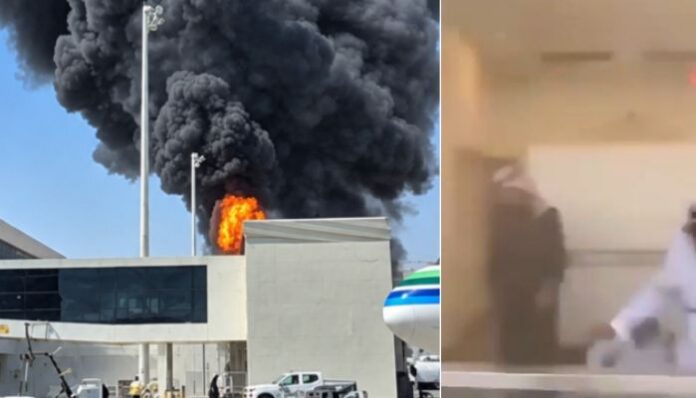
A missile strike by the Iran-backed Houthi rebel group at King Khalid International Airport in Riyadh, the capital of Saudi Arabia, killed 12 people and injured more than 300 others, including some in critical condition, civil aviation authorities said early Sunday (11th October). The Saudi-led coalition has blamed the Houthis in neighbouring Yemen for the attack.
First images have emerged from Riyadh’s King Khalid International Airport following a Houthi attack that killed at least 12 people and injured more than 300. https://t.co/uLHV37e4AB
— Middle East Eye (@MiddleEastEye) October 11, 2026
The missile hit the airport complex housing Terminals 3 and 4, which handle domestic flights, a regional official said. The airport has no military facilities. The attack is the deadliest in any Gulf Arab country since the Iran war began.
According to Saudi authorities, the dead include four Saudi citizens, two Bangladeshi nationals, and one citizen each from Palestine, the United States, Egypt, Jordan, Syria and Sudan. The injured are receiving treatment at several hospitals. Videos shared on social media showed emergency vehicles outside the airport.
Donald Trump says US may join Saudi strikes
US President Donald Trump said Washington was considering joining Saudi Arabia’s military strikes against the Houthis following the attack.
“We may. We’re going to look at it,” Trump said on Saturday. “We just found out about the recent attack. So we’ll make a decision. We move very quickly.”
Trump also said he planned to speak with Saudi Crown Prince Mohammed bin Salman. “What happened in Saudi Arabia is not acceptable,” he said when discussing the attack.
US Secretary of State Marco Rubio confirmed that an American citizen was killed in the strike and condemned the attack, saying, “These reprehensible attacks demonstrate a blatant disregard for innocent civilian life. They must stop now.”
The Saudi-led coalition called the strike a “fully-fledged war crime” and promised a strong response. The Houthis did not immediately comment on the attack. Earlier on Saturday, they accused Saudi Arabia of striking Sanaa International Airport in Yemen’s Houthi-controlled capital.
Airport closed as flight disruptions grow
Saudi civil aviation authorities suspended airport operations following the attack. Police blocked the entrances, and flights were diverted to other airports. The United States, Britain, Germany, Australia and Canada warned their citizens to avoid the airport.
The strike came after several attacks on Saudi airports, military facilities and oil infrastructure over the past week. Earlier Houthi attacks on King Khalid International Airport killed three Saudis, including a pilot. Regional officials also said Thursday’s attacks damaged three aircraft. Saudi national carrier Saudia confirmed that one of its planes was damaged while on the ground, with no passengers aboard.
Air India, FlyDubai, Lufthansa Group and Pakistan International Airlines had already suspended flights to and from Riyadh and other Saudi airports for varying periods. The European Union Aviation Safety Agency expanded its warning on Saudi airspace, citing the growing risk to aviation infrastructure and the possibility of civilian aircraft being mistaken for military targets during missile and drone interceptions.
The Houthis had warned international airlines about operating in Saudi airspace, calling it a potential military target. Saudi authorities also warned that filming or sharing information about missile and drone interceptions and impact sites could lead to legal action.
Saudi Arabia seeks air defence support
Saudi Arabia is facing concerns over its supply of missile interceptors and has asked France, Britain, Pakistan and Egypt for air defence support, regional officials previously told The Associated Press. US assistance has included intelligence sharing, target identification and planning for the latest offensive against the Houthis.
Saudi Arabia and the Houthis have fought since 2015, when Riyadh intervened in Yemen’s civil war in support of the internationally recognised government. The latest escalation follows a Saudi-led military offensive against the rebels, with coalition air support for Yemeni government forces seeking to reverse Houthi gains along the Red Sea.
Meanwhile, US Central Command said an American fighter jet struck and disabled the Panama-flagged cargo ship M/V Ocean Molica in the Gulf of Oman after it left an Iranian port and ignored repeated warnings. The crew was unharmed.
The attacks have raised concerns about regional security and global oil supplies. Despite the violence, Saudi Arabia continued promoting a major international energy conference scheduled to begin in Riyadh on Sunday, October 11. Saudi and Omani foreign ministers also discussed diplomatic solutions to reduce regional tensions.
Houthi-Saudi hostilities intensify
The attack comes amid a wider escalation between Saudi Arabia and the Houthis, who control large parts of Yemen. The group has intensified attacks on Saudi Arabia after announcing a naval blockade against the kingdom earlier this year.
On 19th September, flames and a large plume of black smoke were seen near Riyadh’s international airport. The incident came hours after Saudi authorities issued alerts warning of a possible “hostile aerial threat” over the Saudi capital and other parts of the country.
On 15th September, Saudi Arabia issued an alert about possible assaults on the Islamic holy city of Mecca, along with the governorates of Jeddah and Taif, after the country was repeatedly targeted by Yemen-based Shiite Houthis in recent days. However, the alert was lifted later. Notably, it was the first such alert in Mecca since the start of the latest Middle East conflict.
That evening, Saudi Arabia’s air defence systems intercepted and destroyed a Houthi drone south of Mecca before it could enter the prohibited airspace over the Islamic holy city.
According to spokesperson Turki al-Malki, the drone attack marked the second reported Houthi attempt to target Mecca, following a ballistic missile launch in July 2017.
In recent months, the Houthis have also targeted Saudi vessels and infrastructure, raising concerns about the oil shipments.
