

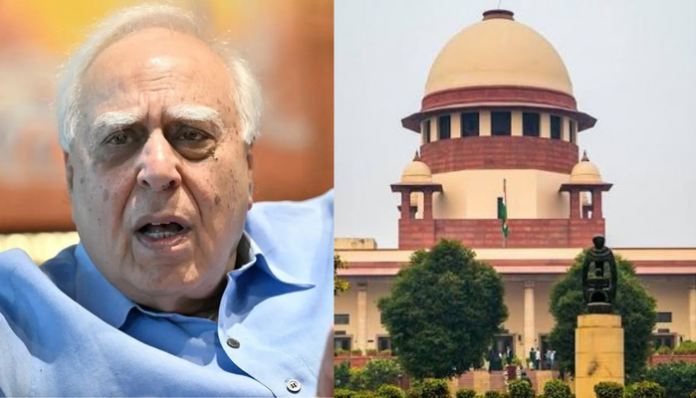
The Supreme Court on Sunday (October 11, 2026) refused to pass an interim order against the Delhi Police and other authorities as Senior Advocate Kapil Sibal tried to press the court for an order. A special Bench of Justices Joymalya Bagchi and V. Mohana heard a batch of petitions concerning the prohibitory measures imposed by the Delhi Police in the national capital in anticipation of a Cockroach Janta Party-led unauthorised agitation.
Sibal was among the lawyers who made their respective submissions before the apex court regarding the events that transpired in Delhi yesterday, including the preventive actions of the Police. During the hearing, Sibal insisted that the court must pass an interim order to ensure uninterrupted movement of trains, traffic and people and internet services in Delhi.
“I want an interim order that all trains in India, from their place of origin, will come to Delhi without any restriction. Because there can be no Section 163. There can be no Article 19(2). Those are the only restrictions that can be placed. That interim order I want,” Sibal said.
Supreme Court says it would “love to give interim relief” but wants to deliberate on whether the Police Act’s requirements are in sync with Article 19(2). Justice Bagchi: The process of protest must follow procedure. “Article 21 does not go beyond procedure.”
— LawBeat (@LawBeatInd) October 11, 2026
However, the Supreme Court did not give in to Sibal’s pressure tactics and declined to pass an interim order. The court observed that the right to protest has to be balanced with other laws. “Article 21 does not go beyond procedure,” the court noted. The court said that it would “love to give interim relief”, but it would first examine whether the requirements under the Police Act are in sync with Article 19(2) of the Constitution.
Notably, Sibal insisted on an interim order despite Solicitor General Tushar Mehta already informing the court that normalcy has been restored in the national capital and that metro and internet services were made fully operational.
The exchange in the Supreme Court was preceded by Sibal’s attempt to cast aspersions on the top court during a press conference yesterday (October 10, 2026). Sibal said that he had lost faith in the Supreme Court and that he no longer saw any reason in approaching it.
“I am tired of keeping on going to the Supreme Court. I am speaking for myself. I don’t think there is any use of going there. I don’t have much hope in the Supreme Court of India,” Sibal said. Sibal’s remarks came in the context of ongoing proceedings relating to allegations of irregularities in the SIR exercise conducted by the Election Commission of India (ECI). The senior advocate looked frustrated over not getting a favourable order from the court.
Raising suspicions about the neutrality of the apex judicial institution after failing to get a favourable decision is quite unbecoming for a legal practitioner of Sibal’s stature.
