

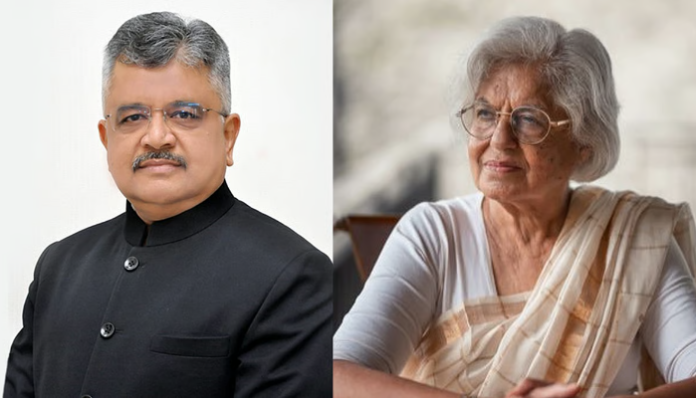
On 15th October (Thursday), a tense moment occurred in the Supreme Court during the hearing of a petition to establish a committee to investigate allegations of sexual assault against female journalists during the opposition protests in Delhi. The incident took place when Indira Jaising, who was arguing for the plea, raised her voice. She demanded that women journalists who have filed complaints against cops not be subjected to any form of coercive action.
Her conduct drew a sharp response from Solicitor General Tushar Mehta, who stated, “Stop shouting at the court. They want their rights of speech and expression to be protected, but they don’t want anyone else to have it, including the court.”
He added, “If she shouts, I cannot do it unless the court decides to hear one side and not the other. I have no difficulty with the court hearing everyone, but it will have to control the interruptions.” He outlined that many people claim to be independent journalists who record and upload content using a microphone.
Mehta conveyed, “What is going on is reel-making, and that happens even at protest sites. So we do not know who is a reel-maker and who is an independent journalist. But nobody should be treated inappropriately, including female police personnel, if you don’t mind. Police personnel also.” Supreme Court also asked, “Does freedom of expression allow every person with a camera to become a journalist?”
He then submitted, “But as to the blanket directions my learned friend seeks regarding a committee, the court may examine what the police have done. If, after that, the court comes to the conclusion that they have not done enough, then it has the power to constitute such a committee, though I am objecting to it at this stage. Second, so far as no FIR against any woman journalist is concerned, that would be too wide a direction.”
Jaisingh alleged, “This is all Nautanki. This is all drama for the media,” after Mehta’s statement.
🚨🚨Solicitor General Tushar Mehta to #CJI Bench: "STOP SHOUTING AT THE COURT. They want their rights of speech and expression to be protected, but they don’t want anyone else to have it, including the Court." Indira Jaising, Senior Advocate: "This is all Nautanki. This is all drama for the media!" SG makes the submission as Indira Jaising raises her voice, pressing for a BLANKET ORDER of no coercive action against women journalists who have filed cases against police officers.
— LawBeat (@LawBeatInd) October 15, 2026
The apex court has been approached by Network of Women in Media, India (NWMI), after which a bench of Chief Justice Surya Kant and Justice Joymalya Bagchi agreed to set up a panel to examine the charges of sexual violence against female journalists. It will be made up of retired women judges and IPS officers.
The court declared, “We are also prima facie agreeing that the committee in your matter must be predominantly or exclusively composed of women. It may comprise a former woman judge, a former woman IPS officer, a former woman social worker or a social activist with a known track record.”
Jaisingh earlier contended, “When they go onto a protest site, they constitute a class by themselves because they not only have the right to speech, not only have the right to protest, but also the right to work. They go there to perform their duties in the exercise of the right to work. Now, being women, they are particularly vulnerable to sexual abuse, being pushed and pulled around, especially by male police officers. This is not to say that the women police officers did not push them. They did. That would constitute harassment.”
She accused the authorities of misusing the Scheduled Castes and the Scheduled Tribes Prevention of Atrocities Act, invoking the case initiated against a woman journalist by Assistant Commissioner of Police (ACP) Vivek Bhagat for making casteist remarks, obstructing official duties and conducting a campaign to harm his reputation.
According to the FIR, the journalist mocked, “Ye Bhagat hai, Meghwal hote hain, ye choti jaati ke hote hai, silai bunai ka kaam karte hai ya sala kahin se ACP ban gaya (He is a Bhagat, a Meghwal, which is a low caste and they do knitting and weaving. How did he become an ACP)?”
On the other hand, Gaurav Bhatia highlighted that Rahul Gandhi shoved a pregnant journalist and asked the court to take notice of the event. He also questioned Jaising’s silence over the issue, pointing to her biased behaviour when it came to reporting on harassment incidents involving women journalists covering the agitation.
