

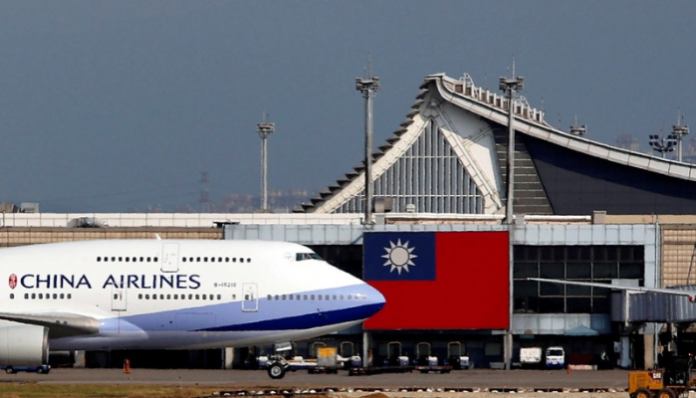
On Wednesday (28 October), Pakistan banned its airspace for Taiwanese airlines in support of Beijing’s One China policy. Pakistan became the first country in the world to take such a measure.
According to a Bloomberg report published. The decision, confirmed by Pakistan’s Defence Minister Khawaja Asif, effectively bars carriers such as China Airlines and EVA Air from transiting Pakistani airspace, forcing them to reroute flights between Asia and Europe.
“The aviation sector follows the One China policy: only mainland China is open. We only allow Chinese airlines to fly over Pakistan’s airspace,” Asif told Bloomberg. The statement draws a clear distinction between carriers from mainland China and those registered in Taiwan.
Beijing regards Taiwan as part of its territory under the One China policy. Pakistan’s move gives practical effect to that diplomatic stance in the civil aviation domain.
The move is the first known instance of a country specifically targeting Taiwan’s commercial airlines through a blanket airspace restriction. However, the duration of the ban and the formal directive behind it remain unclear.
Pakistan has denied carriers from Taiwan access to its airspace in support of Beijing’s One-China policy, the first move of its kind by any country. Full story: https://t.co/2WDTeJIM9l 📷: I-Hwa Cheng/Bloomberg https://t.co/8MyAedd844
— Bloomberg (@business) October 28, 2026
According to flight-tracking data from Flightradar24, China Airlines and EVA have stopped flying over Pakistani airspace from 25 October. Since then, at least a dozen flights operated by the two carriers on routes between Asia and Europe have instead diverted through Russian airspace.
The rerouting adds flight time and fuel costs for the Taiwanese airlines, which have declined to comment on the change. Taiwan’s Civil Aeronautics Administration also did not directly address the rerouting but stated that it has never prohibited airlines from flying over Russia.
Flights to European destinations are most affected by that. In which China Airlines operates flights to Rome and EVA Air serves destinations including London.
The move aligns with Islamabad’s long-standing diplomatic stance on Taiwan. In a joint statement released in May, following Pakistani Prime Minister Shehbaz Sharif’s visit to China, both countries reiterated their commitment to the One-China policy.
In that statement, Pakistan described Taiwan as an inalienable part of the territory of the People’s Republic of China. Pakistan later said that it opposes all forms of Taiwanese independence. This statement is in support of China’s agenda of national unification.
Taiwan’s Foreign Ministry rejected this statement and rejected it as false. It said Taipei maintains that Taiwan is a sovereign country and that neither it nor the People’s Republic of China is subordinate to others.
Under Article 1 of the 1944 Convention on International Civil Aviation, each state has full and exclusive sovereignty over the airspace above its territory. According to ICAO, states may regulate routes, restrict flights, or ban overflights in specified areas, provided they comply with applicable international aviation rules and obligations.
Pakistan’s reported decision thus marks a notable development in the use of airspace restrictions amid tensions over Taiwan’s international status. Its immediate effect is visible in flight rerouting, while the restriction’s duration and broader operational consequences remain unclear.
