

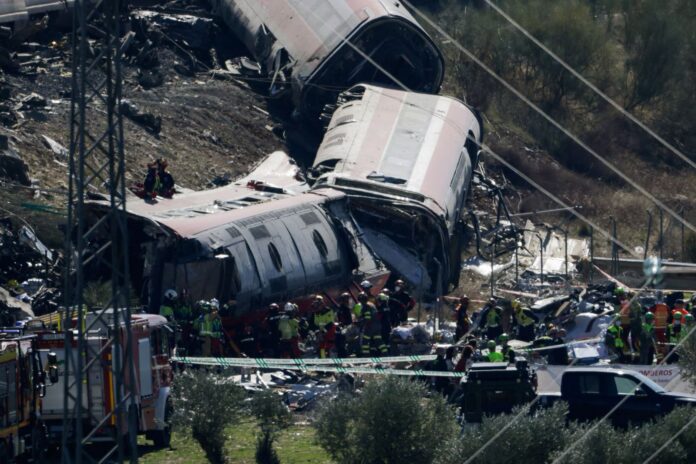
At least 64 people have been killed and several others injured after two high-speed trains collided near Madrid, Spain, on Wednesday morning, October 28. The devastating crash prompted the suspension of rail services connecting Madrid with Ciudad Real and Andalusia, disrupting one of the country’s key rail corridors.
Spain’s rail infrastructure operator ADIF confirmed that the accident occurred in the province of Toledo at around 9 AM local time. Initial reports cited by ABC News suggested that human error may have contributed to the disaster, with a public utility worker reportedly failing to alert an AVE high-speed train about an approaching Iryo train while repairing a major signalling fault. The precise circumstances of the collision remain subject to investigation.
“Traffic on the Madrid-Andalusia high-speed rail line has been suspended following a rear-end collision between two trains,” ADIF said in a statement posted on X.
The accident involved a southbound, state-owned Renfe AVE train that slammed into a stationary Iryo train on the Madrid-Andalusia high-speed rail route. The force of the impact reportedly sent several carriages tumbling down an embankment, leaving emergency services scrambling to rescue passengers and assist the injured.
Esther Padilla, spokesperson for the Castilla-La Mancha regional government, said that the Renfe train was carrying 397 passengers, while 147 passengers were aboard the Iryo service.
Iryo, an Italian-owned rail operator, said it had activated its emergency security protocols and was working closely with the authorities in response to the crash.
Spanish Prime Minister Pedro Sánchez expresses shock
Spanish Prime Minister Pedro Sánchez expressed shock over the tragedy, offering his condolences to the victims and their families. The collision marks another major disaster involving the country’s high-speed rail network within the same year.
In a post on X, Sánchez said he was in constant contact with Transport Minister Óscar Puente and Castilla-La Mancha regional president Emiliano García-Page as emergency teams worked at the accident site.
“Shocked by the serious train accident in Toledo,” Sánchez wrote, adding that emergency services were working to assist those affected and ensure their safety. He also expressed his solidarity and support for the victims and their families.
The Spanish government is coordinating with regional authorities and emergency responders as they deal with the aftermath of the collision.
Second major high-speed rail disaster in Spain this year
The latest accident has renewed concerns about railway safety in Spain, which operates one of Europe’s most extensive high-speed rail networks.
In January, a derailment followed by a collision in Adamuz killed 45 people, making it one of the country’s deadliest railway disasters in recent years. That tragedy had already raised questions about the safety and reliability of Spain’s rail infrastructure.
The latest collision adds to those concerns. The crash is being reported as Spain’s deadliest railway disaster since the 2013 train crash that killed 80 people.
As investigators work to establish what caused Wednesday’s collision, the reported signalling failure and the possibility of human error are likely to be central to the inquiry. The findings will be crucial in determining responsibility and whether additional safety measures are needed to prevent another such tragedy.
