

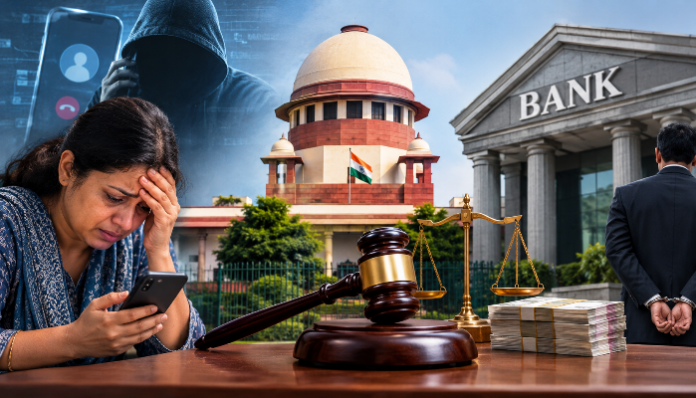
On 29th October (Friday), the Supreme Court noted that financial institutions are responsible for safeguarding victims of digital fraud, pronouncing that banks must be held liable for their losses. According to the court, victims of crimes like digital arrest scams shall be compensated for at least the amount lost once it is established that the episode was a product of a lack of due diligence by the bank.
The development took place as suo motu proceedings on digital arrest scams were being heard by a bench consisting of Chief Justice of India (CJI) Surya Kant, Justices Joymalya Bagchi, and V Mohana. The lawsuit was submitted by a senior citizen couple after losing ₹1.05 crore to imposters using bogus judicial documents.
It emphasised that in the event that financial institutions are identified to have violated their due diligence obligations, the proposed regulatory framework must provide victims with sufficient compensation. The court directed, “We are proposing to direct that wherever such instances take place, the bank will compensate victim and suffer prosecution. It has to be done.”
The apex court voiced concern over such incidents, conveying, “What we are shocked about – why are people not realising? What is wrong with victims? Are they not normal persons? This is everywhere in the media. What kind of person are you in a democratic country if you think you are getting arrested on mobile? Hit the mobile on the wall, and the arrest goes.”
“We have a strong neighbourhood. We feel frustrated that all educated people are getting duped. What are they afraid of with digital arrest? It’s something wrong with fear psychosis. How are people getting trapped like this? Someone tells you on the mobile that you’re arrested; you agree you’re arrested? In a country like this, how are you becoming victims like this? What will you pass on to the next generation if you become a victim at this age? People can go to the court’s website to find out if there’s an order,” it further remarked.
The court referred to RBI regulations, questioning, “Do they have sufficient teeth to control it? Unless there is a penal direction to these banks, they will never mend their ways.” It also demanded data about dubious transactions that were halted and those that went unreported until the crime was exposed.
The centre informed that the number of reported digital arrest instances had decreased by about 50% in comparison to 2025, crediting joint efforts of public awareness initiatives, government ministries and departments, alongside the court’s intervention for the drop.
However, the court stated that this year’s losses from these crimes had reached ₹800 crore. The RBI was instructed to provide a list of all approved financial institutions by the next hearing date of 30th November. It is going to pass instructions applicable to all entities without necessarily involving specific banks in the legal process.
The bench mandated that state police report on instances of digital arrests and recommend preventative actions. “The reports shall be submitted to the inter-departmental committee. The Directors General of Police of all States and Union Territories are directed to ensure compliance,” it announced.
The court underlined the significance of preventive measures, such as automatic reporting of suspicious behaviour, physical verification to confirm the authenticity of transactions, and temporary suspension of odd transactions that depart from an account holder’s documented transaction pattern. “Report will only be post-mortem. What about prevention? Moment a transaction comes, why can’t it be withheld,” it pushed.
The centre suggested notice by 30th November and operationalisation by 31st December to allow time for technical integration. The court asked for the draft regulations and a list of approved financial institutions, stressing, “The regulation must include a liability clause. Otherwise, we will enforce it through a judicial order.”
The bench also sought details about the financial institutions that would be subject to the revised standards and the steps being undertaken to make amends for the losses incurred by victims. It pressed that banks have a duty to alert nearby police stations of any anomalous transactions involving clients who might be victims of such ploys.
The accountability of banks and the issue of mule accounts, which are commonly used to collect and transmit the proceeds of cybercrime, are two important areas that the court recognised as demanding additional intervention. It also highlighted the relevance of improving due diligence standards and implementing procedures to spot and address unusual transactions.
The court outlined that it would review the RBI’s proposed KYC Amendment Directions, 2026, in order to evaluate the clauses pertaining to victim compensation in cases where financial institutions are deemed to have breached their due diligence responsibilities.
