

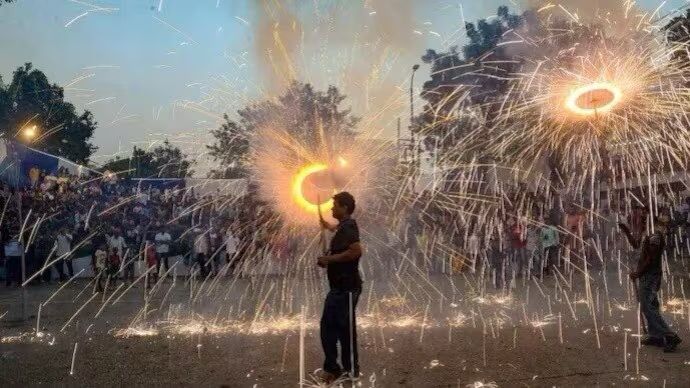
The Supreme Court has reserved its order on the sale and use of firecrackers in Delhi-NCR ahead of Diwali, leaving the fate of this year’s celebrations uncertain. During the hearing, the bench expressed concern over the repeated violation of its directions and called for a fresh approach, questioning the effectiveness of imposing restrictions year after year without ensuring proper enforcement.
A bench of Justices MM Sundresh and PB Varale expressed frustration over the repeated violations of its directions on firecrackers, remarking that court orders were being breached more often than they were being obeyed. The judges suggested it was time to explore “something new and innovative” rather than repeat the same exercise every year.
The bench stressed that tackling pollution requires more than judicial orders. It called for a broader effort to raise awareness, particularly among children and young people, while acknowledging that Diwali is a festival that people want to celebrate.
“We have to send a message here,” Justice Sundresh observed, pointing to the challenge of balancing the expectations of different generations with the need to address pollution. The court indicated that it would pass a balanced order, but questioned whether the directions would actually be implemented.
The government also faced questions over the absence of a compliance report detailing the action taken after the Supreme Court’s previous order on the matter last year.
The judges sought a comprehensive account of enforcement efforts, including the number of teams deployed, inspections conducted, locations visited, dates of inspections and data collected. They also asked for details of the sale of Chinese firecrackers and the action taken against those found selling them.
The court made it clear that restrictions on paper would achieve little without an effective enforcement mechanism. It sought details of prosecutions and other action against violators, with Justice Sundresh observing that the court’s directions appeared to be followed more in breach than in compliance.
The bench also questioned whether a complete ban was necessarily the answer. When Additional Solicitor General Aishwaria Bhati argued that an outright prohibition was not a solution either, the court remarked that Diwali should be enjoyed as a festival of lights.
Instead, the judges floated the idea of making environmental awareness a more integral part of education. They suggested that schools could play a greater role in sensitising children and that prominent personalities, particularly sporting icons such as Virat Kohli, could help spread the message.
The court also indicated that directions to educational authorities could be considered to ensure that children are educated about pollution and responsible celebrations.
With the order now reserved, the question of whether firecrackers will be permitted in Delhi-NCR this Diwali remains unresolved. But the court’s observations point to a wider concern: unless enforcement improves and public awareness grows, the annual legal battle over firecrackers may continue without delivering the intended results.
