

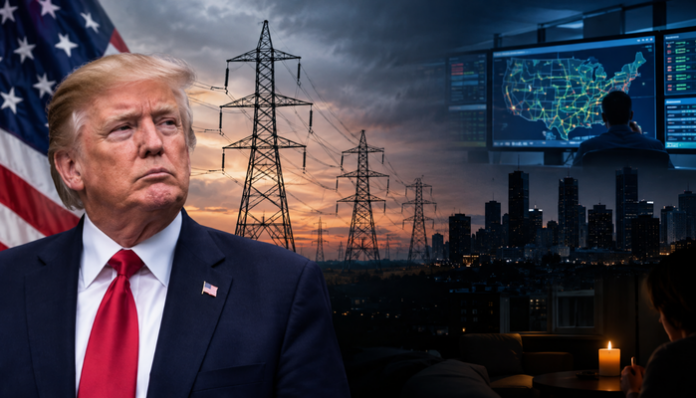
The Trump administration announced a temporary power grid emergency across multiple states earlier this month with the aim of preventing electricity shortages that could cause regional blackouts. The emergency declaration triggered questions as to its causes and the impact in the affected states, particularly because of its timing.
The power grid emergency followed a declaration of national emergency by the US government over the risk posed by foreign-produced equipment in the high-voltage bulk-power system. The two successive declarations point to a possible power grid-related vulnerability that the US government seems to be facing.
The U.S. Department of Energy (DOE) declared a temporary power grid emergency on October 12, 2026, covering 13 states and Washington, D.C. The DOE issued the order under Section 202(c) of the Federal Power Act, allowing certain generating facilities to operate beyond normal restrictions if needed to maintain electricity supplies.
The decision was reportedly meant to prevent electricity shortages that could cause regional blackouts. Energy Secretary Chris Wright granted PJM Interconnection, the regional grid operator serving the Mid-Atlantic and Midwest, temporary emergency authority from October 13 to October 16, 2026. The order came in the wake of rising electricity demand coinciding with scheduled maintenance at power plants and transmission facilities. According to the PJM Interconnection, rising electricity demand and unpredictable weather patterns have led to the unusual measure to ensure grid reliability.
The PJM is the largest grid operator in the US, serving more than 65 million people. Its network covers all or parts of Delaware, Illinois, Indiana, Kentucky, Maryland, Michigan, New Jersey, North Carolina, Ohio, Pennsylvania, Tennessee, Virginia, and West Virginia, as well as Washington, D.C. Under the order, the operator was directed to keep backup generation available and take emergency actions, including directing specific power plants to use additional power generation resources to generate electricity, even by overriding normal environmental restrictions.
This was intended to keep backup generation available to reduce the risk of blackouts during a stretch of unusually warm weather and tight electricity supply. The step was described by the DOE and the PJM officials as a proactive measure to maintain the stability of the grid.
The national emergency declaration
Before the temporary power grid emergency declaration, US President Donald Trump signed an executive order declaring a national emergency. The order was signed on August 26, 2026 declared a national emergency over what his administration described as security threats arising from foreign-made equipment used in the US electricity grid.
The order comes as a result of the US government’s apprehension that the use of foreign-produced equipment in the country’s electricity grid could create cybersecurity, sabotage, unauthorised-access, or supply-chain vulnerabilities. Highlighting the gravity of the vulnerabilities, the order said that the need for uninterrupted and reliable electricity to support critical infrastructure such as AI data centres, advanced manufacturing, and defence production has added to the seriousness of the risk.
“The rapid growth of advanced manufacturing, data centres, artificial intelligence, and defence production has increased the Nation’s dependence on abundant, reliable electricity and magnified the consequences of a successful attack or supply disruption on the bulk-power system,” the order said.
The national emergency order allows the US government to take stricter measures with respect to foreign-made equipment that could pose security risks to the country’s electricity grid. It authorises DOE to stop or impose conditions on the purchase, import, transfer, or installation of covered equipment and associated critical software, firmware, digital services, maintenance services, or remote-access capabilities, in consultation with other agencies.
The US electricity infrastructure has become increasingly reliant on electrical equipment manufactured or supplied by foreign entities, some of which could potentially be linked to governments considered security threats by the United States. This could pose a risk of hostile actors interfering with the functioning of the electricity grid.
The two orders put together explain the wider concerns of the US surrounding US grid reliability and the government’s proactive approach in addressing them.
