

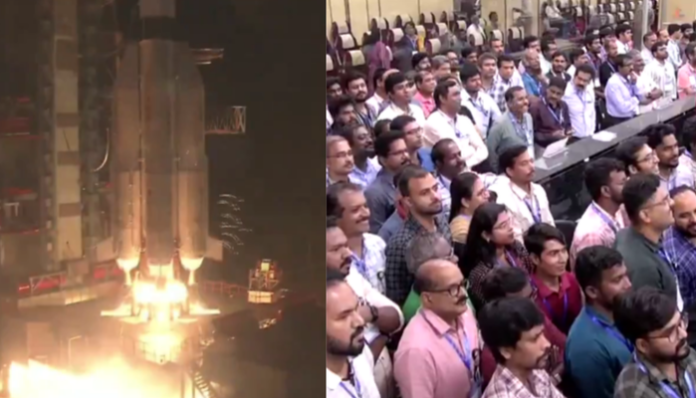
In a major step towards boosting India’s independent satellite navigation system, the Indian Space Research Organisation (ISRO) has successfully launched its next-generation navigation satellite NVS-03 aboard the GSLV-F18 rocket on Friday (October 30, 2026). The satellite was launched at 11:51 pm on Friday from the Second Launch Pad at the Satish Dhawan Space Centre in Sriharikota, Andhra Pradesh.
The 50-metre-tall, three-stage GSLV-F18 rocket successfully deployed the 2,232-kg NVS-03 satellite in its intended Geosynchronous Transfer Orbit (GTO) around 20 minutes after its lift-off. After its deployment, the satellite will undertake orbit-raising manoeuvres to reach its designated geosynchronous slot at 32.5 degrees East.
Announcing the successful launch of NVS-03, ISRO Chairman V Narayanan said that the success has pushed India closer to the goal of “One Nation, One Time”.
🚨 Liftoff of GSLV-F18 carrying NVS-03 at 11:51 PM IST from Second Launch Pad, SHAR! ISRO’s rescue mission for NavIC is now underway 🚀 #ISRO | #GSLVF18 https://t.co/MizXSaUe4R
— ISRO Spaceflight (@ISROSpaceflight) October 30, 2026
The NVS-03 satellite is designed to elevate India’s positioning, navigation, and timing (PNT) capabilities. The achievement is significant, especially after the setback India’s indigenous GPS alternative, NavIC, suffered in January this year when the NVS-02 satellite failed to reach its designated operational orbit after being successfully placed into GTO aboard GSLV-F15. The failure contributed to the postponement of planned launches of NVS-03, NVS-04 and NVS-05.
This was followed by another failure when the final atomic clock aboard the IRNSS-1F satellite stopped functioning in March. The IRNSS-1F was one of the four operational satellites providing Position, Navigation and Timing (PNT) services in NavIC. It was part of the IRNSS (Indian Regional Navigation Satellite System) series of first-generation satellites.
NVS-03 is the third satellite in the NVS series, India’s second-generation fleet of navigation satellites developed by ISRO. With an indigenous atomic clock alongside procured atomic clocks fitted inside it, the satellite is intended to augment NavIC and ensure continuity of navigation services. The successful launch of NVS-03 has restored the operational capacity of the NavIC constellation, which was obstructed by the failure of the NVS-02 and IRNSS-1F satellites.
#WATCH | GSLV -F18 rocket has successfully injected the NVS-03 satellite in orbit. GSLV-F18/NVS-03 Mission accomplished. The GSLV-F18 vehicle placed NVS-03 satellite into a Geosynchronous Transfer Orbit. NVS-03 is the third satellite in next generation navigation satellite system envisaged for providing continuity of navigation services for IRNSS series. The satellite carries Indigenous Atomic clock, along with the procured Atomic clocks. It also includes L1 signal in addition to existing L5/S signals with Coverage over India land mass and a region extending 1500 km around Indian geopolitical boundary. (Video: ISRO)
— ANI (@ANI) October 30, 2026
This is a major feat for India, which is working to strengthen its independent positioning, navigation and timing capabilities through NavIC, India’s indigenous alternative to the GPS. India aims to become self-reliant with respect to satellite-based navigation technology, which has become critical for operations across civilian, commercial and strategic sectors.
NavIC is an autonomous, indigenous satellite navigation system developed by the Indian Space Research Organisation (ISRO). It is designed to provide accurate Positioning, Navigation, and Timing (PNT) services over India and a surrounding region extending up to 1,500 km beyond its borders. It operates as a constellation of satellites in Geostationary and Geosynchronous orbits, providing two primary services: an open Standard Positioning Service (SPS) for civilian applications like mobile navigation, fleet tracking, and disaster management, and a secure, encrypted Restricted Service (RS) for strategic and military operations.
