

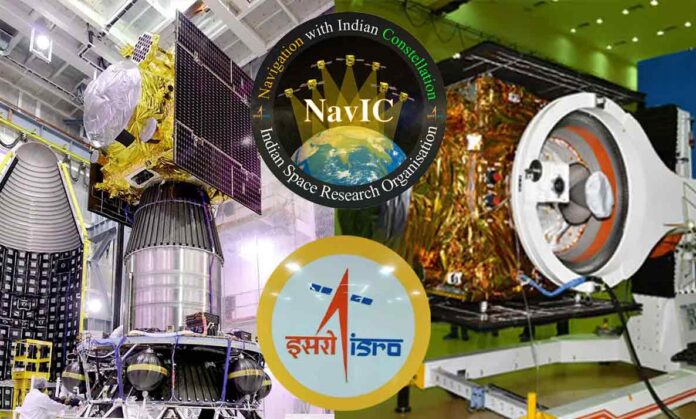
In a significant blow to India’s efforts to achieve navigational self-reliance, the Indian Space Research Organisation (ISRO) has confirmed that the final atomic clock aboard the IRNSS-1F satellite stopped functioning on March 13, 2026, just three days after the satellite completed its 10-year design life.
The failure means IRNSS-1F, one of the four operational satellites providing Position, Navigation and Timing (PNT) services, can no longer support precise navigation. It will now be repurposed solely for one-way broadcast messaging services. With only three satellites remaining fully capable of PNT operations, the Navigation with Indian Constellation (NavIC) system, India’s indigenous alternative to GPS, has dropped below the minimum threshold of four satellites required for reliable regional coverage.
In an official statement issued on Friday, ISRO said, “IRNSS-1F satellite launched in March 2016 has completed its design mission life of 10 years on 10th March 2026. On 13th March 2026, the procured on-board atomic clock stopped functioning. However, the satellite will continue to function in-orbit for various societal applications to provide one way broadcast messaging services.”
IRNSS-1F had already lost two of its three rubidium atomic clocks years earlier and was operating on its final backup. The clocks, critical for measuring signal travel time from satellite to receiver, are the heart of any satellite navigation system, even tiny errors can distort position data by hundreds of kilometres.
This latest failure increases the total number of NavIC satellites that became non-operational for navigation to 8 out of 11 launched since 2013. Most of the satellites failed due to premature atomic clock malfunctions traced to imported rubidium clocks procured early in the programme. Five earlier satellites (IRNSS-1A, 1C, 1D, 1E and 1G) suffered complete clock failures.
In July last year, the govt informed the parliament that out of 11 satellites launched, 4 were providing Position, Navigation & Timing (PNT) services. 4 other satellites were being used for one-way message broadcast after clock failure, 1 satellite got decommissioned after its end-of-life service, and 2 satellites could not reach the intended orbit.
Prior to the IRNSS-1F breakdown, only four satellites — IRNSS-1B, IRNSS-1F, IRNSS-1I and NVS-01 — were providing full PNT services. Even with four functional satellites, the constellation was already critically depleted, with several satellites operating beyond their planned lifespan or in sub-optimal condition.
Space department sources told the media that “location services provided by the NavIC system in India are going to be affected.” The system supports key applications including real-time train tracking, disaster management, fisheries, and military operations. Defence planners had long viewed NavIC as vital for strategic autonomy following the 1999 Kargil conflict, when India was denied access to American GPS data.
Even with four satellites, basic navigation was possible, but the current count of three leaves large gaps in coverage and reliability, especially over India’s vast territory and surrounding region.
The setback comes amid broader challenges for the programme. Development of fully indigenous atomic clocks has faced delays due to component procurement issues, slowing the rollout of second-generation NVS-series satellites. NVS-02, launched in January 2025, failed to reach its intended orbit, and planned launches of NVS-03, NVS-04 and NVS-05 have been postponed following recent PSLV launch anomalies.
ISRO is working to augment the constellation with newer satellites featuring improved indigenous clocks and additional signals in L1, L5 and S bands for better accuracy and interoperability.
