

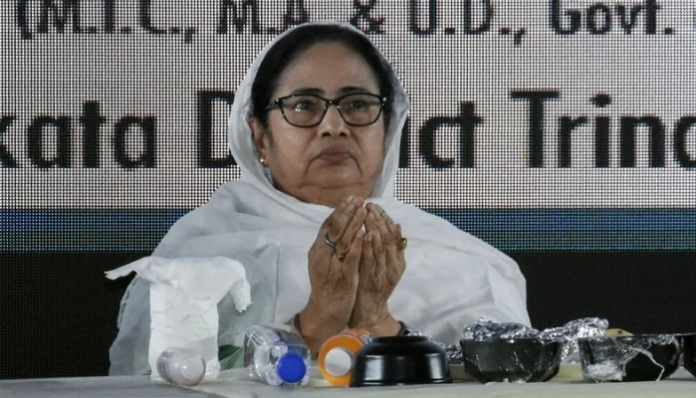
Former West Bengal Chief Minister and Trinamool Congress (TMC) supremo Mamata Banerjee has once again invoked the contentious “Kafir” rhetoric, months after a similar polarising pitch failed to save her party from a decisive defeat in the 2026 West Bengal Assembly elections.
On Sunday, 1 November, speaking at the opposition INDIA alliance’s rally at Ramlila Maidan in the national capital. Banerjee once again proved her Hindu hate and love for Muslims by saying the phrase kafir.
She said, “Jo marte hai vo darte hai; jo kaafir hai vo har roj darte hai.” (Translation: Those who die are the ones who fear; the Kafir {derogatory term for Hindus} live in fear every single day.”)
The remark marks a striking repetition of a political idiom that defined her campaign in the run-up to the 2026 Bengal polls, which ended TMC’s reign in West Bengal.
During the campaign for the 2024 Assembly elections, Banerjee and the TMC deliberately used divisive Muslim terminology, including the “Kafir” framing, to consolidate Muslim votes.
During TMC’s ‘Martyr’s Day’ event in July 2024, Banerjee said: “Jo darte hai wo marte hai, Jo ladte hai wo Kamyab hote hai, hum darpok nhi hai, hum kafir nhi hai, hum gaddar nhi hai.” (Translation – Those who get scared end up losing, while those who put up a fight achieve victory; we are not cowards, we are not kafir.)
The electorate’s response was unequivocal. When the results were declared on 4 May 2026, the Bharatiya Janata Party (BJP) stormed to power with a sweeping majority. BJP won 207 of the 293 seats that were up for grabs. The TMC was reduced to just 80 seats, ending its 15-year rule in the state.
The personal blow for Banerjee was equally severe. In her traditional stronghold of Bhabanipur, she was defeated by her former aide-turned-BJP rival, Suvendu Adhikari, by a margin of 15,105 votes. The loss in the constituency she had long treated as a pocket borough became the defining image of the TMC’s collapse. Adhikari, who had previously unseated her in Nandigram in 2021, described the verdict as a rejection of “the politics of intimidation”.
