

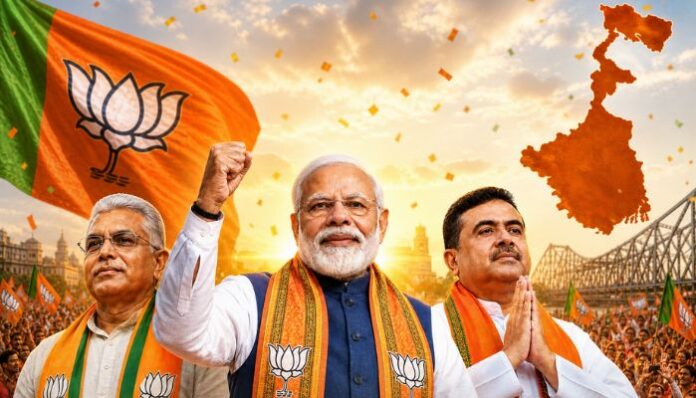
4th May 2026 will go down in history as one of the defining moments in India’s electoral history. The corrupt Pishi-Bhaipo regime of Mamata Banerjee and Abhishek Banerjee finally ran its course. The Bharatiya Janata Party (BJP) overcame one of its last remaining frontiers by winning the West Bengal election with a large mandate.
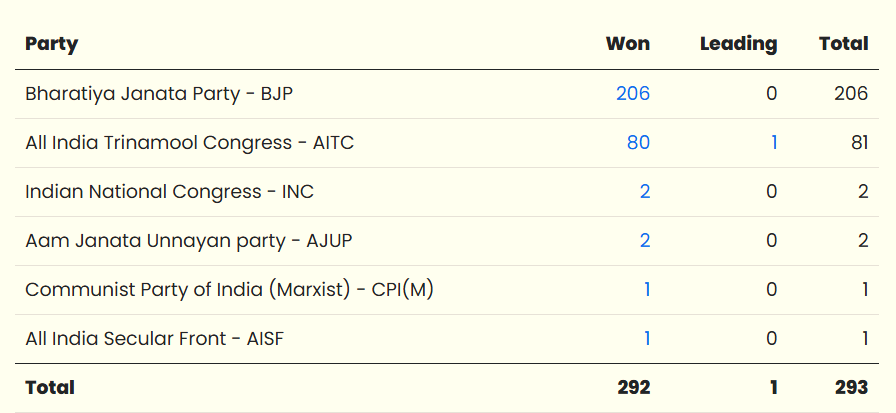
As I glance at the website of the Election Commission of India (ECI), I still find myself in a state of disbelief. The BJP won a whopping 206 constituencies out of 293, and TMC was relegated to just 81 seats. To my personal delight, Mamata Banerjee lost from her Bhabanipur constituency. A decade ago, such a sight was unimaginable and practically impossible.
While it is true that no one is invincible in politics and that the downfall of the TMC was inevitable at some point, the meteoric rise of the BJP from 0 seats in 2011 to winning the 2026 Vidhan Sabha election tells a different story. It did not happen by sheer chance. The party was built brick by brick by its State Presidents and its cadres in the past 15 years.
In the 2000s, the BJP’s political performance in West Bengal was dismal. The party secured only 2 seats in the 2001 Vidhan Sabha election and none in the 2006 election. BJP also fared poorly in the national elections in the State. It secured 0 seats in the 2004 Lok Sabha election and managed to win 1 seat during the crucial 2009 election in Bengal.
The same year, Rahul Sinha was appointed the President of the West Bengal unit of the BJP. He steered the party during the Mamata wave of 2011. BJP was again left with 0 seats during the Vidhan Sabha election. The ascent of PM Narendra Modi to the power corridors of Delhi in 2014 left a mark on the State as well. Under the leadership of Rahul Sinha, the BJP was able to raise its vote share in Bengal from 6.15% to 16.84%, but could increase its seat count to only 2.
The massive foundational change began later that year when RSS ideologue Dilip Ghosh was roped into the BJP and made the General Secretary of the West Bengal unit. He had a distinct personality, which made him stand out immediately.
Ghosh was a match for Mamata’s aggressive style of politics. He was outspoken, cared little about political correctness and dared to look the TMC into the eye. His IDGAF attitude instilled confidence into the demoralised party cadre. Ghosh was rewarded soon with the leadership of the West Bengal BJP in 2015.
He led the party during the 2016 West Bengal Vidhan Sabha election. For the first time in the BJP’s electoral history in the State, the party won 3 seats. It was certainly not up to the mark, but the foundation was set. And the results spoke for themselves in the 2019 Lok Sabha election.
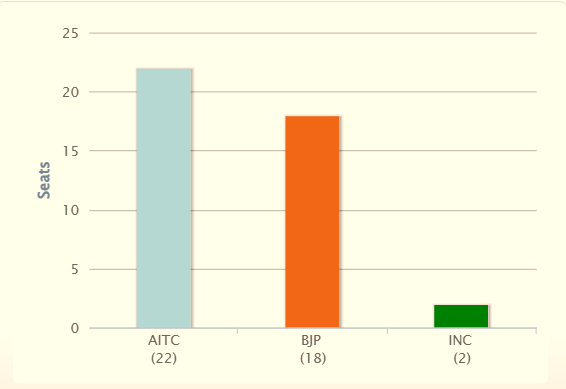
The party’s seat tally went from 2 in 2014 to 18 in 2018. At the same time, the BJP was able to clinch a whopping 40.6% of the vote share. It was an unprecedented swing in the mood of the voters. The message was clear: The party is in the right direction. In the run-up to the 2021 Vidhan Sabha election, many were convinced that it was the end of the TMC raj.
But many were shocked at the results. While the BJP was able to increase its seat count from 3 to 77, it fell short of the majority mark by 71 seats. The central leadership felt that a change was needed to take the fight to the next level. It was then that a two-pronged strategy was used.
Suvendu Adhikari was made the Leader of the Opposition in the West Bengal Vidhan Sabha. He had a calm, strategic demeanour with unmatched popularity, so much so that he defeated Mamata Banerjee in the crucial seat of Nandigram. At the same time, Sukanta Majumdar (who also had an aggressive style like Dilip Ghosh) was roped in as the BJP President.
The party focused on taking the fight against Mamata Banerjee with a missionary zeal. Issues affecting various strata of society, ranging from unemployment to demographic change, were highlighted consistently. Social media was galvanised to create public awareness and develop the movement for change. All of this, coupled with people’s fatigue of the Pishi-Bhaipo regime, created the perfect platform.
4th May 2026 saw Suvendu defeating Mamata Banerjee in her constituency of Nandigram. There should be no doubt in anyone’s mind that his personal popularity played a key role in securing the large mandate. He is likely to be the Chief Ministerial candidate of the BJP as well. And, he deserves all of the fame and applause for making the unthinkable possible.
Suvendu Adhikari took the party to 206 seats, but the foundation was laid by Dilip Ghosh with 40% vote share in the 2019 Lok Sabha and 77 seats in the 2021 Vidhan Sabha election. In our sudden rush to salute the rising sun, we must not forget those who played has played a major role in making the BJP a household name in West Bengal.
‘Bhadroloks’ who were once apprehensive of the BJP due to consistent fearmongering by the TMC regime also saw the good governance of the Modi government in different States of India. The public awakening, the right messaging and the desire to bring glory back to Bengal became the key forces of change. Yesterday’s victory is thus a collective fight of BJP leaders against corruption, appeasement politics and attempts by TMC to erase Hindu culture.


