

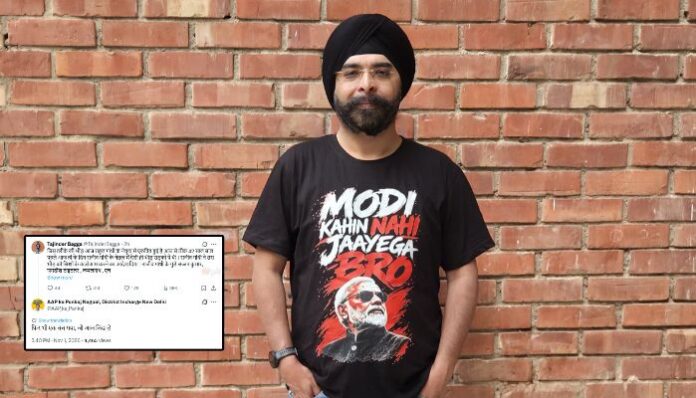
On 1st November, Aam Aadmi Party (AAP) Delhi social media in-charge, Pankaj Nagpal, threatened BJP leader Tajinder Bagga over drawing parallels between events that preceded the 1984 anti-Sikh riots and a Congress MP Rahul Gandhi-led rally in Ramlila Maidan.
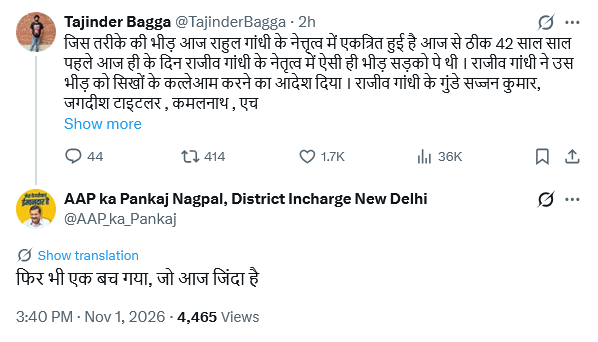
Taking to X, Bagga posted, “The kind of crowd that gathered today under Rahul Gandhi’s leadership had gathered exactly 42 years ago on this very day under Rajiv Gandhi’s leadership—such crowds were on the streets. Rajiv Gandhi ordered that crowd to carry out the massacre of Sikhs. Rajiv Gandhi’s thugs Sajjan Kumar, Jagdish Tytler, Kamal Nath, and H.K.L. Bhagat distributed petrol to the public. For every Sikh killed, a bottle of liquor and a reward of 100 rupees was offered. The police were given clear orders not to stop any killer.”
“The Guru Teg Bahadur Sahib, known as the Shield of India, who sacrificed himself to save the Kashmiri Pandits—for his sacred site, too, the rioters showed no mercy. Kamal Nath set fire to that Gurdwara Rakabganj Sahib. Not only that, all these murderers were rewarded by Rajiv Gandhi with parliamentary seats and ministerial positions,” the BJP leader added.
जिस तरीके की भीड़ आज राहुल गांधी के नेत्तृत्व में एकत्रित हुई है आज से ठीक 42 साल साल पहले आज ही के दिन राजीव गांधी के नेतृत्व में ऐसी ही भीड़ सड़को पे थी । राजीव गांधी ने उस भीड़ को सिखों के कत्लेआम करने का आदेश दिया । राजीव गांधी के गुंडे सज्जन कुमार, जगदीश टाइटलर , कमलनाथ , एच के एल भक्त के द्वारा जनता को पेट्रोल बांटा गया । हर सिख की हत्या करने पे शराब की बोतल और 100 रुपये का इनाम रखा । पुलिस को साफ आदेश था कि किसी भी हत्यारे को रोका ना जाए । जिस गुरु तेग बहादुर साहब को हिंद की चादर कहां जाता है , जिन्होंने कश्मीरी पंडितों को बचाने के लिए अपना बलिदान दे दिया । उस गुरु के पवित्र स्थल को भी दंगाइयों द्वारा बख्शा नहीं गया । कमलनाथ द्वारा उस गुरुद्वारा रकाबगंज साहिब पर आग लगाई गई । इतना ही नहीं इन सभी हत्यारों को राजीव गाँधी द्वारा इनाम के रूप में सांसद और मंत्रिपदों से नवाजा गया ।
— Tajinder Bagga (@TajinderBagga) November 1, 2026
In response to this post, AAP leader Pankaj Nagpal wrote, “Phir bhi ek bach gaya, jo aaj zinda hai [Yet, one survived, who is alive today].”
Highlighting the AAP leader’s remarks, Tajinder Bagga wrote, ” He is AAP’s social media in charge, defending the 1984 killers and wondering why they didn’t kill me too. This is AAP’s sick mindset.”
He is AAP’s social media in charge, defending the 1984 killers and wondering why they didn’t kill me too. This is AAP’s sick mindset. @ArvindKejriwal https://t.co/1QQIuZFzAW
— Tajinder Bagga (@TajinderBagga) November 1, 2026
Congress’ pattern of fomenting chaos
The choice of 1st November for the Congress-led opposition’s demonstration has also become a point of political controversy. Choosing 1st November, the date coinciding with the peak of the 1984 anti-Sikh violence, reflects an ongoing trend. The date for the latest rally proved that the Congress’ pattern of fomenting chaos and unrest remains unchanged, organising political confrontations during a period meant for remembrance of thousands of Sikhs.
The anti-Sikh violence erupted after Prime Minister Indira Gandhi was assassinated by her Sikh bodyguards, Satwant Singh and Beant Singh, on 31st October 1984. From 1st November to 4th November that year, Delhi and other parts of the country witnessed widespread attacks on Sikh families, homes, businesses, and places of worship. The 1984 anti-Sikh riots resulted in the brutal killings of more than 2,800 people, according to official figures cited in subsequent court proceedings, while overall government figures suggest angry mobs brutally murdered 3,350 Sikhs. Unofficial figures claim that around 8,000 to 17,000 Sikhs lost their lives.
Angry mobs, many of which were led by Congress leaders, targeted the community, and Congress leaders Sajjan Kumar and Jagdish Tytler were directly accused of playing a large role in orchestrating the 1984 anti-Sikh riots in India.
However, Congress had tried to justify the riots. On 19th November, 1984, while giving a speech in front of thousands of people, then-Prime Minister Rajiv Gandhi said, “Jab bhi koi bada ped girta hai, to dharti thodi hilti hai” (“When a big tree falls, the earth shakes”), a remark that remains a controversial chapter in the history of the 1984 massacre.
