

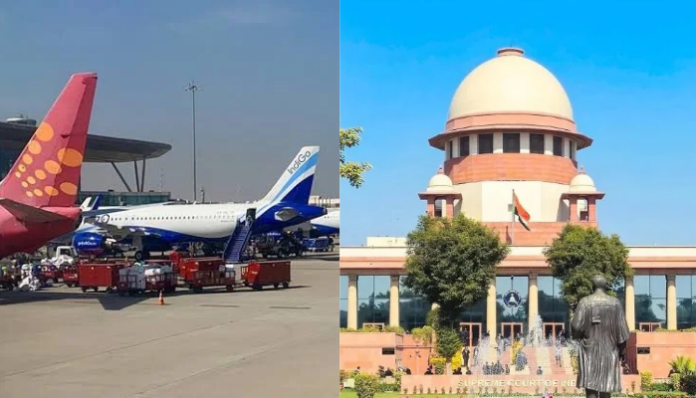
On Monday, 2 November, A Supreme Court bench led by Justice Vikram Nath declined to engage with a plea concerning exorbitant airfares, telling counsel that those aggrieved could avoid air travel.
During the hearing, counsel for the petitioner submitted that airfares had increased by 700% and argued that air travel is an essential service. The counsel also contended that the alleged fare hike amounted to a violation of Article 14 of the Constitution, which guarantees equality before the law and equal protection of the laws.
Justice Vikram Nath’s response was brief: “Don’t travel by air. Next case.”
Plea regarding extremely high airfares mentioned before #SupremeCourt Counsel: The airfares have increased to 700%. It is an essential service. Violation of Article 14. J Vikram Nath: Don’t travel by air. Next case. https://t.co/k7DyXtrZiM
— Live Law (@LiveLawIndia) November 2, 2026
The exchange, highlighted in a social media post with the hashtag #SupremeCourt, indicated that the bench was not inclined to entertain the submission at that stage and moved on to the next matter.
The short remark drew attention to the broader debate over airfare regulation in India, particularly during periods of high demand and festivals. While the counsel sought to frame the issue as one involving an essential service and constitutional equality, the bench did not appear to accept that framing for urgent intervention.
The incident also sparked discussion about judicial responses to public-interest pleas on consumer pricing and whether courts should examine airline pricing practices. However, Monday’s exchange was limited to the oral submission and the bench’s brief response.
The matter was not seen in the terms of urgency, and the bench proceeded to the next case. No further details about the petition or any future listing were available from the exchange.
The exchange underscores a broader perception that the court is increasingly inaccessible to ordinary litigants. While the judge’s comment may have been intended to suggest that air travel is a luxury, the counsel’s point remains unaddressed that aviation is an essential service in a vast country like India.
The dismissal without a reasoned order leaves passengers with little recourse against what many see as exploitative pricing. As one social media user put it, “If the Supreme Court won’t listen to public problems, who will?” The incident has reignited debates over judicial empathy and the court’s role in protecting constitutional rights against arbitrary commercial practices.
