

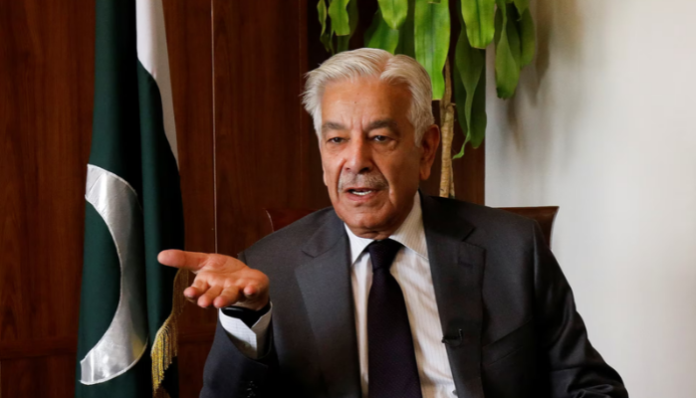
Pakistan’s Defence Minister Khawaja Asif has acknowledged that the military establishment is deeply involved in the country’s governance, foreign policy formulation, diplomatic engagement and key government decisions. His remarks have renewed attention on Pakistan’s so-called hybrid governance model, under which civilian and military authorities share power, with the military exercising considerable influence over major national matters.
In a September 2025 interview with Mehdi Hasan, Asif was pressed on the power dynamic between the civilian government and the military. When asked whether the military leaders are “really the ones in charge” and whether Army Chief Field Marshal Asim Munir is more powerful than him, Asif rejected the framing but conceded that the arrangement is not one of equal power-sharing.
“It’s not equal… We can agree to disagree. It is by consensus, whatever is taking place,” Asif said, describing the decision-making process as one based on consensus rather than civilian supremacy.
Khawaja Asif defended the system as a “hybrid model,” maintaining that the military and civilian leadership operate through consensus in foreign policy matters. He acknowledged that the decision-making arrangement is “not necessarily based on equal power-sharing”.
BIG ADMISSION: Pakistan’s Defence Minister Khawaja Asif says the military runs foreign policy, handles diplomatic engagements & shares power with the civilian govt. Hybrid model of governance under the spotlight amid Army Chief Field Marshal Asim Munir’s expanding influence. Report by @manojkumargupta https://t.co/WqvaqaqpUo #Pakistan #KhawajaAsif #AsimMunir #PakistanMilitary #HybridGovernance #ForeignPolicy
— News18 (@CNNnews18) November 2, 2026
Asif’s remarks are significant given the growing scrutiny of Field Marshal Munir’s expanding influence over Pakistan’s political and institutional landscape. While Pakistan has an elected government headed by Prime Minister Shehbaz Sharif, the military has historically exercised considerable influence over security priorities, relations with neighbouring countries, and broader foreign policy direction.
Pakistan’s military has directly ruled the country for extended periods since independence in 1947. Even under civilian administrations, the establishment has traditionally retained significant sway over defence and foreign affairs, particularly relations with India, Afghanistan, China, and the United States.
These latest remarks take on added significance in light of Asif’s earlier disclosures about former Army Chief General Qamar Javed Bajwa’s attempt to secure another extension in November 2022.
In August 2024, Asif claimed that Bajwa had sought a six-month to one-year extension, ostensibly to resolve the political deadlock at the time, and further alleged that the former army chief had threatened to impose martial law if necessary. Asif’s account was disputed by Punjab Assembly Speaker Malik Muhammad Ahmed Khan, who said Bajwa had not expressed any desire for another extension.
