

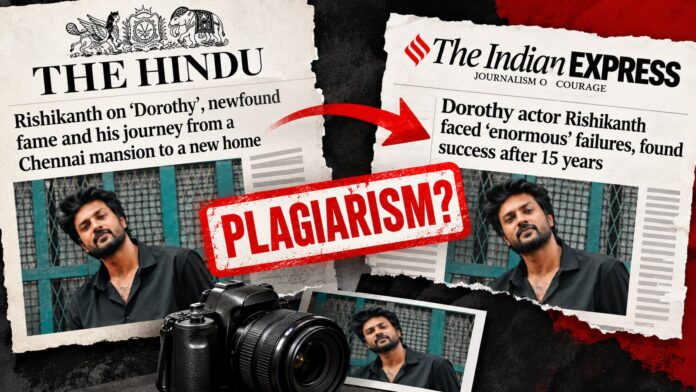
A fresh controversy over journalistic ethics has erupted after The Hindu publicly called out The Indian Express for reproducing substantial portions of its exclusive interview with Tamil actor Rishikanth, reworking parts of the original story and using an accompanying photograph without permission or attribution.
In a strongly worded statement posted on X, The Hindu accused The Indian Express of appropriating its original reporting and photography, questioning the latter’s disregard for basic journalistic standards.
The @IndianExpress has reproduced and reworked substantial portions of an exclusive interview with actor Rishikanth, conducted by The Hindu’s @srinivasjam at our Chennai office. It has also used a photograph from the accompanying photoshoot by our photographer, @thamodharran, without permission or credit. Quoting an exclusive interview is standard journalistic practice. Reproducing virtually an entire story, even with portions reworded, is not. We find this disregard for original reporting and photography deeply disappointing. Credit where it is due is a basic tenet of journalism. https://t.co/9yRtsM8XYG
— The Hindu (@the_hindu) November 5, 2026
The controversy centres on an exclusive interview with Rishikanth conducted by The Hindu journalist Srinivasa Ramanujam at the newspaper’s Chennai office. The interview, which explored the actor’s 15-year struggle in the film industry, his newfound recognition following the success of Dorothy and Modha Rathri, and his journey towards finding a new home, was subsequently published by The Hindu.
However, The Hindu alleged that The Indian Express reproduced and reworked substantial portions of the interview in its own article, published under the headline, ‘Dorothy actor Rishikanth faced enormous failures, found success after 15 years’.
The Hindu also alleged that The Indian Express used a photograph of the actor taken during the accompanying photoshoot by its photographer, Thamodharan B, without seeking permission or providing any credit.
Taking strong exception to the copying, The Hindu clarified that quoting an exclusive interview is an accepted journalistic practice, but reproducing virtually an entire story, even after rewording portions of it, crosses the line.
“Quoting an exclusive interview is standard journalistic practice. Reproducing virtually an entire story, even with portions reworded, is not,” the newspaper said.
It further expressed disappointment over what it described as a disregard for original reporting and photography, reiterating that acknowledging the work of the original journalist and photographer is a fundamental principle of journalism.
“We find this disregard for original reporting and photography deeply disappointing. Credit where it is due is a basic tenet of journalism,” the statement added.
The public criticism has brought the issue of plagiarism, attribution and journalistic accountability into focus, particularly when competing publications report on the same interview or exclusive material.
While newspapers routinely quote one another and build on previously reported information, there is an important distinction between citing an interview and reproducing substantial portions of another publication’s original work without appropriate acknowledgement.
In this instance, The Hindu has specifically objected to both the reproduction of its interview-based reporting and the unauthorised use of its photographer’s work.
The episode raises questions about editorial oversight and the standards that established news organisations are expected to uphold when using reporting and photographs produced by rival publications.
