Home Blog Page 7077

PM Modi’s Ujjwala scheme provides 5 crore LPG connections to the poor, eight months ahead of schedule

0

The Ujjwala scheme which is considered a pet project of Prime Minister Narendra Modi has provided free LPG connections to 5 crore poor households eight months ahead of schedule, Times of India has reported.

The Pradhan Mantri Ujjwala Yojana which was launched on 1 May 2016, aimed at safeguarding the health of women & children by providing them with cleaner LPG fuel for cooking, thereby replacing polluting fuel sources like wood and coal.

Following the launch and armed with a Rs 8000 crore budget, a target was set to provide free LPG connections to 5 crore poor households by 31 March 2019. These beneficiaries were identified on the basis of the Socio-Economic Caste Consensus (SECC).

Now according to the TOI report, this milestone has been achieved eight months ahead of schedule and in celebration of that, Lok Sabha speaker Sumitra Mahajan would hand over the 5th Crore connection to a selected beneficiary, at an event at the parliament.

The Ujjwala scheme was also in the news when it was hailed by the World Health Organisation (WHO) for being instrumental in curbing air pollution.

Now following the early completion of the 5 crore target, the Modi government has set another milestone to provide the free LPG connections to 8 crore poor households by 2020. It has been estimated that out of 24 crore Indian households, 10 crore households still continue to be deprived of LPG connections.

Rebel AAP MLAs declare independence from central leadership: Form autonomous Punjab unit

0

The rebellion in the Aam Aadmi Party (AAP) does not seem to be ending at any time soon. AAP leaders led by Sukhpal Singh Khaira, who was recently removed as the Leader of Opposition in Punjab Assembly, have reportedly declared the party’s Punjab unit as autonomous and also dissolved its current organisational structure.

After Khaira’s meeting with senior AAP leader Manish Sisodia did not yield any positive results, Khaira, along with other leaders organised a convention where seven AAP MLAs along with Khaira reportedly passed a resolution proclaiming the autonomy from the Delhi leadership. Khaira has given a week’s time to the leadership in Delhi to further reconsider the decision to remove him from the post of Leader of Opposition in Punjab Assembly.

AAP Punjab currently has 20 MLAs, out of which 8 MLAs are said to be with Khaira. AAP had summoned all the MLAs to indicate that there is no support for the Khaira faction, but only 11 MLAs are said to have attended the meeting.

The party has termed the disgruntled MLAs as “misguided” and hoped that they will fall in party line in the future to strengthen the party. The state co-president said that holding any convention in the name of the AAP without consulting the party will be illegal.

The convention also protested against the decision to remove Khaira as Leader of Opposition and termed it as “undemocratic way” and rejected Cheema’s appointment. Khaira also slammed AAP supremo Arvind Kejriwal and senior leader Sisodia for trying to control the state from Delhi. He said, “Punjab cannot be run by remote control.”. Khaira said he does not accept the “dictatorial” approach adopted by the “subedars”.

It is reported that the rebel group, consisting of leaders like Kanwar Sandhu from Kharar, Nazar Singh Mansahia from Mansa, Kulwant Singh Mehal Kalan, Baldev Singh from Jaitu, Pirmal Singh from Bhadaur, Jagdev Singh Kamalu from Maur and Jagtar Singh Jagga from Raipur along with Khaira are likely to travel across the state, starting from the Golden Temple, Amritsar.

Maharashtra local body polls: BJP registers success in Jalgaon, leads in Congress bastion Sangli

0

The Bharatiya Janata Party in Maharashtra has registered significant success in the local body polls held in Jalgaon and Sangli-Miraj-Kupwad municipal corporations. According to reports, out of 75 seats in the Jalgaon Municipal Corporation, BJP has won 57, while out of 78 seats in the Sangli-Miraj-Kupwad Municipal corporation poll, BJP is leading in 39 wards and Congress-NCP alliance is leading in 28 seats so far. Shivsena has failed lead in even a single seat.

While BJP was already in power in Jalgaon, Sangli-Miraj-Kupwad has long been considered a Congress fortress. The BJP and Shivsena had a pre-poll understanding in Jalgaon, but the Sangli, BJP had decided to go alone. In this, the significant lead in Sangli is being hailed as a mark of success of Devendra Fadnavis’ leadership in Maharashtra.

Sangli-Miraj-Kupwad municipal corporation was under Congress leadership. Congress reportedly had 41 seats in the 78 ward corporation while Sharad Pawar’s NCP had 19. The BJP had no representation. Congress and NCP had declared an alliance before the polls here. Sangli is native turf for NCP leader Jayant Patil and Congress’ Viswajit Kadam.

BJP had won the Sangli Lok Sabha seat in 2014 and has won 4 assembly seats here. Since then the party was trying to make inroads in the local civic bodies.

In Jalgaon, BJP had 15 members and was in power with the support of local outfits and independent corporators. BJP leaders Eknath Khadse Girish Mahajan hail from here and it is considered as a BJP stronghold. Now with 57 wards comfortably under its belt, the BJP is far ahead of the Shiv Sena which has only 15 wards.

Amidst the chaos of the Maratha agitation and other issues, there was a strong speculation coming from many media outlets that the BJP has been losing grounds on local levels. But with a strong performance in local civic body polls, it looks like BJP is still winning the favour of the people.

Both the Municipal Corporations had a total voter population of 7,89,251. While Sangli saw a 62% voter turnout, Jalgaon had 55%. A total of 754 candidates, 303 in Jalgaon and 451 in Sangli were contesting in the elections.

WHO report praises Swachh Bharat Mission Gramin, 89% rural sanitation achieved so far

0

The World Health Organisation is to release a report today listing out the progress and impact of the Swachh Bharat Grameen mission started by PM Narendra Modi. According to a report in Economic Times, the WHO report is likely to mention that the Swachh Bharat Grameen mission has been able to prevent over 3 lakh deaths due to sanitation-related infectious diseases during 2014 and 2018.


The positive impact on an overall reduction in deaths due to sanitation-related diseases like diarrhoea and protein-energy malnutrition is being attributed to a drastic decrease in open defecation in villages of the country and the phenomenal increase in the number of households with toilets. WHO has reportedly analysed rural health and sanitation data and the health impacts of the Swachh Bharat Grameen mission.

The WHO report also reportedly includes data on the number of deaths over the years due to diarrhoea and protein-energy malnutrition and the decrease in numbers after an increase in household access to toilets in rural India.

According to the latest data in the website of Swachh Bharat Mission -Grameen, there has been a total of 798.61 lakh toilets built across the country since 2nd October 2014. These numbers include the 96,17,501 toilets built in the 2018-19 financial year alone so far. The website, which updates on a real-time basis, also says that a total of 421 districts in the country have declared themselves to be open defecation free (ODF). 4,09,904 villages and 1,81,174 panchayats have declared themselves ODF so far.

19 states and Union Territories have declared themselves ODF so far. According to the WHO report, rural sanitation in India has gone to 89.07% from a mere 45% in 2014. Previously, the state of Uttar Pradesh had registered the highest growth in the number of toilets built in 2017. With the continued pace, the state is now aiming to achieve the ODF status a year ahead of the national target of 2nd October 2019.

According to the data in the Swachh Bharat Grameen website, 2 states, namely Odisha and Bihar are yet to achieve 75% rural sanitation level.

Modi government gave the Economy just what the doctor ordered: Tough structural reforms

0

By the end of UPA government’s tenure in 2014, gross fiscal mismanagement and “policy paralysis” had left Indian economy in the doldrums. Reckless bank lending had created a mountain of bad loans, GDP growth had fallen below 5%, inflation had crossed 6%, current account deficit had crossed 5% of GDP and food inflation had crossed 10%.

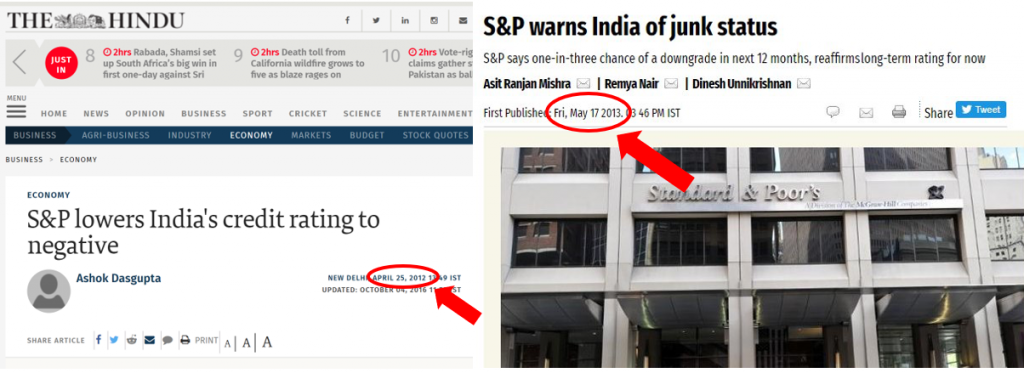
In 2012, S&P lowered India’s credit rating to negative. In 2013, they warned about another possible downgrade to “junk” status and Morgan Stanley included India in the Fragile 5 economies.

Source: The Hindu and livemint

Since coming to power in 2014, Modi government has introduced a series of structural reforms that have helped to curb government expenditure, increase revenue and brought down fiscal deficit year after year.

Deregulating diesel prices

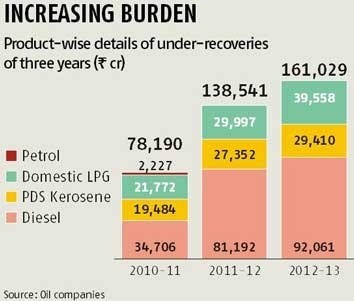
  • As of 2013, Indian Government was subsidizing oil companies to the tune of INR 92,000 crore (INR 920 billion) every year for diesel alone and the amount was expected to cross INR 1,50,000 crores (INR 1.5 trillion) and beyond in coming years
  • Since the roll-out of Diesel prices deregulation by the NDA government in 2014, diesel consumers are required to pay the market price to oil companies. This freed up the funds that government was shelling out in subsidies.
Data Source: Business-Standard
  • Bringing down such government subsidies played a key role in controlling the expenditure and reducing the fiscal deficit

Aadhaar linking and Direct Benefits Transfer to bank accounts

  • It was common for a big part of government benefits and subsidies to be gobbled up by middlemen instead of reaching the actual beneficiaries of such schemes
  • Aadhaar linking and Direct Benefits Transfer to bank accounts has helped arrest the revenue leakage to ghost accounts. 130,000 fake teachers (drawing government salaries), 3.5 crore LPG connections (using government subsidy) and 1.6 crore fake ration cards were discovered
  • Resultant savings amount to Rs. 65,000 crores (INR 650 billion) every year
  • According to a World Bank report of 2016, Aadhaar linkage could potentially help save $11 billion annually for the Indian government by reducing corruption and plugging leakages

Insolvency and Bankruptcy Code (IBC)

  • For long, Industrialists could borrow as much as they wanted from banks and default without any impact. By 2014, UPA government had left Banks crippled with bad loans worth INR 10 lakh crores ($150 billion). Lack of capital had choked India’s credit and industrial growth
  • As explained in this article in detail, Insolvency and Bankruptcy Code (IBC) was passed in May 2016, which created a one-stop solution for resolving the insolvencies and bringing the capital back into the system
  • Since then, IBC has been cracking on all major NPAs. Resolution of Bhushan Steel case brought INR 35000 crore back into the system and Electrosteel brought another INR 5000 crore. Recently, in yet another success Jyoti Structures was ordered liquidation which will bring back more capital for the lender.
  • Due to the fear of IBC, thousands of smaller accounts have cleared their dues which has resulted in another INR 83,000 crore coming back into the banks
  • With many more large accounts set to be addressed in 2018 and 2019, a significant part of the capital lost in the form of bad loans are successfully returning to the banks and making funds available to spur the credit growth

Goods and Services Tax (GST):

  • Extolled as India’s largest tax reform since independence, Congress had struggled for more than 10 years to roll out GST. The reform was stuck due to revenue concerns raised by many states including Maharashtra (Congress ruled), Tamilnadu (non-BJP), Odisha (non-BJP), Kerala (non-BJP) and few other states
  • GST bill proposed by Modi government effectively ensured that no states would lose revenue under the new tax regime, which cleared the way for roll-out by July 2017
  • GST with a tagline of “one nation, one tax” has transformed India into a single market and drastically improved the speed of goods transportation across different states
  • It has also increased the formalization of the economy and brought more businesses under the tax net. Since the launch of GST, the number of indirect taxpayers increased by 50%, direct tax collections surged drastically to an all-time high and India’s tax to GDP ratio has improved
  • Financial Times has listed India’s GST rollout as a lesson for India’s neighbours and other developing countries for arresting tax evasion

Ujwal Discom Assurance Yojna (UDAY):

  • For many decades, due to political reasons, State Power Distribution Companies (DISCOMS) had been supplying electricity at low tariffs that are even below the cost. To make the matters worse, unusually high inefficiencies in power distribution had further strained their finances. Consequently, loss-making discoms had piled up a massive load of debt totalling to INR 4.8 trillion (by September 2015)
  • In 2015, NDA government launched UDAY to rescue the country’s ailing discoms with an objective of freeing them from their massive losses and making them operationally viable
  • Under the scheme, states took over (75% of) the debt of their respective discoms which brought down the cost of debt
  • More importantly, and in return for this bailout, the discoms were given target dates (up to 2019) to adopt technology for increasing their efficiency parameters such as reduction in power transmission losses, preventing power theft and faulty metering, installing smart meters and implementing GIS (geographic information system) mapping of loss-making areas. States were also required to ensure that power tariffs were revised regularly
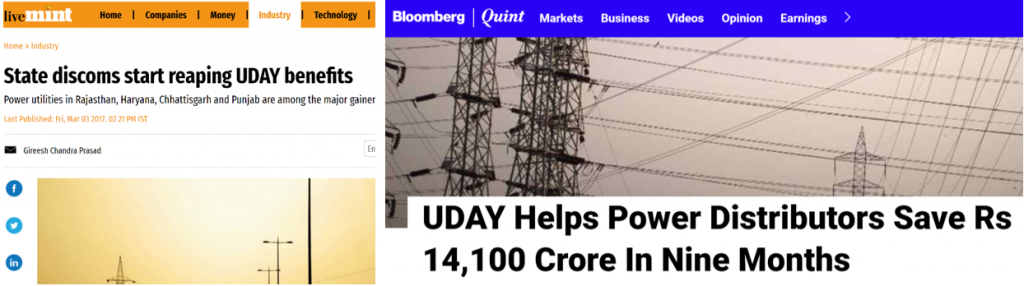
  • Increased efficiency, reduced interest costs and higher revenues have started showing results. Since the launch of UDAY, discoms in Rajasthan, Haryana, Chhattisgarh and Punjab have reported a huge reduction in their interest costs
  • Rajasthan’s interest cost in 2016-17 dropped by half. Chhattisgarh’s projected interest cost in 2016-17 fell to just 19% of previous year. Haryana managed a turnaround and even reported a profit. Discoms reported a cumulative savings of more than INR 14,000 crore (INR 140 billion) by December 2016
  • PwC India has projected that as the demand picks up further (with increasing GDP, increased manufacturing under Make in India, higher electrification coverage and focus on 24×7 power) and the gap between the cost to revenue is bridged, many more discoms will become profitable in the next two to three years
  • Real time progress of this project with each discom level data can be tracked on UDAY Dashboard
Source: livemint& Bloomberg

Impact and Results:

Four years into its tenure, the structural economic reforms implemented by Modi government have systematically helped in controlling government expenditure, arrested revenue leakages in corruption/tax evasion and increased government’s revenue through increased tax base. This has helped reduce fiscal deficit year after year.

  • A recent Forbes report published in May 2018 titled “India’s Disappearing Deficit” mentions –

The Indian government is close to balancing its books for the first time since the Global Financial Crisis of 2007-2009

India’s primary fiscal deficit, which excludes interest payments on the national debt, has fallen from 1.1% of GDP to virtually nothing since Modi and Jaitley took office in May, 2014.

The gross fiscal deficit, which includes interest payments, is down from 4.5% to 3.2%

It would be the fourth consecutive year with a deficit less than 1% of GDP

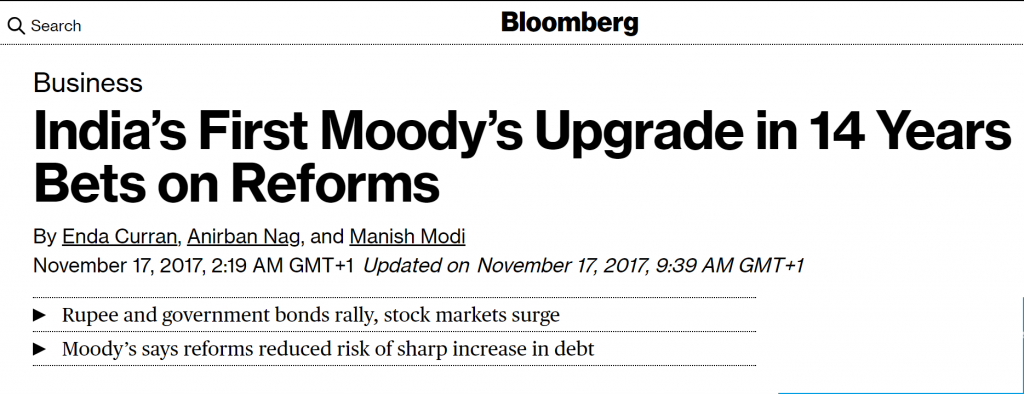
  • Lower Fiscal deficit translates to increased debt repayment ability which reduces India’s cost of external debt. Consequently, in 2017, Moody’s upgraded India’s credit rating. The last upgrade had happened in 2003 during the previous BJP government led by Vajpayee
Source: Bloomberg
  • In January 2018, considering the successful outcomes through IBC and introduction of Bank Recapitalization, CRISIL Ratings agency upgraded India’s Public Sector Banks outlook from “Negative” to “Stable”
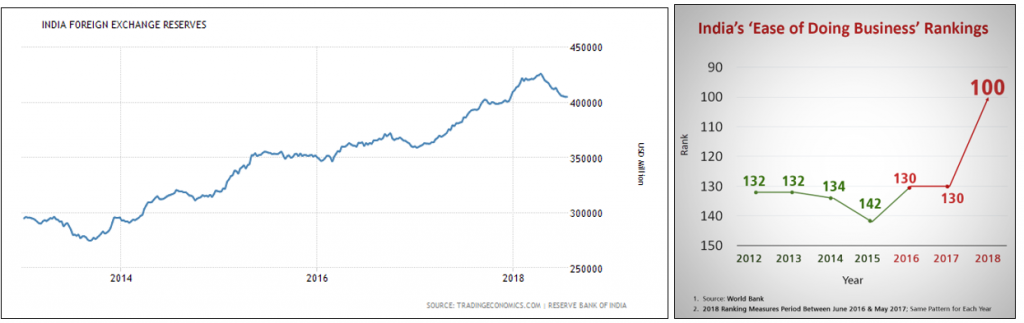
  • From $280 billion in 2014, India’s Foreign Exchange Reserves have consistently increased to reach a comfortable all-time high of $400 billion in 2018
  • In 2017, India’s ranking in World Bank’s Ease of Doing Business improved by 42 places to reach 100. This is the highest improvement in rankings by any country ever and helped India break into Top 100
Source: TradingEconomics and Business Today
  • It must be noted that these rankings are based on data up to May 2017 and hence do not consider the benefits of uniform taxation brought in by GST (rolled out in July 2017). The next release of rankings (expected in Oct 2018) is likely to consider a stabilized GST and many successful insolvency outcomes from IBC. Both these factors are expected to help India improve its ranking even further. Per Finance Minister Mr Arun Jaitley, many more reforms are lined up based on which India could target Top 50 in World Bank’s EoDB ranking. Such improvement in ranking is expected to attract more businesses, bring in more investment, create more jobs and increased prosperity.

From S&P downgrade and Fragile Five in 2013, India’s economy has managed a phenomenal turn-around within 4 years. The above listed structural reforms by the Modi government have addressed many of the systemic issues holding back the economy and unleashed it onto the path of unprecedented growth in future years.

Assam’s neighbouring states on alert to contain infiltration by illegal immigrants

0

Days after the publishing of final draft of the National Register for Citizens (NCR) in Assam, the Northeastern states are jittery about the influx of illegal immigrants pouring into their states. N Biren Singh, Manipur Chief Minister on Thursday said that his government has already taken up precautionary measures covering all approaches into the state. He said that police check posts have been opened at the border areas and police is patrolling the areas frequently. A special check post has also been opened at state capital, Imphal and state and district level committees are formed to screen entry or presence of illegal immigrants.

Indian citizens need to have an inner line permit (ILP) to visit or stay in the state, which borders China, and foreigners need to have a restricted area permit (RAP). Arunachal Pradesh, which borders with China, has started ‘Operation Clean Drive’ across state to assist district authorities to conduct spot verification of people at all entry points along the inter-state boundary. In fact, the All Arunachal Pradesh Students’ Union (AAPSU), apex student body in the state has asked the ‘undocumented immigrants’ to leave the state within 15 days. Last week, the Arunachal government launched a drive in various districts to identify people, who do not have the necessary permits.

Nagaland and Tripura, too, have reportedly taken measures to contain the entry of people from outside the state. Nagaland, like Arunachal Pradesh, also has restricted entry and the government has asked the residents to inform the district and police administration about ‘unusual influx of outsiders’. We had earlier reported how over a thousand alleged illegal immigrants were apprehended while trying to enter Meghalaya from Assam in trucks.

According to the NRC, as many as 40 lakh people among the total of 3.29 crore population of Assam were potential illegal immigrants in India. Opposition parties have perceived it as an opportunity to score one over the BJP and made inflammatory remarks while the Government, and the Army on various occasions, has maintained that illegal immigrants pose a serious threat to the demography and security of the country.

Virat Kohli brings Test Cricket alive by playings a captain’s knock to steer India’s ship to safety

0

Cricket comes in three flavours, catering to three distinct personalities. Twenty20 is for the impatient who seek instant gratification. One Day Internationals (ODI) is for normal people who prefer moderation over either extremes.

Test cricket is for connoisseurs who prefer to read novels over weekends. It is for the philosophical and meditative type. While the viewer has the liberty to choose, the challenge for a cricket player is to adapt and play all these formats.

Indian cricket team’s captain Virat Kohli is perhaps one of those cricketers who has managed to put up a decent show in all three formats in the ongoing India tour of England.

I must confess that I have been aloof from developments in cricket ever since T20 took centre stage. The ongoing test match between England and India in Birmingham has woken up the cricket fan in me from deep slumber. The second day in particular has been a treat to watch for fans of both sides.

The first half of the day was captured by spirited bowling by young Curran who picked three top order batsmen. Pacers brought down the Indian team to a situation (182-8 after Mohammed Shami’s dismissal) where the probability of scoring 200 seemed to be quite low.

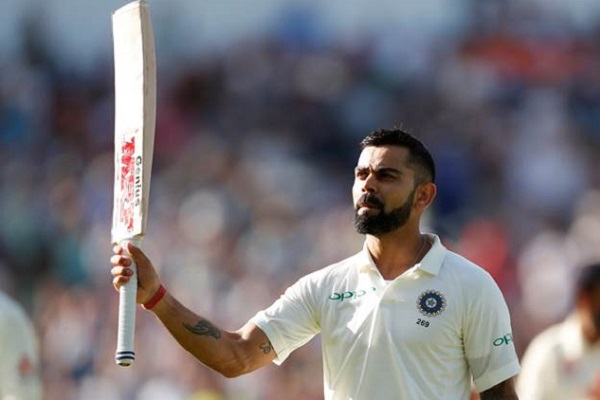
The Indian captain saved the ship from sinking on the second day of the first test at Edgbaston. This is not an exaggeration as he scored 149 runs which was more than 50 per cent of total Indian score of 274.

Kohli held his fort in spite of hiccups in the beginning of his innings. He was neither over cautious nor too aggressive in his well poised innings. Quick singles, cautious leaves and flamboyant cover drives were part of the Indian captain’s innings.

Virat Kohli even managed to survive James Anderson’s sharp bowling. The battle between the two was one of minds. Out of 74 deliveries bowled by Anderson, Kohli managed to score just 18 runs. Luck was on his side, no doubt. Two drop catches on 21 and 51 did help him survive. Several nicks that went to the slip failed to carry.

The best part of his innings came when he played with tail-enders. He had the responsibility of scoring runs, protecting his partner and surviving on the field simultaneously. The finesse with which he executed this plan of action with the Indian tail, led to a certain extent of frustration among the English bowlers. One must not forget the presence of mind of Ishant Sharma, who asked for a review of two LBW decisions, which were overturned by the third umpire. This had a pivotal role in keeping the partnership between Sharma and Kohli alive.

The most significant partnership of the Indian innings was the one between Umesh Yadav and Virat Kohli. Yadav came in when Kohli was on 97. The top priority was Yadav’s survival at the crease till Kohli got the remaining three runs for his century. The element of excitement generated during Kohli’s nineties was comparable to that of a ODI or T20. The 57 run partnership wherein Umesh Yadav scored a mere one run was testament to the perfection with which Kohli had managed the strike.

Yadav played his role by managing to survive for 16 deliveries including an entire over facing Stokes. He was applauded by the crowd for merely surviving each delivery. Finally, Rashid got the prized wicket of Kohli, who was caught while trying to ease his arms on the off side.

India managed to pickup a wicket ( Alastair Cook ) at the end of the day. Indian spin has been far more successful that England’s in this test.

The test looks brilliantly poised as we enter the third day. If India manages to bowl out England, they will get the opportunity to chase the target with two days remaining. Significant improvement in the fielding department, especially slips could make sure that India gets what it wants.

SP’s ‘Samajwad’: Akhilesh Yadav built illegal structure worth over Rs 4.67 crores in govt bungalow

0

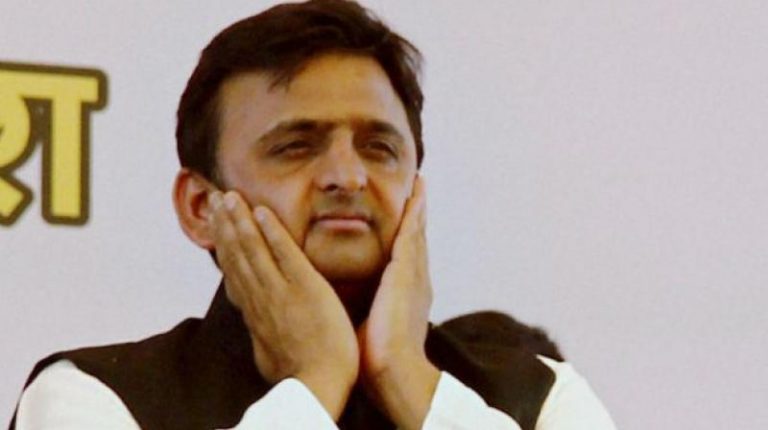
Aside from the state government warning that action would be taken against former Chief Minister of Uttar Pradesh Akhilesh Yadav, for the ‘damages’ inflicted to public property while vacating his official bungalow, a probe conducted by a ‘technical committee’ indicated that Yadav spent over Rs 4.67 crore on erecting ‘illegal structure’ in the official bungalow.

The state government spokesperson and health minister Siddharth Nath Singh said “The report submitted by the five-member committee states that Yadav not only caused damage to the government bungalow but also carried out illegal construction inside it. He carried out extra construction without taking permission of the estate department. Legal action will be taken against him for flouting the rules.”

Singh said that after the media had highlighted the damages Akhilesh caused to the bungalow, Yadav had lambasted the state government, “He tried to make it a political issue but now the report of the committee has made it clear that Yadav damaged the bungalow. Now he should respond to the probe report,” said the minister.

In a 266 pages report submitted by the inquiry committee headed by Chief Engineer (Bhawan) of Public Works Department (PWD) mentioned damage to the terrace, kitchen, electrical equipment, floor tiles, lawns, paint, brickwork and bathroom fittings of worth Rs 5.19 lakh. Besides, the team also claimed that the loss due to illegal structure erected by Yadav came to Rs 5.84 lakh.

The probe team also found that besides construction carried out by Estate Department, Yadav had pumped in Rs 78.39 lakh for maintenance/beautification, Rs 54.15 lakh for the extension of house, Rs 174.95 lakh in two-storeyed guest house, Rs 156.50 lakh on security house/two storeyed-waiting room, Rs 56.53 lakh on servant’s quarter (double storeyed), Rs 22.92 lakh on generator room, Rs 13.19 lakh on Trimix flooring and Rs 1.23 lakh on pathway. All this came to a whopping Rs 5.57 crore.

It may be mentioned that out of this amount, about Rs 90 lakh went from Estate Department coffers.

The row over the vacating of official bungalows started when the Supreme Court, on 7th May 2018, struck down the amendment to the Uttar Pradesh Ministers (Salaries, Allowances, and Miscellaneous Provisions) Act 1981 to provide for the allotment of government residence to former chief ministers for a lifetime. Former CMs, including Mayawati, Mulayam Singh Yadav, Rajnath Singh, Kalyan Singh, Akhilesh Yadav and ND Tiwari were amongst those who were asked to vacate the government bungalows following the Supreme Court order.

Setting a new example of ‘socialism’, former Uttar Pradesh chief minister and current president of Samajwadi Party, left his government accommodation in ruins after he was asked to vacate it on Supreme Court’s orders. When confronted on this, the arrogance he exuded only shows how entitled the politicians of our country are, especially those shoved down our throats because of nepotism.

Karan Thapar’s book is a well timed means to revive the Lutyens’ media from its creaking future

0

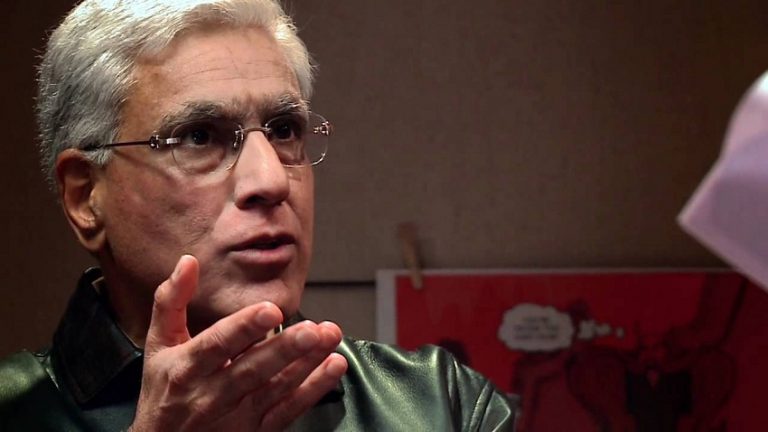
Just when people assumed the decline of the Lutyens’ media, its poster boy – Karan Thapar, hit back with a desperate attempt to make the nation relive its “golden age”. Having released a book titled ‘Devil’s Advocate: The Untold Story’, Thapar made it a point to reveal numerous undocumented conversations with well-known individuals and anecdotes. But the approach he uses both, in his book and while promoting his book, makes a commoner question his knowledge of basic journalistic ethics, and the dignity with which he addresses the people of this country.

In a book launch event, Karan Thapar was asked questions by Rajdeep Sardesai in the presence of politicians including Rahul Gandhi, amongst a massive audience. The self-proclaimed ‘Anglophile’ began by making his love for Britain (and his contempt for ‘another place’) quite clear; when asked a personal question, on why he spends the New Year in London, Karan responds: “I’m a great believer…that you have to begin the year in a civilised country.”

However much of an implication Karan Thapar makes of India being an ‘uncivilised’ country, we might as well give him the benefit of the doubt, because he later says in an interview that it was a “tongue-in-cheek” comment. Such “tongue-in-cheek” comments, of course, do not bode well for a man attempting to deny his aristocratic placement in India, because he denounces the basic civility (which often translates to the perceived dignity), that India and its people have.

But of course, Thapar does not stop at that for a remark that must have been “tongue-in-cheek”. With a serious tone and mannerism, he goes on to defend his position on ‘civility’ (instead of passing it off as a joke) when he says:

“We’re pretty uncivilised at the moment, when we start killing people because they are Dalits, or because they eat beef, when we slaughter them because they’re taking cows down the street, or when we claim innocent people to be child molester, child lynchers or whatever. We’re pretty uncivilised in that. You don’t see that happening in most other countries in the world, be they rich, poor, western or eastern”

The very fact that Thapar wishes to dwell on that point and defend his position brings about a sense of seriousness and meaning to his initial remark. The handful of incidents he is referring to can be explored in good depth for his position on the occurrence of such incidents, to debunk. But even if we assumed that such crimes are taking place in India, that does not give him the right to stoop to pejorative terms that refer to his own country, as fundamentally uncivilised.

And it is not like the United Kingdom ha,s never seen incidents of that degree. Who can forget the time when an 80-year-old Sikh man was beaten up by a British woman, as people just watched on? Or the several incidents of hate crimes over eastern Europeans?

Going by his hollow logic, that (along with many more incidents) should make the United Kingdom an uncivilised nation too. But this romanticised colonial hangover is precisely what blinds Karan Thapar from noticing the fact that hate crimes, sadly, occur in nearly every country.

His colonial fanaticism, however, is not much of an issue, until it gets coupled with profound ignorance of basic morals. In his book, he reveals a conversation that was off the record, with Pavan Varma, where he quotes him on all sorts of things including the notion that Prashant Kishor ‘told him’ that Modi “will never forgive” Karan for the interview. Having seen this, Pavan Varma made it very clear on where he stood:


It is thus important for us to understand what follows because it speaks volumes on Karan Thapar’s story of convenience and sheer hypocrisy.

Thapar begins by defending his position with the idea that “Pavan, perhaps had a senior moment” when he ‘forgot’ the conversation. When questioned on why Karan revealed the conversation that took place off the record, his only response was: “Pavan never asked for the conversation to be confidential. If he did say so, I would not have (revealed it).”

First of all, one violates every ethic as a journalist, when one reveals their sources. To add icing on the incomprehensible cake, when one makes off the record conversations public, they make a spectacle out of non-issues where people who trusted the journalist are compelled to reiterate their public position.

It not only is a severe breach of trust but contradicts the fundamental ethics with which journalists are told to approach their duty in society. And the fact that an off the record conversation was not ‘specifically asked’ to be confidential does not change anything.

Besides, since when did Karan Thapar begin caring about upholding secrecy when specifically requested?

Last I checked, on the same page, when Sambit specifically asked if Karan “could keep a secret before he answered”, Karan Thapar breached Sambit Patra’s trust too. So, the idea that Karan would have upheld secrecy if Pavan Varma asked him is with due respect, humbug.

Interestingly, the only defence of his morally abhorrent position on Patra occurs in the interview with Madhu Trehan, where he claims “I revealed it (the breach of trust) myself! You didn’t dig it up… It’s in the book!”, as though that takes away from the downright disgusting levels he resorts to, while revealing information. Simply boasting about having “revealed that in the book” does not take away from the fact that he knowingly relied on a contravention in the underlying moral code, to achieve the publicity he wanted.

The truth would, hence, appear to be that Karan Thapar does not particularly care about whether or not a person asks for secrecy or confidentiality. He is a hypocrite who tosses morals aside, based on his whims and fancies, and what suits his demeanour at a given time.

Karan Thapar is the same man who believed Pallavi Joshi did not deserve a role because of her skin colour, the same man who placed the clothing of numerous prime ministers over their groundbreaking policies, the same man who argues in order to put down the civility of his country- all of which, is perfectly reflective of the Lutyens elite’s attitude.

To analyse the scenario at its heart, one must never forget the critical timing of this book. Just when there commenced, a nationwide discussion on the creaking future of the once celebrated Lutyens’ media, Karan Thapar struck with his articulation, as a means to revive the elephant in the room. He continues to downplay its purpose when he describes his book as a mere product of some newfound “free time”.

But when Thapar knowingly violates the basics of what his profession stands for, one must contemplate on how desperate he is, to find ways to insult a set of people suppressing his actively propagated ideas. Along with the timing, it must be remembered what a celebrated journalist this man was, for decades.

Karan Thapar is the epitome of the Lutyens’ elite, involving a select few journalists who belong to an ecosystem of power and privilege. And that position of entitlement is what makes these journalists open to little complexity, and what puts them, far from the critical awareness of this nation’s intricacies, while masquerading as the nation’s conscience keepers.

Make no mistake, this book needs to be recognised as a means for the Lutyens’ media to reclaim what they have lost in recent times.


Switzerland’s top court allows sharing of data with Indian authorities in tax evasion cases

0

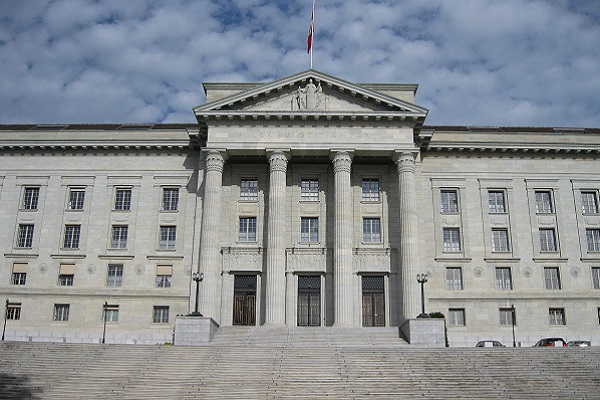
The federal court in Lausanne, which is the topmost court in Switzerland has allowed its tax authorities to share bank account details of two Indian citizens in connection with a tax evasion probe, Reuters has reported.

As per the report, the matter pertains to a French whistleblower named Herve Falciani, who while working for HSBC had disclosed the names of thousands of customers in 2008 whom he suspected of being involved in tax evasion.

Falcini who was an IT employee at HSBC fled with large quantities of sensitive client data in 2006. After unsuccessfully trying to sell the data in Lebanon, he ultimately handed it over to the French authorities. The French government as a used it to go after thousands of tax evaders.

As a result of his crime, Falciani was sentenced to five years in jail in absentia for industrial espionage owing to him being outside Switzerland.

According to a Swissinfo report, the Federal court rejected an appeal by two Indian citizens who wanted the information sharing between India and Switzerland blocked under a tax evasion case. The Indian citizens in their defence had claimed that the data required by the Indian authorities was stolen and thus violated the “principle of good faith”.

The judges though disagreed and remarked that it was perfectly fine for a country to use the data for investigative purposes as long as it did not buy the data. Also as explained in the report, the information sharing agreement between India and Switzerland does not require the country to reveal how it chanced upon the data.

The Federal court also ruled that in India’s case it did not make explicit statements about the source of the data it sought, and thus ruled that India should be given access to the data it needs.