

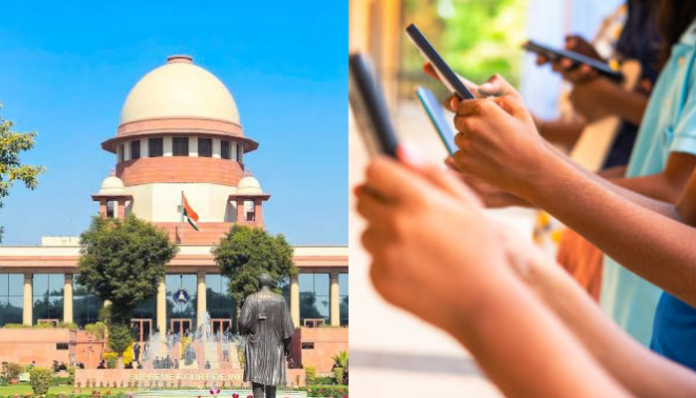
On 16th October (Friday), the Supreme Court ruled that children have a fundamental right to access and use the internet, adding that a complete ban based on age may expose them to greater online risks instead of protecting them. The court stated that children should not have to choose between their safety and their freedom to use the internet.
A bench of Justices J B Pardiwala and K V Chandran made the observations while hearing applications filed by child rights NGO Just Rights for Children Alliance and another applicant. The applications raised concerns about social media platforms failing to meet their legal duties to report child sexual exploitation and abuse material (CSEAM) to Indian authorities.
#BREAKING | Supreme Court Says Internet Access Is a Fundamental Right; Rejects Blanket Age-Based Ban on Children’s Internet Use SC Calls for Stronger Child-Safety Measures, Says Children Cannot Be Completely Barred from Accessing the Internet. @AdityaRajKaul https://t.co/V632gqMvmI
— NDTV (@ndtv) October 17, 2026
The bench said internet access falls under Article 21, which protects life and personal liberty, read with Article 19(1)(a), which guarantees freedom of speech and expression. It added that children enjoy these rights regardless of their age.
The court insisted that such bans could push children towards less regulated platforms, where parents and authorities may find it harder to monitor their activities. It added that children facing online grooming, threats or manipulation might also hesitate to seek help from parents, guardians or trusted adults for fear of being punished for using the internet.
Calling blanket restriction measures whose effectiveness had not been proven, the bench said such bans could not replace stronger action by technology companies, law enforcement agencies and the government. However, it clarified that targeted restrictions on harmful content and services, including adult websites, could be introduced.
Supreme Court calls for child-friendly online safeguards
Instead of a complete ban, the court suggested safeguards such as parental consent, guidance and supervision, and a dedicated “child mode” for social media accounts. It conveyed that children’s accounts could be private by default, with limits on messages from unknown adults and better control over advertisements and content. The Centre has been asked to decide how parental consent should be verified for pre-teens.
The bench also directed the Centre to create a National Hash and URL List Database to identify and remove child sexual abuse material across platforms. A hash is a digital identifier that helps recognise a file, while a URL identifies an internet address. The database could be set up through the government’s Sahyog Portal or as a separate system.
The court noted that the existing portal mainly handles individual complaints and takedown notices, rather than automatically helping platforms identify the same abusive material across services. It stated that each database entry must undergo multiple checks, with the final assessment conducted independently by at least three trained human analysts. It further mentioned that the database must contain hashes and URLs, not the abusive material itself.
The bench also called for safeguards against wrongful removal, audit records and a grievance-redressal system. It asked the government to frame guidelines for hash-matching, URL listing and other detection methods, and amend the Information Technology Rules where necessary. The directions also cover reporting duties, paid and subscription-based content, digital-safety awareness, and counselling and psychological support for victims.
The court further called for awareness programmes beginning at the primary school level. The Centre has been asked to submit an affidavit on the steps taken to implement the directions. The matter will next be heard on December 10.
What the Supreme Court said earlier about minors on social media
On September 28, the Supreme Court raised concerns about social media platforms allowing children aged 12 and 13 to create accounts. “How can these platforms allow 12- to 13-year-olds to have accounts? It is contrary to the law of the land,” the court observed.
It asked the Centre to address the issue under the Information Technology (Intermediary Guidelines and Digital Media Ethics Code) Rules, 2021, warning that it could issue directions if the government failed to act within the existing legal framework. The petition sought measures to stop minors from creating or managing accounts on platforms such as Instagram and X, formerly Twitter.
