

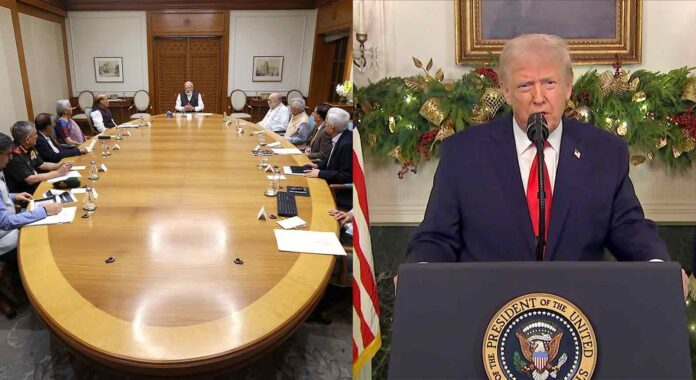
The Cabinet Committee on Security (CCS), chaired by Prime Minister Narendra Modi, is scheduled to convene at 7 PM today in the national capital to review the rapidly evolving situation in West Asia stemming from the ongoing US-Israel military campaign against Iran. The meeting comes as US President Donald Trump is scheduled to deliver a national address providing an “important update” on the Iran war.
Cabinet Committee on Security (CCS) to meet at 7 pm today, in Delhi.
— ANI (@ANI) April 1, 2026
The CCS meeting, the latest in a series of meetings this month, will assess the conflict’s implications for India’s energy security, supply chains, macro-economic stability, and the safety of Indian nationals in the region. Officials are expected to review mitigating measures for fuel availability, essential commodities, and potential disruptions, building on prior discussions about diversifying imports and supporting affected citizens.
In the US, President Trump is set to deliver a national address tonight (9 PM Eastern time, 6.30 AM on 2nd April in India) to provide an “important update” on the war. According to White House, he is expected to detail the latest military progress, reaffirm that the conflict could conclude in “two to three weeks,” and stress that Iran “need not strike a deal” for operations to wind down while keeping “all options on the table” for broader actions.
ON THE WORLD STAGE: President Trump will address the nation tonight at 9p ET to provide an "important update" on the war in Iran, press secretary Karoline Leavitt announced. pic.twitter.com/wuq8udKCLY
— Fox News (@FoxNews) April 1, 2026
As per reports, all major American broadcast TV networks will interrupt their regular programs to air Trump’s address,
Trump has repeatedly signalled openness to escalated measures, stating in recent remarks that the US will “finish the job properly this time” and avoid the “forever wars” of the past. Pentagon officials have confirmed fresh deployments of additional Marines, sailors, paratroopers, and special operations forces to the Middle East, along with an aircraft carrier strike group already in position.
The timing has sparked speculation of coordinated global responses to the month-long war, which began with US-Israeli airstrikes on February 28 targeting Iranian military sites, nuclear infrastructure, and leadership, including the killing of Supreme Leader Ali Khamenei. Iran has retaliated with missile and drone strikes across the region, including on Israel, Gulf states, and shipping, severely disrupting the Strait of Hormuz, a chokepoint for about 20% of global oil trade. This has triggered historic spikes in petrol and diesel prices worldwide, exacerbating economic pressures.
Speculation of a potential US ground invasion has intensified sharply in the lead-up to the address by Trump. Analysts point to troop movements and statements from Defence Secretary Pete Hegseth, who has emphasised “unpredictability” as a key strategy.
Reports suggest possible targets could include Iran’s Kharg Island oil export hub or other critical infrastructure to cripple Tehran’s ability to sustain the conflict. Iran has warned it has mobilised over a million fighters and would inflict “severe and unbearable costs” on any invading forces.
Trump has not explicitly ruled out ground troops but has also indicated a preference for a swift resolution. He has claimed that the US forces could end their attacks on Iran within two to three weeks, even if Tehran does not make a deal, and the war may “end soon”. During a media interaction at the White House on Tuesday, Trump said, “We’ll be leaving very soon. I would say within two weeks, maybe three. We knocked out a tremendous amount of missile-making facilities.”
