

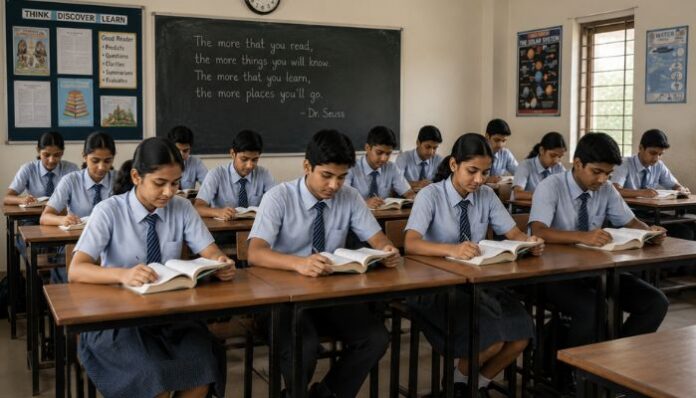
The Central Board of Secondary Education (CBSE) has announced that students studying in Class IX will now have to study three languages from 1st July, 2026. The decision has been taken as part of the National Education Policy (NEP) 2020 and the National Curriculum Framework for School Education (NCF-SE) 2023.
According to a circular issued by the CBSE on 15th May, students must choose three languages referred to as R1, R2 and R3. Out of these, at least two languages must be native Indian languages.
No board exam for the third language
The Board has also made it clear that there will be no separate CBSE Board examination for the third language (R3) in Class X. Instead, the assessment for this language will be done completely by schools through internal evaluation.
CBSE said the move is aimed at reducing pressure on students and keeping the focus on learning rather than exams. However, the marks or performance in the third language will still appear on the student’s CBSE certificate.
The Board also clarified that no student will be stopped from appearing in the Class X Board examinations because of the third language requirement.
Rules for choosing languages
Schools can offer any language that is included in the CBSE subject list. However, students can study a foreign language as the third language only if the other two chosen languages are Indian languages. Foreign languages may also be taken as an optional fourth language.
CBSE has also shared details about how the new system will be introduced. Since special secondary-level textbooks for the third language are not yet ready, students of Class IX will temporarily use Class VI textbooks for the chosen R3 language.
Schools have been advised to support these textbooks with local and state-level literary material so that students get better language exposure.
Support for schools facing teacher shortage
The Board acknowledged that some schools may face difficulties in arranging qualified language teachers. To deal with this, CBSE has allowed schools to use temporary solutions such as sharing teachers between schools, using virtual teaching support, or hiring retired teachers and qualified postgraduates.
Relaxation for some categories of students
CBSE has also announced special relaxations for Children with Special Needs (CwSN), foreign students coming back to India, and schools located outside the country. These cases will be handled individually based on specific needs.
