

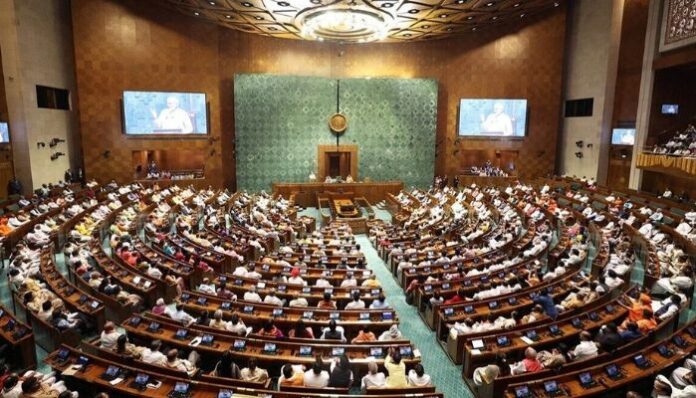
The Union Government is set to introduce The Constitution (131st Amendment) Bill, 2026, in a Special Session of Parliament scheduled for April 16 and 17, proposing a major change in the structure of the Lok Sabha by increasing its total strength from 543 to 850 members.
#BREAKING Centre proposes Constitution Amendment Bill to increase the seats of Lok Sabha to 850.
— Live Law (@LiveLawIndia) April 14, 2026
The Bill also proposes to omit Article 82(3), which mandated that next delimitation shall be after the 2026 Census. pic.twitter.com/TB3nIvcWo9
Under the proposed changes to Article 81, up to 815 members will be elected from States, while not more than 35 members will represent Union Territories, in a manner decided by Parliament. Alongside this, the government has also brought the Delimitation Bill, 2026, which seeks to replace the Delimitation Act, 2002 and lay down a fresh process for redrawing constituencies.
A key part of the amendment is the change to Article 82. At present, delimitation is tied to the first Census conducted after 2026. The new proposal removes this condition, allowing delimitation to take place even before the 2026-27 Census. This change is important because it can speed up the implementation of women’s reservation.
The Bill also proposes a change to Article 334A, making it possible to implement a one-third reservation for women in the Lok Sabha and State Assemblies immediately after delimitation. Earlier, under the Constitution (106th Amendment) Act, 2023, this reservation was linked to delimitation after the next Census.
To carry out the process, the government will set up a Delimitation Commission through a notification. This Commission will be led by a current or former Supreme Court judge, and will include the Chief Election Commissioner (or a nominated Election Commissioner) and the State Election Commissioner as members. Each State will also have ten associate members, five MPs and five MLAs, but they will not have voting rights.
The Commission will use the latest Census data to decide the number of Lok Sabha seats for each State and Union Territory, the strength of State Assemblies, and the number of seats reserved for Scheduled Castes and Scheduled Tribes. It will also redraw constituency boundaries, keeping them compact and considering administrative limits, connectivity, and public convenience. At present, seat allocation is still based on the 1971 Census, while constituency boundaries rely on the 2001 Census.
The Bill also includes a provision to reserve nearly one-third of seats for women, including those from the Scheduled Castes and Scheduled Tribes. These reserved seats will rotate among constituencies and within SC/ST reserved areas as well.
Once the Delimitation Commission issues its orders and they are published in the Gazette of India, they will have the force of law and cannot be challenged in court. However, the current Lok Sabha and State Assemblies will continue as they are until they are dissolved, and any by-elections before that will follow the existing constituency boundaries.
