

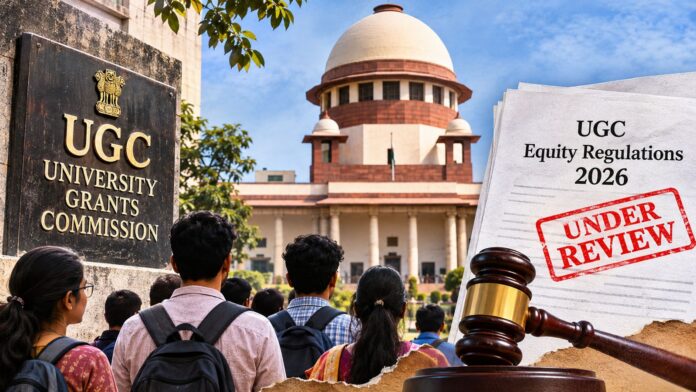
The Union government is considering constituting a special committee to review the University Grants Commission’s (UGC) controversial 2026 equity regulations after the Supreme Court stayed their implementation in January, flagging concerns that certain provisions were vague and could be exploited to target students.
Solicitor General Tushar Mehta informed the Supreme Court on Thursday (November 5) that the Centre was examining the issue and contemplating the formation of a committee to reconsider the regulations. He assured the court that the government was looking at ways to ensure that no section of students feels excluded, dissatisfied or apprehensive under the proposed framework.
Mehta submitted before a bench comprising Chief Justice of India Surya Kant and Justice Joymalya Bagchi, following the court’s suggestion that the government revisit the regulations and ensure that the interests of every student are protected.
Questioning the need for a framework that could leave sections of students feeling vulnerable, the bench emphasised that the next generation must remain at the centre of the exercise.
“Why don’t you revisit these regulations so that the next generation is taken care of? They should protect the interest of every student,” the bench told the Solicitor General.
The court subsequently adjourned the matter, observing that it had conveyed its suggestions to the government and would wait for the Centre to decide its next course of action.
“We have given them advice. Let us see what they do,” the bench remarked.
Why did the Supreme Court stay the UGC’s 2026 equity regulations?
The development comes amid a contentious legal battle over the UGC (Promotion of Equity in Higher Education Institutions) Regulations, 2026, which were notified on January 13 and stayed by the Supreme Court on January 29.
While the regulations were introduced to strengthen mechanisms against discrimination in universities and colleges, their provisions attracted criticism over the scope of their definitions and the possibility of misuse.
The Supreme Court had expressed serious reservations about the language of the regulations, observing that certain provisions were vague and could be exploited by mischievous elements. It also warned that the framework, in its existing form, could create divisions in society and have “dangerous impacts”.
To ensure that students facing discrimination continued to have legal and institutional remedies, the court directed that the UGC’s 2012 anti-discrimination regulations would remain in force until further orders.
The 2026 framework requires universities, colleges and deemed universities to establish Equal Opportunity Centres and equity committees to address discrimination complaints and promote an inclusive environment on campuses.
However, while groups representing marginalised students have supported stronger institutional safeguards, several upper-caste organisations and students have opposed the regulations, arguing that their provisions are one-sided and could be weaponised against students from other communities.
The opposition has also spilt onto the streets. On Tuesday, a group of upper-caste students staged a protest outside the UGC headquarters in Delhi, demanding that the regulations be withdrawn.
Regulation 3(c) at the centre of the legal challenge
A major point of contention in the petitions before the Supreme Court is Regulation 3(c), which defines caste-based discrimination as discrimination “only based on caste or tribe” against members of the Scheduled Castes (SCs), Scheduled Tribes (STs) and Other Backward Classes (OBCs).
The petitioners have argued that this definition effectively excludes students belonging to the general category from the protection of the regulations, even if they face discrimination on caste-related grounds.
They have also questioned the absence of what they consider adequate safeguards against false or malicious complaints, arguing that the framework could be misused in the absence of appropriate checks and balances.
The challenges were filed by social activist and entrepreneur Rahul Dewan, post-doctoral researcher Mrityunjay Tiwari and advocate Vineet Jindal. Advocate Vishnu Shankar Jain represented Dewan before the Supreme Court.
At the heart of the dispute is a larger question: how can higher education institutions create effective safeguards against caste-based discrimination without introducing provisions that leave other students vulnerable to arbitrary action?
How the UGC’s equity regulations came about
The 2026 regulations have their origins in a 2019 petition filed before the Supreme Court seeking stronger institutional safeguards against caste-based discrimination in higher education institutions.
The plea was moved by the parents of Rohith Vemula, a research scholar at the University of Hyderabad who died in January 2016, and Payal Tadvi, a medical student who died in May 2019 after allegedly facing caste-based discrimination at her college.
Although the UGC had introduced anti-discrimination regulations in 2012, concerns over their implementation prompted demands for a more robust mechanism to address complaints and ensure accountability within educational institutions.
The subsequent regulatory framework sought to strengthen institutional responses through dedicated equity bodies and complaint redressal mechanisms.
However, the controversy surrounding the 2026 regulations has exposed the difficulty of designing an anti-discrimination framework that commands the confidence of all stakeholders.
With the Centre now considering a special committee to revisit the rules, the government faces the task of addressing genuine concerns about discrimination while ensuring that the regulatory framework does not become a source of apprehension or potential victimisation for any section of students.
The Supreme Court has left the ball in the Centre’s court. What emerges from the proposed reconsideration could determine how India balances protections against discrimination with fairness, due process and equal treatment across its higher education institutions.
