

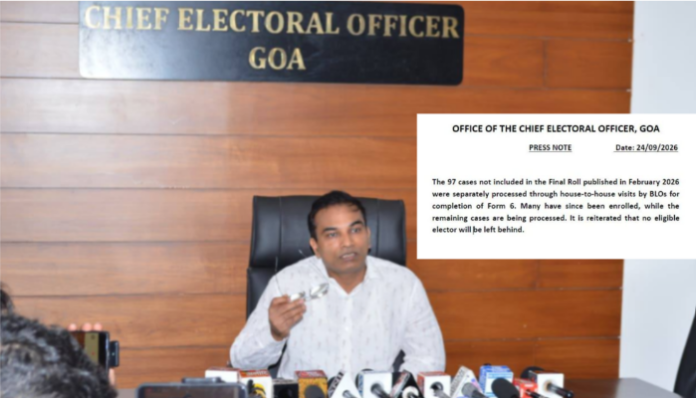
On 24th September (Thursday), the office of the Chief Electoral Officer of Goa, Dr Sanjay Goel, has clarified that no eligible voter is going to be excluded during the Special Intensive Revision (SIR) of the electoral roll. The statement was made in response to claims that the final voter list released in February following the exercise did not include the names of 97 eligible voters in Goa.
The official communication read, “The 97 cases not included in the Final Roll published in February 2026 were separately processed through house-to-house visits by BLOs (Booth Level Officers) for completion of Form 6. Many have since been enrolled, while the remaining cases are being processed. It is reiterated that no eligible elector will be left behind.”
“We had flagged to the Election Commission in February (regarding the list of 97 voters to be included). Subsequently, we went ahead and published the final roll. Immediately after, I wrote to both the DEOs (District Election Officers) that all these (97) cases should be part of the electoral rolls by filing Form 6 and the BLOs must visit their addresses and get the requisite documentation done. Since then, we have collated data, and many of the names (in the list of 97) have been added to the electoral rolls after filing Form 6. And for the remaining cases, we are taking the initiative, and the BLOs will go to their addresses. And once their Form 6 details are filled, they will be added to the roll in a time-bound manner,” Goel reiterated while talking to The Indian Express.
On 23rd September, the media house had published a report stating that voters who were identified for “logical discrepancies” were given the chance to submit supporting documentation and objections in order to be added to the electoral rolls. Electoral Registration Officers (EROs) and Assistant EROs reviewed the cases of 649 electors who had come forward. The officials examined the cases and determined that 97 were qualified for inclusion.
The article then alleged that between 11th and 17th February, the Goa CEO wrote eight messages requesting a way to overturn the decision and for the names to be included, but the 97 voters remained absent from the final electoral roll that was released on 21st February. However, it has now come to light that the procedure for including voters had been initiated shortly, and many have already been added in the electoral rolls.
A “logical discrepancy” is a mismatch that the software detects while attempting to match a voter to a parent or relative on an older roll. Voters who faced this issue during the SIR drive were directed to provide documents and be heard prior to the release of the final roll by the Supreme Court on 29th January.
OpIndia already explained that “logical discrepancy” is a serious administrative and technological issue regarding the charges pertaining to the matter in the IE piece. A software system failing to accommodate a particular administrative decision is evidence of a software or workflow failure. It is not automatically evidence that the ERO’s statutory power has been transferred to the Election Commission of India (ECI) headquarters.
To establish the latter, one would need to show who actually exercised the power, under what authority and whether the ERO was legally prevented from doing so. Furthermore, OpIndia’s Ritika Chandola spoke to two EROs over the report’s claim of centralisation of powers. Both categorically rejected the suggestion that their statutory powers had been usurped by the ECI’s central administration. They dismissed the claim that the ECI website had effectively taken over their statutory responsibilities.
