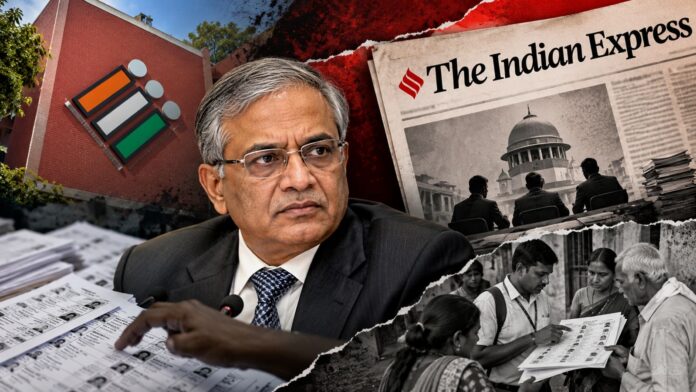
If there is one thing The Indian Express appears to have discovered during its latest investigation into the Election Commission of India, it is that the words “internal crisis”, “illegal”, “centralisation” and “cloud over its conduct” make for excellent headlines.
Whether the evidence supports the dramatic narrative is another matter.
On September 23, The Indian Express, in a series of reports authored by Ritika Chopra, presented what it described as an unprecedented rupture within the Election Commission. Its principal finding was that Election Commissioners Sukhbir Singh Sandhu and Vivek Joshi had recorded objections at least 14 times over 10 months on issues concerning the Special Intensive Revision, Form 6, electoral-roll software, voter additions and deletions and other administrative decisions.
The report then took those objections and constructed a much larger narrative around them: that powers were being centralised in Delhi, that statutory Electoral Registration Officers were being bypassed, that software was overriding field-level decisions and that the Election Commission was facing an unprecedented institutional breakdown.
There is just one problem.
The evidence presented by the newspaper does not automatically establish any of those conclusions.
And the Election Commission has now responded directly.
In a press note issued on September 23, the ECI said that it is a multi-member constitutional body and that written notes, observations, technical suggestions and internal checks and balances are standard features of its functioning.
Official Press Note pic.twitter.com/xIQvXHqMSt
— Election Commission of India (@ECISVEEP) September 23, 2026
It said operational queries raised during the draft stage are part of normal administrative practice and that differing views are a normal part of institutional deliberation before a final decision is taken.
That inconvenient fact substantially complicates the dramatic storyline being sold to readers.
An objection is not an institutional coup
Let us begin with the celebrated “14 objections”.
Yes, two Commissioners objected to various decisions. That is newsworthy. It is legitimate to examine what they objected to, why they objected and what happened subsequently.
But The Indian Express repeatedly moves from “two Commissioners objected” to “the Commission is in unprecedented rupture” as if the latter automatically follows from the former.
It does not.
The newspaper itself reports that the objections were made through internal notes and communications. In other words, these were precisely the mechanisms through which Commissioners are expected to raise concerns within an institution.
The ECI has now made the point explicitly: internal notes and observations are part of the checks and balances within the Commission. It also says that all official orders, decisions and administrative directions carry legal sanction and follow the statutory procedures prescribed under the 2023 Act.
In fact, the legal framework itself contemplates disagreement.
Section 18 of the 2023 Act provides for the Commission’s business to be transacted, as far as possible, unanimously, while providing for matters on which the Commissioners differ to be decided by majority.
So what exactly is being presented as evidence of institutional collapse?
The existence of disagreement in an institution whose governing law expressly provides for disagreement.
That may be an interesting institutional story. It is not, by itself, evidence of a constitutional breakdown.
‘Illegal’ according to whom?
The Form 6 controversy provides an even better example of the problem with the Indian Express framing.
The newspaper reports that the online Form 6 was modified to ask new voters whether they, their parents or grandparents appeared in the electoral roll from the previous SIR. It further reports that Commissioner Vivek Joshi had objected to the change and that Sukhbir Singh Sandhu subsequently described it as “unauthorised” and “illegal”.
The objection itself is a fact.
But there is a rather important difference between saying: “A Commissioner called the change illegal.”
and saying: “The Election Commission illegally changed Form 6.”
The first is a report of an internal disagreement.
The second is a legal conclusion.
The newspaper’s own material establishes the former. It does not turn the Commissioner’s objection into a judicial determination.
If the precise statutory procedure for modifying Form 6 was violated, that can and should be demonstrated by reference to the applicable rules and the legal authority under which the modification was made.
But putting the word “illegal” in the headline because one Commissioner used that word in an internal note is precisely the kind of headline-driven framing that can leave readers with a conclusion stronger than the underlying evidence.
The biggest allegation, ‘Delhi has taken over the voter database’, faces a major problem
The most consequential claim in the investigation is the alleged “centralisation” of electoral-roll databases.
According to The Indian Express, Commissioners raised concerns that state-level officials did not have “proper and complete access” to the electoral-roll system and warned against the gradual centralisation of the database. The newspaper then takes this further, claiming that ECINet can effectively override ERO decisions and describing this as a concentration of power at the ECI headquarters.
This is where the report’s sweeping conclusion runs headlong into the facts on the ground.
OpIndia’s Ritika Chandola spoke to two Electoral Registration Officers over the Indian Express report’s claim of centralisation of powers. Both categorically rejected the suggestion that their statutory powers had been usurped by the ECI’s central administration.
EXCLUSIVE GROUND CHECK | EROs On Record: No Lockout, No Remote Control From Delhi
— OpIndia.com (@OpIndia_com) September 23, 2026
Officers spoken to by OpIndia’s @RitikaChandola said their ECINet access was never withdrawn and that deletion orders continued to rest with the ERO, challenging a central claim in the Indian… pic.twitter.com/UzwNjxHENP
They did not describe themselves as powerless functionaries waiting for Delhi to approve every addition, deletion or modification.
They rejected the claim that the ECI website had effectively taken over their statutory responsibilities.
Because an allegation about the centralisation of statutory power should ideally be tested by speaking to the statutory officers who supposedly lost that power.
And when those officers say that their powers have not been taken away, the allegation requires substantially more evidence before it can be elevated into a settled fact.
The ECI has made the same point in its official response. It says ECINet operates under cybersecurity and audit controls, while statutory authorities including EROs and DEOs continue to exercise their powers for registration and deletion under law.
There is obviously nothing inherently suspicious about having a central technological platform.
A national election system with hundreds of millions of voters cannot realistically function on disconnected spreadsheets and standalone computers sitting in individual districts.
Centralised technology is not the same thing as centralised statutory authority.
That distinction seems to have disappeared somewhere between the internal notes and the Indian Express headline.
The Goa episode may demonstrate a software problem. That is not the same as proving a power grab
The newspaper’s Goa example deserves examination.
It reports that EROs found 97 voters eligible after considering their documents, but the software did not have the necessary functionality to record their decisions before the final roll was published.
If that happened as reported, it is a serious administrative and technological issue. But even then, one has to be careful about what the evidence proves. A software system failing to accommodate a particular administrative decision is evidence of a software or workflow failure.
It is not automatically evidence that the ERO’s statutory power has been transferred to the ECI headquarters.
To establish the latter, one would need to show who actually exercised the power, under what authority and whether the ERO was legally prevented from doing so.
The Indian Express appears to move rather quickly across those evidentiary steps.
The ‘13 crore deleted voters’ headline also needs the missing context
The report prominently says that SIR has “struck more than 13 crore names” from draft electoral rolls across 30 States and Union Territories.
The number sounds enormous. And it is.
But it is also a draft-roll figure.
A name being absent from a draft roll does not necessarily mean that a genuine voter has been permanently and finally disenfranchised. Electoral-roll revision necessarily involves identifying deceased voters, duplicate entries, voters who have shifted residence and other categories requiring verification.
The distinction between draft deletion and final exclusion after the prescribed process is not a minor technicality. It is central to understanding what SIR actually does.
Yet the sheer size of the number is repeatedly used to heighten the sense of impending electoral catastrophe.
Again, the headline gets the emotional weight. The qualification comes later, if at all.
Even the West Bengal example does not prove what the headline implies
The report also raises questions about appeals filed in West Bengal and asks who authorised appeals against voters whom judicial officers had restored to the rolls.
That is a legitimate question.
But the report itself acknowledges that the question of who exactly filed those appeals remains unclear.
So, once again, there is an unanswered administrative question — not an established case of unlawful action.
There is a difference between “we don’t yet know who authorised this” and “the Commission unlawfully centralised the process.”
Good investigative journalism should preserve that distinction.
Headline journalism tends to erase it.
What the Indian Express report conveniently leaves in the background
There is another important fact in the ECI’s response.
The Commission says that while The Indian Express has highlighted selected internal notes from 10 months, it has overlooked the much larger body of approvals, decisions, instructions and initiatives undertaken during the same period.
The ECI says it introduced around 40 new initiatives and undertook electoral reforms, including electoral-roll revision, and that these decisions were the outcome of unanimous decisions of the full Commission over the past year.
That does not make the objections irrelevant.
But it makes the phrase “internal crisis” much more contestable.
If the full Commission has continued to take decisions, approve initiatives and conduct elections and electoral exercises across multiple states, then a responsible account needs to explain that broader institutional functioning rather than selecting a collection of dissenting notes and presenting them as the entire story.
The ECI specifically points out that it has recently conducted major electoral exercises in Bihar, Kerala, Tamil Nadu, Puducherry, Assam and West Bengal involving extensive administrative machinery and Commission approvals.
That is not the picture of an institution that has simply stopped functioning.
The Indian Express wanted a crisis. The facts show a disagreement
There is nothing wrong with investigating disagreement within the Election Commission. In fact, the public deserves to know when constitutional functionaries disagree over electoral administration.
But journalism has a responsibility beyond finding the most alarming interpretation of documents.
The Indian Express has established that two Commissioners recorded objections. It has established that there were disputes over Form 6. It has established that concerns were raised about access to electoral-roll software. It has raised legitimate questions about the Goa software episode and the authorisation of certain appeals.
But it has not established, merely by presenting those facts, that the Election Commission’s statutory powers have been unlawfully centralised in Delhi.
It has not established that EROs have been stripped of their statutory authority.
And it certainly has not established that the existence of internal disagreement amounts to an “unprecedented rupture” in the functioning of the constitutional body.
The ECI’s official response directly contests that interpretation, stating that internal observations are normal institutional checks, that official decisions have legal sanction and that EROs and DEOs continue to exercise their statutory powers.
The testimony of the two EROs spoken to by OpIndia further complicates the central premise of the Indian Express story.
And that is perhaps the most revealing part of this entire episode.
The newspaper went looking for an ECI crisis and found dissent. It found questions and presented them as conclusions. It found internal objections and packaged them as institutional collapse. It found a centralised software architecture and presented it as centralised political control.
The Election Commission may well have legitimate questions to answer. There should be.
But if the standard is accountability, it has to apply to journalists too.
An internal note is not a court judgment. A software problem is not proof of a power grab. A disagreement is not an institutional collapse. And a sensational headline cannot substitute for the missing facts.
The Election Commission deserves scrutiny. So does the reporting that scrutinises it.
When the facts don’t quite support the headline, perhaps the headline needs revising, not the facts.