

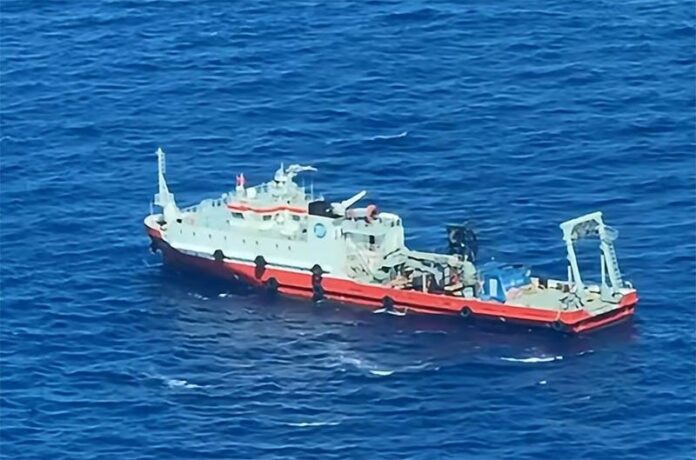
A Chinese civilian research vessel has spent more than a week loitering in waters off the Philippines’ northern Batanes Islands, triggering fresh concerns in Manila over Beijing’s increasingly assertive activities in strategically sensitive waters.
The 70-metre Jia Hai Ke 7 sailed from Xiamen on September 19 and reached waters near Itbayat, the northernmost inhabited island in the Batanes province, three days later. According to Automatic Identification System (AIS) data tracked by MarineTraffic, the vessel remained in the area through at least Tuesday.
The Philippine Coast Guard confirmed the vessel’s presence on Monday, saying its movements appeared inconsistent with ordinary passage through the area.
Coast Guard spokesman Jay Tarriela said the ship was approximately 38 nautical miles (70 km) northwest of Itbayat and had been repeatedly slowing down, changing position and holding station rather than following a conventional transit route.
In other words, the vessel was not simply passing through.
Tarriela said the movement pattern was consistent with a ship conducting marine scientific research rather than one merely navigating through Philippine waters. Philippine aerial patrols reportedly issued three radio challenges asking the crew to identify its mission and stop what Manila described as unauthorised surveying. The vessel did not respond.
The incident is particularly sensitive because of where the ship is operating.
The Batanes Islands sit between Taiwan and the northern tip of Luzon, placing them close to one of the most strategically important maritime corridors in East Asia. The waters around the islands also contain subsea telecommunications cables carrying data between Southeast Asia, North America and Northeast Asia.
That has raised questions in Manila about whether research and seabed-mapping activities could provide valuable information about critical underwater infrastructure.
A strategic location between Taiwan and the Philippines
The latest incident comes against the backdrop of growing tensions over the Batanes Islands themselves.
In June, several Chinese scholars publicly argued that Batanes was geographically connected to Taiwan and therefore fell within what they described as Chinese sovereignty. Beijing has not officially adopted that claim.
Nevertheless, the comments caused alarm in Manila, particularly because the islands occupy a strategically important position immediately south of Taiwan.
The dispute has acquired another dimension following a decision by the Philippines and Japan in May to begin formal negotiations over the delimitation of their overlapping exclusive economic zones and continental shelves.
China has strongly objected to the initiative, declaring the negotiations unlawful and arguing that the relevant waters form part of Chinese maritime zones projected from Taiwan.
Beijing regards Taiwan as part of China and has not ruled out the use of force to achieve reunification. The United States, Japan and the Philippines, among most other countries, do not recognise Taiwan as an independent sovereign state.
Beijing rejects Manila’s accusations.
China has defended the presence of the Jia Hai Ke 7.
The Chinese embassy in Manila said the vessel was operating in waters that Beijing considers to be under Chinese jurisdiction.
China’s state-run Global Times likewise described the ship’s mission as legitimate marine geological surveying and scientific research.
The newspaper accused the Philippines of exaggerating security concerns and portraying ordinary civilian research as a military activity, arguing that Manila was deliberately increasing tensions in the region.
The vessel itself is not an ordinary commercial ship. According to the China Classification Society, the Jia Hai Ke 7 is China’s first privately owned research vessel fitted with a Dynamic Positioning Class 2 system.
The DP2 system allows a vessel to maintain a highly precise position at sea, a capability particularly useful for offshore geological and seabed surveys.
Built for Zhuhai Jiahai Marine Technology Co, the vessel entered service in April last year.
Research vessels becoming a new grey-zone concern
The episode is the latest in a growing series of controversies involving Chinese research and survey vessels operating around strategically sensitive waters.
Since May, Chinese mainland research vessels have repeatedly appeared east of Taiwan, prompting concerns in Taipei. Similar vessels have also operated around the Philippines and Japan.
Last month, the Philippine Coast Guard accused another Chinese survey vessel, the Haiyang Dizhi 10, of spending 25 days conducting what Manila called unauthorised operations inside the Philippine exclusive economic zone, including waters around the disputed Scarborough Shoal.
Manila also accused the vessel of periodically switching off its AIS transponder, making its movements harder to track.
The wider concern is not necessarily that every civilian research mission is covertly military in nature. Rather, seabed surveys can generate information that has applications far beyond civilian science, including detailed knowledge of underwater terrain, maritime infrastructure and potentially the location and characteristics of subsea communications networks.
That makes research vessels an increasingly important feature of the broader grey-zone competition playing out across the Indo-Pacific.
And with Batanes sitting just south of Taiwan and astride strategically important maritime routes, the prolonged presence of the Jia Hai Ke 7 has ensured that Manila is watching its movements closely.
