

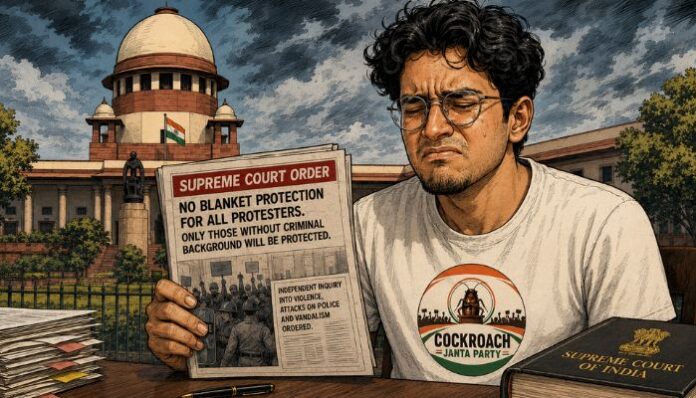
On 28th July, the Cockroach Janta Party (CJP) objected to the Supreme Court’s interim directions concerning FIRs registered during student protests. CJP spokesperson Saurav Das claimed that the order contradicted assurances given by the Centre during negotiations that ended the agitation at Jantar Mantar.
Delhi: Cockroach Janta Party Chief Spokesperson Saurav Das says, "The government had publicly assured the youth on Saturday that no FIRs would be filed against protesters or students and that existing FIRs would be withdrawn. However, after the Supreme Court's order in the PILs… pic.twitter.com/ctHMIZKeL8
— IANS (@ians_india) July 29, 2026
While speaking to IANS, Das claimed that the government had assured protesters that all FIRs against them would be withdrawn and that no retaliatory action would follow. He argued that the apex court’s allowing investigations to continue was “not acceptable” and accused the government of using the court’s order to avoid honouring its commitment.
Notably, the Supreme Court did not grant blanket protection to everyone who participated in the protests. The bench protected students and protesters without criminal backgrounds from coercive action while excluding those with criminal records. It also called for an independent investigation into violence against protesters, attacks on police personnel and vandalism.
CJP targets government over court order
In a post on X, Das claimed that the Supreme Court’s directions were being “politicised” and “weaponised” by the government. He demanded the withdrawal of every FIR, while arguing that police should seek the cancellation of bail in older cases if criminals were found among demonstrators.
The Supreme Court cannot be politicised for government’s gains. Its orders cannot be weaponised to achieve those gains. A solemn guarantee was given before the nation. Those ought to be honoured. All FIRs ought to be withdrawn. If criminals roamed, police must apply for…
— Saurav Das (@SauravDassss) July 28, 2026
CJP is seeking immunity in cases arising from the protest even as the court stressed that violence from all sides required scrutiny. The Solicitor General told the court that nearly 250 police personnel were injured and that hardened criminals and anti-social elements had infiltrated protest sites. The Centre supported an impartial inquiry while seeking an opportunity to place its factual account on record.
Das, who attempted to undermine the authority of the Supreme Court through his objections on public platforms and in the media, threatened renewed protests in Delhi and across the country if the Centre did not issue a written guarantee and withdraw the FIRs. He claimed that the court had not barred the government from doing so.
Government must not erase criminal cases
The government cannot be expected to erase criminal cases indiscriminately when the Supreme Court has distinguished peaceful students from people with criminal backgrounds. Any assurance protecting genuine protesters cannot become a shield for rioters, vandals or repeat offenders. The independent inquiry will offer a lawful route to identify excesses, establish responsibility and protect innocent students without undermining action against those who attacked police or damaged public property.
