

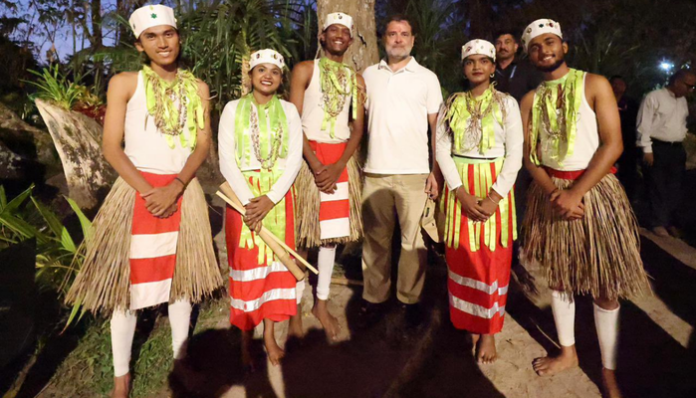
Congress leader Rahul Gandhi is on a three-day visit to the Andaman and Nicobar Islands, from 26th April to 28th April. Addressing Congress workers at Dr B.R. Ambedkar Auditorium on Sunday (27th April), Gandhi reiterated his opposition to the Great Nicobar Project. He claimed that the development project would result in adverse consequences for the local communities and the environment. He also met representatives of The Wave Andaman during his visit to Swaraj Dweep and discussed the Great Nicobar Island project.
The Congress party has long been opposing the Modi government’s ambitious development project for the Nicobar Islands. Last year in September, Rahul Gandhi’s mother Sonia Gandhi wrote a lengthy editorial, “The making of an ecological disaster in the Nicobar,” declaring the Great Nicobar Project to be a totally misplaced expenditure that poses an “existential danger” to the island’s indigenous communities and “threatens one of the world’s most unique flora and fauna ecosystems.” She claimed that the project will “permanently displace” the Nicobarese and Shompen tribes.
Gandhi made baseless claims regarding the project, claiming that due process and regulatory safeguards were evaded for clearing the project and that the Social Impact Assessments were also flawed. Her claims do not hold water as the project was vetted by the National Green Tribunal, a High Powered Committee of the Environment Ministry, and the National Centre for Sustainable Coastal Management.
What is the Great Nicobar Project?
The Great Nicobar Project is planned near Galathea Bay on Great Nicobar Island and spans around 166 sq km. The megaproject, estimated to cost between ₹72,000 and ₹92,000 crore, aims to develop the island into a massive strategic and economic hub. It involves the diversion of nearly 130 sq km of forest land and the felling of close to one million trees. The project includes an international container transhipment terminal, a dual-use civil and military airport, an integrated township and a 450-MVA gas and solar-based power plant.
Great Nicobar lies along a major east–west shipping route and is almost equally distant from Colombo, Port Klang and Singapore. At present, around 25% of India’s cargo is transshipped through foreign ports, with Colombo alone handling nearly 40% of India’s transhipment traffic. The government argues that the Galathea Bay port, with its natural depth of 18-20 metres, can reduce this dependence and save thousands of crores annually in port revenue and related economic activity.
The project is planned in four phases. Phase 1 is targeted for completion by 2028 and is expected to handle 4 million TEUs. By 2058, the capacity is projected to reach 16 million TEUs.
