

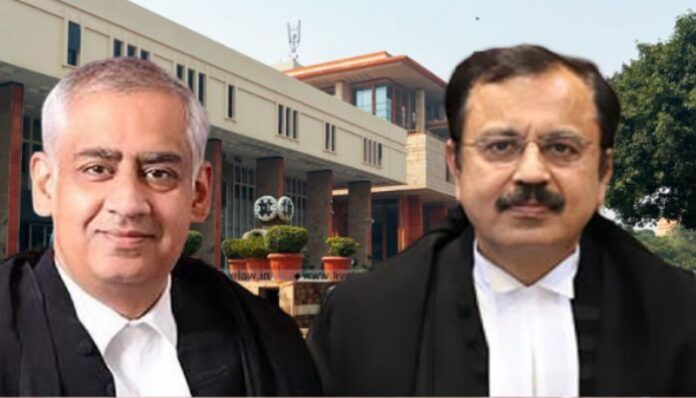
On 21st April, the Delhi High Court found YouTuber Gulshan Pahuja guilty of criminal contempt for posting videos containing offensive and baseless remarks against judges and the judicial system. The order was passed by a Division Bench of Justice Navin Chawla and Justice Ravinder Dudeja.
What led to the case
The issue started after Pahuja uploaded videos on his YouTube channel “Fight 4 Judicial Reforms.” In these videos, he interviewed advocates Shiv Narayan Sharma and Deepak Singh, during which comments were made targeting judicial officers and the institution itself.
Three judicial officers later brought these videos and their banners to the High Court’s notice, asking for contempt proceedings.
The court’s view on the videos
The Court noted that the videos contained abusive language and sweeping statements, including claims that some judges were corrupt or not doing their work. It said such remarks were not based on any proof and were aimed at creating mistrust and sensationalism rather than meaningful discussion.
The Bench made it clear that while people can criticise court decisions, attacking the integrity of judges without solid evidence crosses the line. It also pointed out that judges cannot publicly defend themselves, which makes such accusations even more serious.
The Court further observed that Pahuja went beyond fair criticism and directly targeted three judicial officers, even suggesting that litigants should not expect justice if their cases were heard by them.
Apology by advocates accepted
Advocates Shiv Narayan Sharma and Deepak Singh submitted unconditional apologies. They said they did not agree to their interviews being uploaded online and were unaware of the objectionable thumbnails and banners.
The Court accepted their explanation and dropped contempt proceedings against them.
Campaign vs Contempt
Pahuja defended himself by saying his videos were part of a campaign for judicial reforms, including audio-video recording of court proceedings.
The Court clarified that there is no issue with such a campaign. However, it stressed that the contempt case is about the manner in which judges and the system were targeted without any factual basis.
Strong observations by the Court
The Bench said that dissatisfaction with a court order does not give anyone the right to question a judge’s honesty or competence. It reminded us that the legal system already provides a process of appeal if someone is unhappy with a judgment.
The Court described Pahuja’s actions as a clear case of criminal contempt, stating that he had effectively passed his own “verdict” against judges without any proof, which undermines the authority of the judiciary.
While holding Pahuja guilty, the Court has not yet decided on the punishment. He has been asked to respond to this issue within two weeks and to appear in person at the next hearing scheduled for 12th May.
