

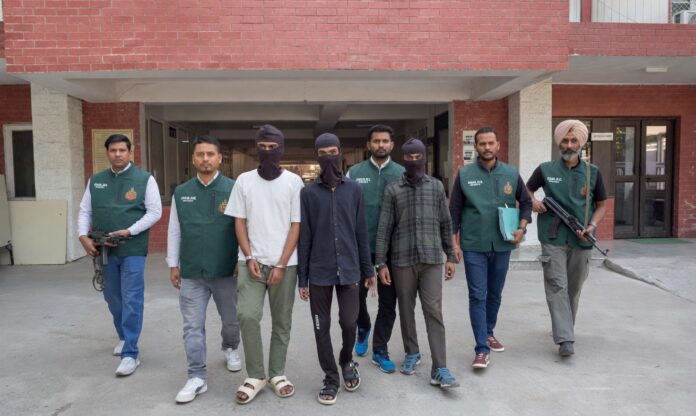
The Delhi Police Special Cell has arrested four radicalised youths from three states, two from Maharashtra, one from Odisha and one from Bihar, in connection with an alleged conspiracy to carry out terrorist activities inspired by Islamist ideology.
According to an official statement from the Delhi Police, the suspects were motivated by calls to establish a Caliphate and believed in the emergence of a “Lashkar-e-Khorasan” (an army emerging from Khorasan) flying black flags. They were reportedly preparing to participate in “Ghazwa-e-Hind”, a concept associated with jihadist groups seeking to wage war in the Indian subcontinent.
The accused have been identified as Mosaib Ahmad alias Sonu alias Kalam from Thane, Mohammad Hammad from Mumbai, Sheikh Imran from Bhubaneswar in Odisha, and Mohammad Sohail from Katihar in Bihar.
The youths are accused of actively radicalising and recruiting others through encrypted social media groups. One of the accused allegedly raised funds for jihad activities via QR codes and bank details, while promising to arrange weapons and physical training for recruits.
#WATCH | Delhi police Special Cell (NDR) has arrested four radicalised youth from three states — Maharashtra (2), Odisha (1), Bihar (1). The accused were inspired by the ideology of establishing a Caliphate and believed in the emergence of a “lashkar from Khurasan” with black… pic.twitter.com/o4aZpWh79P
— ANI (@ANI) April 18, 2026
According to police, members of the group acted as administrators and participants in several online groups, where discussions on jihad and the formation of an Islamic state were carried out.
An Improvised Explosive Device (IED) was recovered from one suspect. Two others were said to have been collecting locally sourced materials to assemble a remote-controlled IED for a potential terror attack. Mosaib Ahmad, originally from Azamgarh in Uttar Pradesh and currently working at an automobile workshop in Thane, has allegedly used his mechanical skills to assist in assembling the IED by modifying a remote-controlled toy car.
Mohammad Hammad, a Class 12 student pursuing studies through correspondence in Mumbai, was procuring materials such as ball bearings, nails and electronic components. He was also sharing images of these items within the group before handing them over for assembly.
Sheikh Imran from Bhubaneshwar, who works as a security guard and delivery boy, created online groups where discussions on jihad, khilafat and potential targets such as the Ram Mandir, Parliament and military installations were held. The fourth accused Mohammad Sohail, a plumber from Katihar in Bihar, was running multiple social media accounts through which he allegedly incited youth and raised funds by sharing his bank details and QR codes.
Police added that one of the accused had visited multiple sensitive installations in Delhi, including the Red Fort, and shared an image depicting a black flag atop the monument on social media to influence others.
The operation was carried out by the Special Cell’s NDR unit. The four individuals have been taken into custody, and further investigations are underway to determine the full extent of the network and any additional handlers or accomplices. Mobile phones and other digital devices belonging to the accused have been seized for forensic analysis.
