

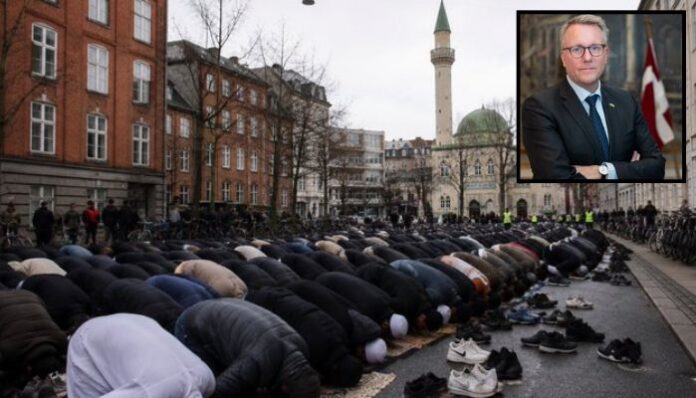
Denmark’s Immigration Minister Morten Bødskov has announced that the government is once again considering a ban on the public broadcast of the Islamic Azaan, arguing that such practices do not fit into Danish public life. The proposal has reignited a debate in the country over religious freedom, integration and immigration.
Muslim call to prayer set to be banned in radical crackdown on 'Islamisation' – 'No place in Denmark!'https://t.co/prlJn7TbAo
— GB News (@GBNEWS) June 25, 2026
Minister says Azaan has “no place” in Denmark
Bødskov, who belongs to Denmark’s centre-left Social Democrats party, said the government plans to restart an investigation into whether a nationwide ban on public Azaan broadcasts can be legally implemented.
“The Azaan should not be heard over Danish rooftops,” the minister told Danish news agency Ritzau. “It has no place in Denmark, and you shouldn’t be in any doubt whether you’ve ended up in a suburb of Islamabad when you walk around Denmark.”
BREAKING:
— Visegrád 24 (@visegrad24) June 24, 2026
Denmark’s new socialist Immigration Minister Morten Bødskov announces that he’ll ban the Islamic call to prayer
He says that “parts of the country shouldn’t feel like a suburb of Islamabad”
The Red-Green alliance isn’t as strong in Denmark as in other parts of Europe pic.twitter.com/ILB0MAs88e
The minister also argued that what he described as a gradual “Islamisation” of Danish society was taking up too much public space.
Denmark Moves to Ban Islamic Call to Prayer, Minister Says Country Should Not Sound Like Pakistan
— The Gateway Pundit (@gatewaypundit) June 25, 2026
Link in the comment section: pic.twitter.com/cJ8xxdCg3y
Third attempt to bring restrictions
This is not the first time Danish authorities have explored such a move. According to reports, it is the third attempt by a Danish immigration minister to create a legal framework that could restrict or ban public Azaan broadcasts. Similar efforts were made in 2020 and again in 2025.
In some areas of Denmark, including parts of Copenhagen, local regulations already prevent loudspeaker broadcasts from mosques because of strict noise-control rules.
Immigration policies already among Europe’s toughest
Denmark has become known for having some of Europe’s strictest immigration policies under Prime Minister Mette Frederiksen, who recently began her third term in office.
The country’s controversial “ghetto laws” allow authorities to relocate migrants from neighbourhoods with high concentrations of foreign residents. Denmark has also introduced other strict measures for asylum seekers, including rules requiring some applicants to contribute towards their living expenses.
During the 2015 refugee crisis, Denmark accepted significantly fewer asylum seekers than several neighbouring European countries.
Any attempt to ban public Azaan broadcasts nationwide could face legal hurdles. Denmark’s constitution protects the right to practice religion publicly, although certain restrictions already exist for activities considered anti-democratic or linked to banned organisations.
Officials are expected to examine whether a ban can be justified by balancing religious freedom with the rights of residents living near mosques.
Denmark has a population of around six million people, including roughly 270,000 Muslims. The country is estimated to have about 100 mosques, including the Grand Mosque of Copenhagen, which currently does not broadcast the Azaan outdoors under an agreement with local authorities.
